Chandra Deep Field South
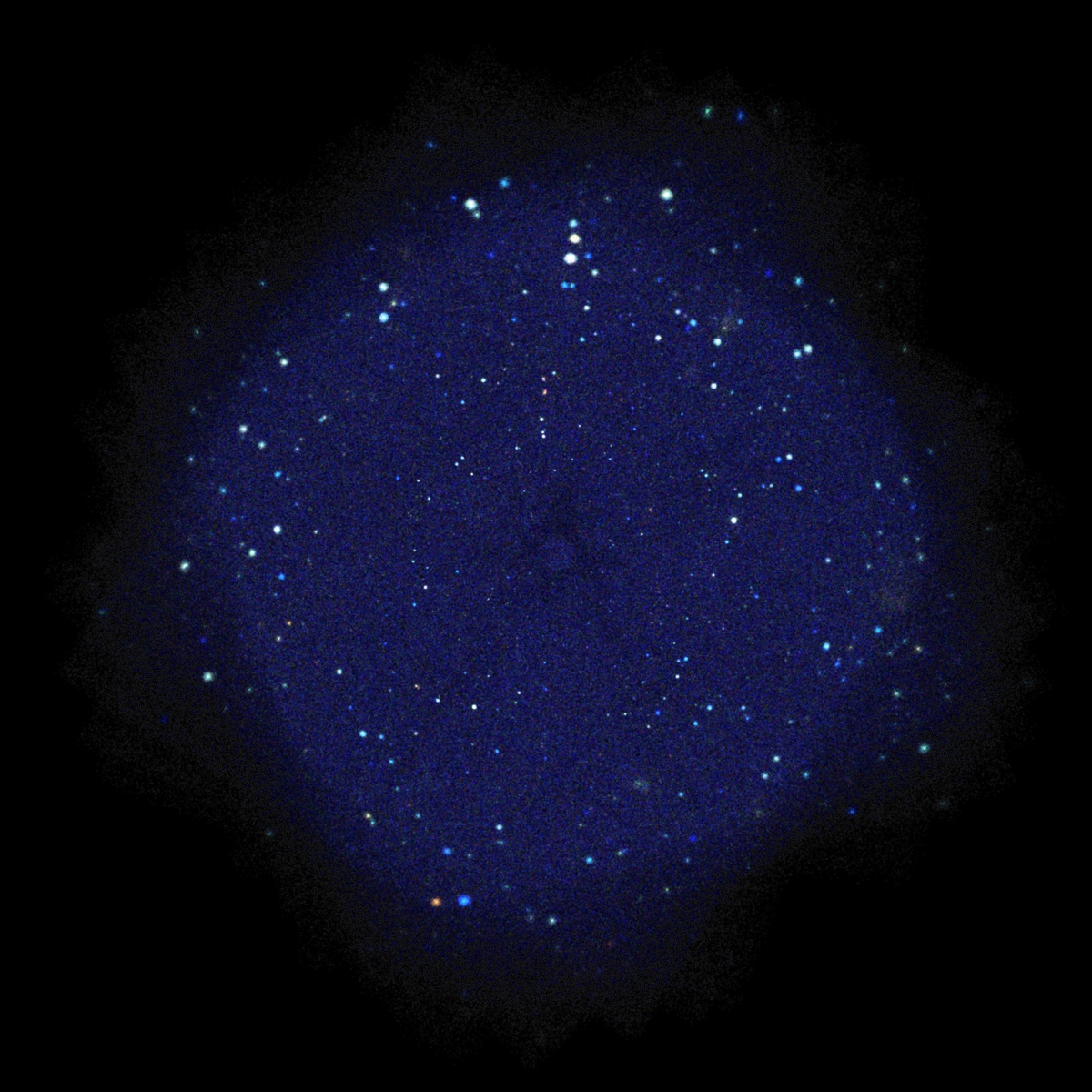
.jpg) The deepest X-ray image ever obtained, made with over 7 million seconds of observing time with NASA's Chandra X-ray Observatory. | |
| Alternative names | CDF-S |
|---|---|
 Related media on Commons Related media on Commons | |


The Chandra Deep Field South (CDF-S) is an image taken by the Chandra X-ray Observatory satellite. Containing only stars fainter than magnitude 14 lying in the Fornax constellation, the image is centered on RA 3h 32m 28.0s DEC −27° 48′ 30″ (J2000.0), covering 0.11 square degrees and measuring 16 arcminutes across.[2][3][4]
The image was created by compositing 11 individual ACIS-I exposures for a cumulative exposure time of over one million seconds, in the period 1999–2000, by a team led by Riccardo Giacconi.[3] This region was selected for observation because it has much less galactic gas and dust to obscure distant sources.[4] Further observations taken between 2000 and 2010 have resulted in a total of exposure of over four million seconds.[5] The Chandra Deep Field South is the single target where Chandra has observed the longest.
The fields themselves are considered "deep fields" because, like the Hubble Deep Field, they are able to see the most distant objects compared to other X-ray images of the Universe. But while the exposure time was similar to Hubble's, the CDF-S and ECDF-S both have a larger field of view.[6]
Extended Chandra Deep Field South

The Extended Chandra Deep Field South (ECDFS) comprises four contiguous observations each of about 250 thousand seconds, using Chandra’s ACIS‑I instrument. They flanked the original deep CDF-S field. Together they cover approximately 0.3 square degrees and were completed in 2004–2005 to provide a wider, shallower complement to the ultra-deep central pointing. This extension enabled improved sampling of large-scale structure, environment studies of X-ray sources, and generation of enhanced point-source and extended-source catalogs.[7]
There was substantial follow-up across optical, infrared, radio, and submillimetre bands, including VLT/Keck spectroscopy, VLA imaging, the LABOCA survey and Euclid.[8] In late 2024, the ECDFS was chosen as one of the key fields for Data Preview 1 (DP1), the first science-grade data release from the Rubin Observatory’s LSST Commissioning Camera. DP1 was released June 30, 2025; the ECDFS was observed for 21 Epoch.
Science outcomes
Multispectral observations of the region were carried out in collaboration with the Very Large Telescope and the Paranal Observatory. Through the course of these investigations, the X-ray background was determined to have originated from the central supermassive black holes of distant galaxies, and a better characterization of Type II quasars was obtained.[9] The CDFS discovered over 300 X-ray sources, many of them from "low luminosity" AGN lying about 9 billion light years away. The study also discovered the then most distant Type II quasar, lying at redshift z=3.7, some 12 billion light years away.[4]
As of 2001, the Chandra X-ray images were considered the deepest ever recorded.
In 2014 and 2015, astronomers detected four very intense burst of X-rays, currently unexplained, from a small galaxy, known as CDF-S XT1, about 11 billion light years from Earth.[10]
In 2017, a mysterious X-ray flare was discovered in X-ray images of CDF-S taken by the Chandra X-ray Observatory. The cause of this flare has not yet been clearly determined. It represented a phenomenon that could not be explained by existing variable celestial objects.[11]
GOODS Survey
As part of the Great Observatories Origins Deep Survey, deep observations were conducted of a 320 square arcminute region centered on CDF-S. This project involved NASA's large space telescopes—Spitzer, Hubble, and Chandra—as well as ESA's Herschel and XMM-Newton, alongside ground-based observatories.[12]
See also
Notes
References
Citations
- ^ information@eso.org. "Chandra Deep Field South (Detail)". www.eso.org. Retrieved 2026-01-30.
- ^ "Chandra Deep Field South – Field Selection". Retrieved 12 December 2011.
- ^ a b Staff (March 2001). "ESO – The Chandra Deep Field South". Retrieved 10 October 2009.
- ^ a b c Staff (May 2001). "ESO Press Release 05/01 – Chandra and the VLT Jointly Investigate the Cosmic X-Ray Background". Archived from the original on 3 September 2007. Retrieved 10 October 2009.
- ^ "The Chandra Deep Field-South Survey". Archived from the original on 2015-02-20. Retrieved 2015-04-16.
- ^ "Chandra Press Room :: Deepest X-Rays Ever Reveal universe Teeming With Black Holes :: March 13, 2001". chandra.harvard.edu. Retrieved 2026-02-10.
- ^ Lehmer, B. D.; et al. (2005). "The Extended Chandra Deep Field–South Survey: Chandra Point-Source Catalogs". The Astrophysical Journal Supplement Series. 161 (1): 21–40. arXiv:astro-ph/0506607. Bibcode:2005ApJS..161...21L. doi:10.1086/444590. ISSN 0067-0049.
- ^ Lea, Robert (2025-03-19). "Euclid space telescope's 1st results reveal 'a goldmine of data' in search for dark matter and dark energy (images, video)". Space. Retrieved 2025-07-01.
- ^ Type II quasars appear, from our plane of view, to be deeply embedded in dust and gas.
- ^ Overbye, Dennis (31 March 2017). "A Mysterious Flash From a Faraway Galaxy". The New York Times. Retrieved 31 March 2017.
- ^ Bauer, F. E.; Treister, E.; Schawinski, K.; Schulze, S.; Luo, B.; Alexander, D. M.; Brandt, W. N.; Comastri, A.; Forster, F. (2017). "A new, faint population of X-ray transients". Monthly Notices of the Royal Astronomical Society. 467 (4): 4841–4857. arXiv:1702.04422. doi:10.1093/mnras/stx417.
- ^ "GOODS: The Great Observatories Origins Deep Survey". www.stsci.edu. Retrieved 2026-01-30.
External links
- A Pool of Distant Galaxies – the deepest ultraviolet image of the Universe yet – ESO Photo Release
- APOD Chandra Deep Field South
- Smoothed and enhanced version of CDF-S[1]
| Stars |
| ||||||||||
|---|---|---|---|---|---|---|---|---|---|---|---|
| |||||||||||
| |||||||||||
| |||||||||||
| Galaxies |
| ||||||||||
| |||||||||||
| |||||||||||
 Category Category | |||||||||||