Eric Harris and Dylan Klebold
Eric Harris and Dylan Klebold | |
|---|---|
  Harris (left) and Klebold (right) in their 1999 senior year portraits | |
| Born | Eric David Harris April 9, 1981 Wichita, Kansas, U.S. Dylan Bennet Klebold September 11, 1981 Lakewood, Colorado, U.S. |
| Died | April 20, 1999 (Harris aged 18 and Klebold, 17) |
| Cause of death | Suicide by gunshot wound (both) |
| Education | Columbine High School (both) |
| Occupations | Harris: Shift leader at Blackjack Pizza Klebold: Cook at Blackjack Pizza |
| Parent(s) | Harris: Wayne Harris and Katherine Poole Klebold: Thomas Klebold and Susan Yassenoff |
| Details | |
| Date | April 20, 1999 11:19 a.m. – 12:08 p.m. MDT (UTC−6) |
| Location | Columbine High School |
| Targets | Students and staff at Columbine High School; first responders |
| Killed | 14 (total, including a victim who died in 2025)
|
| Injured | 23 (3 indirectly; combined total)
|
| Weapons | Harris: Hi-Point 995 carbine, Savage 67H pump shotgun, explosives and two knives Klebold: Intratec TEC-DC9, Stevens 311D double-barreled sawed-off shotgun, explosives and two knives[a] |
| Part of a series of articles on the |
| Columbine High School massacre |
|---|
 |
|
Location: Perpetrators: Eric Harris and Dylan Klebold |
Eric David Harris (April 9, 1981 – April 20, 1999) and Dylan Bennet Klebold (/ˈkliːboʊld/ KLEE-bohld; September 11, 1981 – April 20, 1999) were American high school seniors and a mass murderer duo who perpetrated the massacre at Columbine High School on April 20, 1999, in Columbine, Colorado. Harris and Klebold killed 13 students and one teacher and wounded 23 others.[b] After killing most of their victims in the school library, the two died by suicide. At the time, the attack was the deadliest high school shooting in United States history.[c] The ensuing media frenzy and moral panic led to "Columbine" becoming a byword for school shootings, and becoming one of the most infamous mass shootings ever perpetrated.[3][4]
Harris and Klebold met while attending middle school and gradually became close. By their junior year of high school, they were described as best friends who were dependent on one another. Early reports characterized them as unpopular and frequent targets of bullying; however, many peers later stated that the two were not near the bottom of the school's social hierarchy, as both had numerous friends and active social lives. Columbine High School was alleged to have an intense "jock culture", in which popular students—primarily athletes—received preferential treatment from faculty and peers.[5] Harris and Klebold often wore black trench coats in their everyday attire; as a result, it was initally believed that they were members of a school clique known as the "Trenchcoat Mafia", a group of students who were said to rebel against the school's norms.[6] This was later found to be unsubstantiated, as Harris and Klebold had little to no affiliation with the group.[7]
According to their writings, Harris and Klebold appear to have begun planning the attack by May 1998, nearly a year beforehand, although each had previously made references to a shooting. Over the following eleven months, they secretly built explosives and amassed an arsenal of weapons, targeting an attack date in April 1999, just weeks before their graduation. Both left behind journals and video recordings, created individually and together, that foreshadowed the massacre and provided insight into their rationale for the shooting. They intended for this material to be widely viewed and to inspire followers, although much of it has never been released by authorities. The FBI concluded in May 2000 that Harris exhibited psychopathic traits, including narcissism, unconstrained aggression, and a lack of empathy, while Klebold was described as an angry depressive with a vengeful attitude toward individuals he believed had mistreated him.[8] However, since neither Harris nor Klebold had been formally diagnosed with any personality disorders during their lifetimes,[9] these conclusions have been criticized and remain debated.
In the years following the massacre, news outlets and commentators have attributed multiple potential motivating factors to the attack, including bullying, mental illness, racism, psychiatric medication, and exposure to violence in media. Despite these analyses, the exact motive for the attack remains inconclusive. Harris and Klebold have since become figures in popular culture, often portrayed, referenced, and depicted in various media. Some perpetrators of subsequent attacks have cited the duo as an influence, a phenomenon commonly referred to as the “Columbine effect”.
Early life
Eric Harris
Eric David Harris was born on April 9, 1981, in Wichita, Kansas. His mother, Katherine Ann Poole, was a homemaker. His father, Wayne Harris, served in the United States Air Force as a transport pilot. Both parents were born and raised in Colorado. He had an older brother named Kevin, born in 1978.[10]
When Harris was two years old, the family moved to Dayton, Ohio. In 1989, they relocated to Oscoda, Michigan. While living in Oscoda, pastor William Stone recalled the family as "great neighbors" and said he often saw Wayne highly engaged with his sons.[11] The Harris family then moved to Plattsburgh, New York, in 1991. During his time at Stafford Middle School, Harris played Little League Baseball, regularly attended birthday parties, and was described as "part of the crowd". Kyle Ross, a former classmate in Plattsburgh, remembered him as "just a typical kid."[12] The Harris family then settled in Littleton, Colorado in 1993 following Wayne's retirement from the military.[13] They lived in rented accommodations during their first three years in the area, until purchasing a home south of Columbine High School.[14][15] Harris's father took a job with Flight Safety Services Corporation, and his mother became a part-time caterer.[16][17] In a 1997 English class assignment, Harris recalled the difficulty of moving from New York to Colorado: "It was the hardest moving from Plattsburgh. I have the most memories from there. When I left [my friends] I felt alone, lost and even agitated that I had spent so much time with them and now I have to go because of something I can't stop."[18] In one of the so-called "basement tapes", he blamed his father for moving the family frequently, stating that it forced him to "start out at the bottom of the ladder."[19]
Shortly after moving to Littleton, Harris began attending Ken Caryl Middle School. Around the same time, he underwent two surgical operations to correct pectus excavatum, a congenital condition in which the breastbone sinks into the chest.[20][21] The deformity remained mildly observable at the time of his autopsy.[22]
Dylan Klebold
Dylan Bennet Klebold was born on September 11, 1981, in Lakewood, Colorado, to Thomas and Sue Klebold.[13] In a 2016 interview with Colorado Public Radio, Sue recalled experienced a fleeting sense of foreboding at Dylan's birth, describing it as "a passing feeling that went over very quickly, like a shadow," which she interpreted as a warning that her child might bring her great sorrow.[23] As an infant, Klebold was treated for pyloric stenosis, a condition in which the opening between the stomach and small intestines thickens, causing severe vomiting during the first few months of life.[24]
Klebold's parents had met when they were both studying at Ohio State University.[25][26] After they both graduated, they married in 1971, and their first child, Byron, was born in 1978.[25][27][28] Thomas worked in geophyiscal consulting and, at the time of the massacre, ran a mortgage management business from home.[26] Sue worked for the Colorado Community College System, administering job training grants for people with disabilities.[29] Both Klebold's parents were described as pacifists who disdained weapons.[26][30][31] Klebold and his older brother attended confirmation classes in accordance with their father's Lutheran background while also observing some religious traditions at home reflecting their mother's Jewish heritage.[30][32][33]
Klebold attended Normandy Elementary School for first and second grade and then transferred to Governor's Ranch Elementary School where he was part of the Challenging High Intellectual Potential Students (CHIPS) program for gifted children. According to classroom accounts, though Klebold was bright as a young child, he appeared somewhat sheltered in elementary school, which made his transition to middle school difficult.[31][34][35] His parents were reportedly unconcerned the difficulties adjusting, assuming it was typical behavior for young adolescents.[31][35][36]
During his earlier school years, Klebold was a member of the Cub Scouts alongside Brooks Brown, a friend since the first grade.[37][38] He also played baseball and was described as an avid fan of the sport, often wearing a Boston Red Sox cap and participating in a fantasy league.[36][39]
Background
Friendship
Overview
Harris and Klebold became friends while attending Ken Caryl Middle School. The two entered Columbine High School in 1995 as a freshman, shortly after the school had undergone a major renovation and expansion.[40] At Columbine High School, Harris and Klebold retained a close-knit friend group with shared interests in computers and media.[41][42] After their sophomore year of high school, however, the two were described as inseparable, often spending time bowling, carpooling, watching movies, and playing video games together. Chad Laughlin, a friend of Harris and Klebold, said that they typically sat alone together at lunch, keeping to themselves.[43] Detailed information on Harris and Klebold's conversations remain unknown, aside from the "basement tapes", of which only transcripts have been released, along with a short audio clip recorded surreptitiously by a victim's father.[44]
Judy Brown, mother of Brooks Brown, thought that Harris was more emotionally dependent on Klebold, who was more liked by the broader student population.[45] In his writings, however, Klebold expressed that he did not feel loved or accepted by anyone, which may have led him to seek validation from Harris.[46] Sue Klebold believes that her son's self-destructive personality, combined with Harris's rage, caused the boys to reinforce each other's behaviors, resulting in a very unhealthy dynamic.[47]
Personalities
Some peers described Harris as charismatic, and others described him as nice and likable.[48][49] From some accounts, he had many friends and played midfield for a local soccer team, the Columbine Rush, during his first two years in high school. Josh Swanson, a former teammate, said that Harris was a "solid" soccer player who enjoyed the sport a lot.[50][51] By junior year, however, Harris was known to be quick to anger and to threaten people with weapons.[48][52] Classmates also noted a stylistic change, as he transitioned from preppy attire to dressing in darker, cargo-style clothing.[49][53][54]
Harris often bragged about his ability to deceive others, once stating in a tape that he could make anyone believe anything.[44] Brooks Brown recalled on one occasion, when a girl refused to continue dating Harris after attending freshman homecoming with him, Harris staged a mock suicide with fake blood, and Brown helped play along.[55] When the girl saw Harris lying on the ground as if dead, she screamed for help, but he stood up and laughed, prompting her to storm off in tears.[53][56]
Though some described Klebold as friendly and easy going, many considered him shy and quiet.[35][36] He was often fidgety and rarely opened to new people, particularly to women.[57] However, in the final year of his life, many observed a change in his behavior: he became more short-tempered and prone to outbursts of anger.[58][59][60] Prior to the shooting, Klebold had been disciplined for swearing at teachers, slamming classroom doors, and defacing a person's locker with a homophobic slur.[59][60][61]
Initial high school activity
Computer use
Amid a technological boom, Harris, Klebold, and their group of friends owned personal computers, which allowed them to remain active on the internet.[62] They also connected their computers on a private server to play first-person shooter games together, including Doom II and Quake. In 1996, Harris began creating a set of levels for Doom II, which later infamously became known as the "Harris levels".[63][64] The levels are downloadable over the internet through Doom WADs.[65]
Harris maintained a significant online presence under the handle "REB" (short for Rebel, a nod to the mascot of Columbine High) and other aliases, including "Rebldomakr", "Rebdoomer", and "Rebdomine". Klebold went by the names "VoDKa" and "VoDkA", after the alcoholic beverage and as a play on his initials. Harris operated various websites that hosted his Doom and Quake files, as well as information about the teams with whom he gamed online. These websites were shut down by America Online hours after the shootings and preserved for the FBI.[66]
At school, both Harris and Klebold were involved in video and sound productions and worked as computer assistants, helping to maintain Columbine High's network.[13] However, the pair had their privileges revoked and were suspended in October 1997 after gaining confidential access to students' locker combinations and sharing them.[67][68]
Early police reports
Throughout the early months of 1997, Harris, Klebold, and some friends engaged in nighttime acts of criminal mischief on weekends. These escapades included setting off explosives, stealing street signs, vandalizing the homes of classmates the two disliked, and drinking alcohol together afterwards.[69] In his webpages, Harris referred to the acts as "rebel missions", and the summarized his involvement in "mission logs."[70]
Brooks Brown and Harris, who had previously been friends, severed ties in February 1997 after Harris damaged Brown's car windshield with a chunk of ice during a neighborhood snowball fight. In response, Brown proceeded to inform the Harris parents of their son's secret alcohol collection, and convinced them to have Harris apologize to the Brown family in-person.[71] Humiliated by the incident, Harris soon began posting death threats to Brown on his website, writing, "All I want to do is kill and injure as many of you as I can, especially a few people. Like Brooks Brown." On August 7, 1997, an anonymous "concerned citizen" reported one of Harris's websites to the Jefferson County Sheriff's Office for online threats against the Browns, who were notified.[72] Months later, in March 1998, the Brown family followed up with the police after finding out that Harris had showcased building pipe bombs on a separate website.[72][73]
It was later revealed that, based on the Brown family accounts and a report of an unexploded plastic pipe bomb found on a bike path about two miles from Columbine, an investigator drafted an affidavit in April 1998 for a search warrant to be executed on the Harris household; however, the warrant was never submitted to a judge.[74][75][76]
Burglary arrest and diversion
On the night of January 30, 1998, Harris and Klebold broke into a parked van in a Dear Creek Canyon Park lot and stole electronic equipment. Shortly afterward, a Jefferson County sheriff's deputy noticed the two boys parked further down the road at another park entrance. Because the park area was closed at that time of night, the deputy approached them to investigate, announcing his presence as one of the boys prepared to move the stolen items into the trunk of Harris's car. After both were questioned about the origin of the equipment, Harris admitted to the theft.[77] On March 25, 1998, Harris and Klebold were convicted of mischief, breaking and entering, trespassing, and theft. Having left favorable impressions on juvenile officers, the two were sentenced to participate in a paid diversion program that included community service, anger management classes, and counseling, in exchange for the future expungement of their criminal records.[78]
Two months later, in May 1998, as part of the diversion program, Harris submitted a letter of apology to the owner of the van.[79] In the letter, Harris expressed regret for his actions; however, in a personal journal entry dated April 12, 1998, he wrote: "Isn't america supposed to be the land of the free? how come, If im free, I cant deprive some fucking dumbshit from his possessions If he leaves them sitting in the front seat of his fucking van in plain sight in the middle of fucking nowhere on a fri-fucking-day night? Natural selection. Fucker should be shot. [sic]".[80][81]
Senior year
Months prior to the attack
Harris and Klebold worked as cooks at a Blackjack Pizza located about a mile south of Columbine High School. Weeks before the attack, Harris was promoted to shift manager.[82] On February 3, 1999, the two were discharged from the diversion program several months ahead of schedule for good behavior. In the final termination report, their probation officer described both as "bright" young men, characterizing Harris as "likely to succeed in life as long as he stays on task and remains motivated", while stating Klebold was "intelligent enough to make any dream a reality, but needs to understand hard work is part of it".[78][83][84]
In January 1999, Klebold applied to the University of Arizona for computer science, and was later accepted for the 1999-2000 academic year.[85] A month prior to the shooting, the Klebold family visited Tucson, Arizona to tour the campus, and in the days before the attack, they put a financial deposit down for a dormitory.[86][87] Harris, meanwhile, applied to join the United States Marine Corps, but was informally rejected on April 15, 1999,[88][89] due to his use of fluvoxamine, an SSRI antidepressant, required from court-ordered anger management therapy.[90][91]
Gathering materials
Planning
Writings
Harris began keeping a journal in April 1998, a short time after the pair was charged with breaking into a van, for which each received ten months of juvenile intervention counseling and community service in January 1998. They began to formulate plans then, as reflected in their journals.[92]
Klebold had already began writing; his journal was titled A Virtual Book: EXISTENCES. In a journal entry dated March 31, 1997, he talks about his depression and suicidal thoughts, over two years prior to the massacre.[93] For the rest of his writings, Klebold often wrote about his view that he and Harris were "god-like" and more highly evolved than every other human being, but his secret journal records the aforementioned self-loathing and suicidal intentions. Page after page was covered in hearts, as he was secretly in love with a Columbine student. In a entry dated November 3, 1997, nearly a year and a half prior to the massacre, Klebold first makes a reference to going on a shooting spree, but with his female student crush.[94]
Harris and Klebold wrote some about how they would carry out the massacre, and less about why. Klebold penned a rough outline of plans to follow on April 20, and another slightly different one in a journal found in Harris's bedroom.[95] In one entry on his computer, Harris referenced the Oklahoma City bombing, and they mentioned their wish to outdo it by causing the most deaths in US history. They also mentioned how they would like to leave a lasting impression on the world with this kind of violence.[96] Much speculation occurred over the date chosen for their attack. The original intended date of the attack may have been April 19; Harris required more ammunition from Mark Manes, who did not deliver it until the evening of April 19.[97][92][98]
Violence in school assignments
For a December 1998 economics class project requiring Harris to create a business service advertisement, he and Klebold produced a video titled Hitmen for Hire, which was released publicly in February 2004. The video depicts them as contract killers extorting money in exchange for protecting weaker "preps" from bullies.[99] The video has been described as resembling a dress rehearsal, showing the two walking through school hallways and shooting at students outside with fake guns.[100]
Both additionally displayed themes of violence in their in-class writing projects. In December 1997, Harris wrote a paper on school shootings titled "Guns in School",[101][102] and a poem from the perspective of a bullet. In January 1999, he wrote a Doom-based first-person shooter story, prompting his teacher to remark, "Yours is a unique approach and your writing works in a gruesome way—good details and mood setting."[103][104] In February 1999, Klebold submitted an English paper describing a tall, left-handed man dressed in a trench coat, hat, and boots, who kills nine "college preps" with automatic pistols and explosives. The unnamed character appeared to reflect Klebold's own physical traits and foreshadowed his later involvement in the massacre. When his teacher confronted him about the excessively violent content, Klebold replied, "It's just a story."[105][106][107]
Acquiring weapons
Firearms
Harris and Klebold were unable to legally purchase guns because both were underage at the time. In November 1998, Klebold enlisted Robyn Anderson, an 18-year-old Columbine student and future prom date, to make a straw purchase of two shotguns and a Hi-Point carbine for them. No charges were filed against Anderson in exchange for her cooperation with the investigation following the shootings.[108] After illegally acquiring the weapons, Klebold sawed off his Savage 311-D 12-gauge double-barrel shotgun, reducing its overall length to approximately 23 inches (580 mm), while Harris's Savage-Springfield 12-gauge pump shotgun was shortened to around 26 inches (660 mm).[109]
Klebold also purchased a TEC-DC9 semi-automatic handgun with a complex ownership history. The manufacturer of the gun first sold it to Miami-based Navegar Incorporated, which then sold it in 1994 to Zander's Sporting Goods in Baldwin, Illinois. The gun was subsequently sold to firearms dealer Larry Russell in Thornton, Colorado. In violation of federal law, Russell failed to maintain records of the sale, yet he determined that the purchaser was at least twenty-one years of age. Two men, Mark Manes and Philip Duran, were later convicted of supplying weapons to Harris and Klebold.[110]
Explosives
The bombs used by the pair varied and were crudely made from carbon dioxide canisters, galvanized pipe, and metal propane tanks. The CO2 and pipe bombs were primed with matches placed at one end of their fuses. Both had striker tips on their sleeves. When they rubbed against the bomb, the match head lit the fuse. The weekend before the shootings, Harris and Klebold had purchased propane tanks and other supplies from a hardware store for a few hundred dollars. Several residents of the area claimed to have heard glass breaking and buzzing sounds from the Harris family's garage, which later was concluded to indicate they were constructing pipe bombs.[111]
More complex bombs, such as the a diversion that detonated on the corner of South Wadsworth Boulevard and Ken Caryl Avenue during the massacre, had timers. The two largest bombs built were found in the school cafeteria and were made from small propane tanks. Only one of these bombs went off, only partially detonating.[13] It was estimated that if any of the bombs placed in the cafeteria had detonated properly, the blast could have caused extensive structural damage to the school and would have resulted in hundreds of casualties.[112]
Massacre

Tuesday, April 20, 1999 marked less than five weeks before the senior class was scheduled to graduate. Early that morning, neither Harris nor Klebold were marked as present during a 6 a.m. bowling class at the Belleview AMF lanes in nearby Englewood.[113] It was later confirmed, however that the two came to school and placed a pair of duffel bags in the cafeteria sometime before 11:00 a.m. Each bag contained 20-pound propane bombs, set to detonate during the "A" lunch shift, which would begin at 11:15 a.m. During the time between, the two went to the Harris's house to change into tactical gear.
Brooks Brown, who was smoking during lunch break, saw Harris returning late at around 11:10 a.m. near the school's junior parking lot.[114] The two had reconciled from their series of prior disputes just a few months before the shooting, reportedly at Klebold's urging.[38] Brown approached Harris and jokingly scolded him for skipping a morning test, noting that Harris was usually serious about schoolwork and punctuality. Harris replied, "It doesn't matter anymore," and added seconds later, "Brooks, I like you now. Get out of here. Go home."[115] Feeling uneasy and already prepared to skip his next class, Brown drifted off the school grounds. At 11:19 a.m., having walking some distance away from the school, he heard the first gunshots and quickly reported the encounter to the police via a neighbor's cell phone.[116]
Harris and Klebold's plan called for the bombs to detonate while Harris and Klebold waited at their cars, shooting, stabbing, and throwing additional explosives at survivors of the initial attack as they ran out of the school. At noon, this would have been followed up by bombs placed in their personal cars detonating, intended to kill first responders and others on scene.[117] When the devices failed to detonate, Harris and Klebold entered the school and began shooting classmates and teachers. At 11:29 a.m., Harris and Klebold entered the library, where ten deaths occurred. Of the 56 library hostages, 34 remained unharmed and were able to escape after Harris and Klebold initially left the library area. Investigators later determined the shooters had enough ammunition to have killed all of the hostages.[118]
Harris was responsible for nine of the fourteen confirmed deaths—Rachel Scott, Daniel Rohrbough,[119] Anne Marie Hochhalter (initially left paraplegic and eventually died from her injuries in 2025),[120][121][122][123] teacher Dave Sanders, Steven Curnow, Cassie Bernall, Isaiah Shoels, Kelly Fleming, and Daniel Mauser—while Klebold was responsible for the remaining five victims: Kyle Velasquez, Matthew Kechter, Lauren Townsend, John Tomlin, and Corey DePooter. Twenty-three others were injured, 20 by the shooters, most in critical condition.[124][125]
Suicide
At 12:02 p.m., nearly an hour after their initial shooting spree, which had up to that point resulted in 12 student deaths, one teacher fatally wounded, and 24 other students and staff injured, Harris and Klebold returned to the library from walking through the school.[126] They are believed to have returned to observe their car bombs detonate, which had been set up to explode at noon; the devices failed to detonate.[126] Harris and Klebold then fired at police from the west windows, though no one was injured in the exchange. Three to six minutes later, they approached the bookshelves near a table holding Patrick Ireland, who was severely wounded and intermittently conscious, and Lisa Kreutz, a student injured earlier in the library, who was unable to move.[127]
By 12:08 p.m., Harris and Klebold had killed themselves. In a subsequent interview, Kreutz recalled hearing a comment such as, "You in the library", around this time. Harris sat down with his back to a bookshelf and fired his shotgun through the roof of his mouth, while Klebold went down on his knees and shot himself in the left temple with his TEC-9. Just before shooting himself, Klebold lit a Molotov cocktail on a nearby table, beneath which Ireland was lying, causeing the tabletop to momentarily catch fire. Beneath the scorched film of material on the cocktail was a piece of Harris' brain matter, suggesting that he had already died prior to Klebold.[128][129] Their bodies were found at about 3:30 p.m., and cleared for explosives.[130]
Immediate aftermath
Harris and Klebold's bodies were sent to the Jefferson County's Coroner Office on the evening of April 21 for further examination.[131] Autopsies were conducted the next day, and the cause of death for both was ruled as suicide.[132] On April 24, Klebold was cremated following a short funeral service for family members and friends.[133][134][135] According to the 2023 book Homegrown by Jeffrey Toobin, Harris was also cremated, and his ashes were kept in an evidence locker in the office of Denver-based private investigator Ellis Armistead, alongside a box of Timothy McVeigh's ashes.[136]
The Columbine High School massacre remained the deadliest high school shooting in U.S history until it was surpassed by the Stoneman Douglas High School shooting, committed by Nikolas Cruz on February 14, 2018.[137][138]
Suggested rationales
Initial reaction
There was controversy over whether Harris and Klebold should be memorialized. Some were opposed, saying that it glorified murderers, while others argued that Harris and Klebold were also victims. Atop a hill near Columbine High School, crosses were erected for Harris and Klebold along with those for the people they killed,[139] but the father of victim Daniel Rohrbough cut them down, saying that murderers should not be memorialized in the same place as victims.[140]
Media accounts
Trenchcoat Mafia
Early accounts of the shooting depicted Harris and Klebold as very unpopular students and targets of bullying. While sources support accounts of bullying specifically directed toward them,[141][142][143] claims that they were outcasts have been reported to be false, as both had many friends and acquaintances.[41][42] Harris and Klebold were initially reported to be members of a clique called the "Trenchcoat Mafia", a name given by jocks to describe those who wore black trench coats and rebelled against the school hierarchy.[144][145] Harris's father erroneously stated in a 9-1-1 call he made on the day of the shooting that his son was "a member of what they call the 'Trenchcoat Mafia'".[146] It was later confirmed that the pair were not members, nor did they appear in the group's photo for Columbine's 1998 yearbook, but that they were friends with some of its members.[147][148][d] Most of the primary members of the "Trenchcoat Mafia" had left the school by the time Harris and Klebold committed the massacre; none were considered suspects in the shootings or were charged with any involvement in the attack.[144]
Music
Marilyn Manson was blamed by the media in the wake of the Columbine shooting, and responded to criticism in a 2001 interview with Michael Moore, in which he was asked, "If you were to talk directly to the kids at Columbine and the people in the community, what would you say to them if they were here right now?", to which he replied, "I wouldn't say a single word to them—I would listen to what they have to say, and that's what no one did", referring to people ignoring red flags that rose from Harris and Klebold prior to the shooting.[153]
Two German industrial bands, KMFDM and Rammstein, received heavy scrutiny for perceived themes of aggression and fascism following the attacks, as both Harris and Klebold were fans.[154][155][156] It was revealed that Harris had a large Rammstein sticker on the back of his car and regularly wore the band's merchandise, while also uploading lyrics of KMFDM songs ("Son of a Gun", "Stray Bullet" and "Waste") to his website.[157] Adiditionally, the date of the massacre, April 20, 1999, coincided with the release date of the KMFDM album Adios.[158] Harris noted the coincidence of the album's title and April release date in his journal.[81] In response, frontman Sascha Konietzko issued a statement rebuking the attacks and affirming that KMFDM was "against war, oppression, fascism and violence against others" and "none of us condone any Nazi beliefs whatsoever".[159]
Nazism
The attack occurred on the birthday of Adolf Hitler, which led to speculation in the media. Some people, such as Robyn Anderson, who knew the perpetrators, stated that the pair were not obsessed with Nazism nor did they worship or admire Hitler in any way. Anderson stated, in retrospect, that there were many things the pair did not tell friends. In his journal, Harris mentioned his admiration of what he imagined to be natural selection, and wrote that he would like to put everyone in a super Doom game and see to it that the weak die and the strong live.[81] On the day of the massacre, Harris wore a white T-shirt with the words "Natural selection" printed in black.[42]
An April 22, 1999, article in The Washington Post described Harris and Klebold:
They hated jocks, admired Nazis and scorned normalcy. They fancied themselves devotees of the Gothic subculture, even though they thrilled to the violence denounced by much of that fantasy world. They were white supremacists, but loved music by anti-racist rock bands.[160]
Along with inaccurate reports that Harris and Klebold were members of the "Trenchcoat Mafia", early reports also incorrectly described the group as wearing swastikas on their clothing and as a cult with ties to neo-Nazism.[144]
Bullying
At the end of Harris's last journal entry, he wrote: "I hate you people for leaving me out of so many fun things. And no don't fucking say, 'Well that's your fault,' because it isn't, you people had my phone number, and I asked and all, but no. No no no don't let the weird-looking Eric KID come along, ooh fucking nooo."[42] However, in another entry by Eric in his journal, he stated that even if he were complimented and respected more by his peers, the attack would've still, in all likelihood, occurred.[161]
Similarly, Klebold wrote in his journal both about his perceived rejection, a desire to belong, and an extreme contempt for others. In March 1997, he wrote, "I do shit to supposedly ‘cleanse’ myself in a spiritual, moral sort of way... trying not to ridicule/make fun of people ([name omitted] at school), yet it does nothing to help my life morally." Two months later he wrote, "I am GOD compared to some of those un-existable [sic] brainless zombies," referring to his perception of his perceived tormentors.[162] In the a recorded videotape, Klebold stated, "You've been giving us shit for years. You're fucking gonna pay for all the shit! We don't give a shit. Because we're gonna die doing it."[163][44] However, he and Harris also stated on the tapes that nobody was to blame and that the attack could not have been prevented.[164]
Culture at Columbine High School
Accounts from parents and school staff described bullying at Columbine as "rampant."[165] Nathan Vanderau, a friend of Klebold, and Alisa Owen, Harris's eighth-grade science partner, reported that the pair were frequently targeted by other students. Vanderau noted that a "cup of fecal matter" was once thrown at them.[166] Chad Laughlin recounted: "A lot of the tension in the school came from the [1998 senior] class above us. There were people fearful of walking by a table where you knew you didn't belong, stuff like that. Certain groups certainly got preferential treatment across the board. I caught the tail end of one really horrible incident, and I know Dylan told his mother that it was the worst day of his life." According to Laughlin, the incident involved jocks pelting Klebold with "ketchup-covered tampons."[143] Brooks Brown supported Laughlin's account, recalling: "People surrounded them [Harris and Klebold] in the commons and squirted ketchup packets all over them, laughing at them, calling them faggots.[167] That happened while teachers watched. They couldn't fight back. They wore the ketchup all day and went home covered with it."[141] In his 2002 book No Easy Answers: The Truth Behind Death at Columbine, Brown also wrote that Harris's chest condition drew intense ridicule from other students.[142]
Despite student reports, other commentators have disputed the theory that bullying was the motivating factor.[168] Jeff Kass, author of Columbine: A True Crime Story, wrote that the perpetrators themselves were among the bullies.[169] Peter Langman argues against bullying being the cause of the attack;[170][161] other researchers have concurred.[171]
Revenge
After their January 1998 arrest, which both had recorded in diversion as the most traumatic thing they had ever experienced, Klebold wrote a yearbook message to Harris, saying how they would have fun getting revenge and killing police, and that his "wrath" stemming from the incident would be "god-like". On the day of the massacre, Klebold wore a black T-shirt with "WRATH" printed in red.[42] It was speculated that revenge for the arrest was a possible motive for the attack, and that the pair planned on having a massive gun battle with police during the shooting. Klebold wrote, "life was no fun without a little death", and that he would like to spend the last moments of his life in "nerve-wracking twists of murder and bloodshed." He concluded by saying that he would kill himself afterward in order to leave the world that he hated and go to a better place.[8]
Some of the home-recorded videos, called the "basement tapes", have reportedly been destroyed by Jefferson County police. Harris and Klebold reportedly discussed their motives for the attacks in these videos and gave instructions in bomb making. Police cite the reason for withholding these tapes as an effort to prevent them from becoming "call-to-arms" and "how-to" videos that could inspire copycat killers.[172] Some people have argued that releasing the tapes would be helpful, in terms of allowing psychologists to study them, which in turn could possibly help identify characteristics of future killers.[173]
Behavioral analysis
Mental disorders
Although early media reports attributed the shootings to a desire for revenge on the part of Harris and Klebold for bullying that they received, subsequent psychological analysis indicated Harris and Klebold harbored serious psychological problems. Harris and Klebold were never diagnosed with any mental disorders, which is overwhelmingly uncommon in mass shooters.[174] According to Supervisory Special Agent Dwayne Fuselier, the FBI's lead Columbine investigator and a clinical psychologist, Harris exhibited a pattern of grandiosity, contempt, and lack of empathy or remorse, distinctive traits of psychopaths that he concealed through deception. Fuselier adds that Harris engaged in mendacity not merely to protect himself, as Harris rationalized in his journal, but also for pleasure, as seen when Harris expressed his thoughts in his journal regarding how he and Klebold avoided prosecution for breaking into a van. Other leading psychiatrists concur that Harris was a psychopath.[8]
According to psychologist Peter Langman, Klebold displayed signs of schizotypal personality disorder – he struck many people as odd due to his shy nature, appeared to have had disturbed thought processes and constantly misused language in unusual ways as evidenced by his journal. He appeared to have been delusional, viewed himself as "god-like", and wrote that he was "made a human without the possibility of BEING human." He was also convinced that others hated him and felt like he was being conspired against, even though according to many reports, Klebold was loved by his family and friends.[175]
Psychiatric evaluations
Harris took the drug fluvoxamine, an SSRI antidepressant, as part of court-ordered anger management therapy stemming from his 1998 arrest.[176][177] Although some friends of Harris suggested that he had stopped taking the drug before the massacre,[178] his autopsy reports showed low therapeutic or normal (non-toxic) blood levels of fluvoxamine in his system—approximately 0.0031 to 0.0087 mg/mL—at the time of his death.[179] After the shootings, opponents of contemporary psychiatry, such as Peter Breggin,[180] claimed that the psychiatric medications prescribed to Harris after his conviction may have exacerbated his aggressiveness.[181]
Lawsuits
On April 19, 2001, the families of more than 30 victims received shares in a $2,538,000 settlement from the families of the perpetrators and the two men convicted of supplying the weapons used in the massacre.[182] The Harris and Klebold parents contributed $1,568,000 to the settlement from their homeowners insurance policies, Mark Manes contributed $720,000, and Philip Duran contributed $250,000.[183] The Harrises and the Klebolds were additionally ordered to guarantee an additional $32,000 for any future claims, while Manes was ordered to hold $80,000 and Duran $50,000 for the same purpose.[184]
One family had filed a $250-million lawsuit against the Harrises and Klebolds in 1999 and did not accept the 2001 settlement. In June 2003, a judge ordered the family to accept a $366,000 settlement.[185][186] Two months later, the families of five other victims received undisclosed settlements from the Harrises and Klebolds.[185]
In October 2001, five Columbine families sued Solvay Pharmaceuticals, the manufacturer of Fluvoxamine, under the claim that the drug pushed Harris to become homicidal and psychotic.[187][188] By October 2002, all but one of the original plaintiffs dropped the suit; only survivor Mark Taylor remained.[189] In February 2003, Taylor settled after Solvay agreed to donate $10,000 to the American Cancer Society.[190]
Legacy
Influence in popular culture
ITV describes the legacy of Harris and Klebold as deadly, noting that they have inspired several instances of mass killings in the United States and abroad. CNN describes that the duo as having left a lasting mark on pop culture, while the Napa Valley Register has called them "cultural icons".[191][192] Dave Cullen, the author of Columbine, described Harris and Klebold as the creators of a movement for disenfranchised youth.[193]
Copycat shootings
According to psychiatrist E. Fuller Torrey of the Treatment Advocacy Center, a legacy of the Columbine shootings is its "allure to disaffected youth".[194] As a result, it has influenced several subsequent school shootings, with the perpetrators of these attacks praising Harris and Klebold.[195][196][197] Seung-Hui Cho, who committed the Virginia Tech shooting in April 2007, referred to the duo as "martyrs".[198] Natalie Rupnow, who in December 2024 carried out the Abundant Life Christian School shooting in Madison, Wisconsin, wore a KMFDM shirt similar to Harris, which suggested that she may have intended to emulate him.[199]
Sociologist Ralph Larkin examined twelve major school shootings in the US in the up to 2008 and found that in eight of them, perpetrators made explicit reference to Harris and Klebold.[200] Larkin wrote that the Columbine massacre established a "script" for shootings: "Numerous post-Columbine rampage shooters referred directly to Columbine as their inspiration; others attempted to supersede the Columbine shootings in body count."[201] A 2015 investigation by CNN identified "more than 40 people... charged with Columbine-style plots," while an investigation by ABC News identified "at least 17 attacks and another 36 alleged plots or serious threats against schools since the assault on Columbine High School that can be tied to the 1999 massacre." Ties identified by ABC News included online research by the perpetrators into the Columbine shooting, clipping news coverage and images of Columbine, explicit statements of admiration of Harris and Klebold, such as writings in journals and on social media, in video posts,[e] and in police interviews, timing planned to an anniversary of Columbine, plans to exceed the Columbine victim counts, and other ties.[203] 60 mass shootings have been carried out, where the perpetrators had made at least a single reference to Harris and Klebold.[204]
Writing for The New Yorker, Canadian journalist Malcolm Gladwell proposed a threshold model of school shootings in which Harris and Klebold were the triggering actors in "a slow-motion, ever-evolving riot, in which each new participant's action makes sense in reaction to and in combination with those who came before."[200][205] In some cases, threats of a repeat attack has led to the closure of entire school districts.[206]
Fandom
Harris and Klebold have also spawned a fandom that calls itself "Columbiners", primarily active on the blogging site Tumblr. While some members express a scholarly interest in the pair or the events, the majority, mostly young women, express a sympathetic or, at times, sexual interest, in Harris and Klebold.[207] The fandom has produced homoerotic art of the two, fan fiction imaging the their lives had the shooting not occurred, and costumes replicating the outfits Harris and Klebold wore on the day of the attacks.[208][209] According to the news site All That's Interesting, "Many of these 'Columbiners' have no positive feelings about the massacre, but are instead focused on the troubled inner lives of its perpetrators because they see themselves in them."[208] The fandom has received intense criticism for glorifying Harris and Klebold and for allegedly inspiring shooting plots, such as the Halifax mass shooting plot.[210]
Media about the duo
Documentaries
The documentary film Bowling for Columbine, directed by Michael Moore and released in 2002, focuses on a perceived American obsession with guns, their affect in schools, and their role in the shooting.[211] The film also features interviews with several survivors of the attack as well as people who knew the perpetrators.[211][212]
In 2004, the shooting was dramatized in the History Channel documentary series Zero Hour, with Harris and Klebold portrayed by Ben Johnson and Josh Young, respectively.[213]
Movies
In the 2002 Ben Coccio film Zero Day, which was inspired by the Columbine shooting, two shooters are played by Andre Keuck and Cal Robertson and called "Andre and Calvin" after their actors.[214]
The 2003 Gus Van Sant film Elephant depicts a fictional school shooting, some of whose details were based on the Columbine massacre, such as one scene in which one of the young killers walks into the evacuated school cafeteria and pauses to take a sip from a drink left behind, as Harris did during the shooting.[166][215] In the film, the killers are called "Alex and Eric" after the actors who portray them, Alex Frost and Eric Deulen.
The 2016 biographical film I'm Not Ashamed, based on the journals of Rachel Scott, includes glimpses of Harris's and Klebold's lives and of interactions between them and other students at Columbine High School. Harris is played by David Errigo Jr. and Klebold is played by Cory Chapman.[216]
Video Games
On the sixth anniversary of the massacre, game designer Danny Ledonne released a role-playing video game entitled Super Columbine Massacre RPG!, in which the player assumes the roles of Harris and Klebold as school shooters.[217] The game received substantial media backlash for allegedly glorifying the pair's actions.[218] The father of one victim told the press, "It [the game] disgusts me. You trivialize the actions of two murderers and the lives of the innocent."[219]
Reaction of Sue Klebold
Sue Klebold, the mother of Dylan, was initially in denial about her son's involvement in the massacre, believing, among other things, that he had been manipulated by Harris. However, after viewing the "basement tapes" in October 1999, she came to terms with Dylan's role in the attacks.[220] Ten years later, she spoke publically about the Columbine High School massacre for the first time in an essay published in the October 2009 issue of O: The Oprah Magazine. In the piece, Klebold wrote, "For the rest of my life, I will be haunted by the horror and anguish Dylan caused", and, "Dylan changed everything I believed about myself, about God, about family, and about love." Stating that she had no knowledge of her son's intentions, she said, "Once I saw his journals, it was clear to me that Dylan entered the school with the intention of dying there."[221] In Andrew Solomon's 2012 book Far from the Tree, Klebold acknowledged that during the massacre, when she discovered that Klebold was one of the shooters, she prayed that he would die before harming others: "I had a sudden vision of what he might be doing. And so while every other mother in Littleton was praying that her child was safe, I had to pray that mine would die before he hurt anyone else."[222]
In February 2016, Klebold published a memoir titled A Mother's Reckoning, recounting her experiences before and after the massacre.[223][224] It was co-written by Laura Tucker and included an introduction by Andrew Solomon. It received favorable reviews, including from the New York Times Book Review, and peaked at number two on The New York Times Best Seller list.[225][226] That same month, Klebold's first televised interview with Diane Sawyer aired as a 20/20 special on ABC News.[227][228] She told Sawyer, "I think we like to believe that our love and our understanding is protective, and that 'if anything were wrong with my kids, I would know,' but I didn't know, and I wasn't able to stop [Dylan] from hurting other people. I wasn't able to stop his hurting himself and it's very hard to live with that." She also stated, "If I had recognized that Dylan was experiencing some real mental distress, he would not have been [at Columbine]. He would have gotten help."[229]
On February 2, 2017, Klebold delivered a speech at a TED Talk titled, "My son was a Columbine shooter. This is my story."[230] As of February 2026, the talk has been viewed more than 26 million times on YouTube and the official TED website.[231][232][233] In July 2021, Klebold appeared on an episode of the BBC documentary series Storyville, alongside other American parents whose children had committed school shootings.[234]
See also
- God complex
- List of attacks related to secondary schools
- List of school shootings in the United States
Notes
- ^ Neither Harris nor Klebold used their knives during the shooting.
- ^ One victim died in 2025. Harris and Klebold directly wounded 20 people by gunfire; three others received injuries related to the attack.
- ^ Many early reports said the Columbine massacre was the worst school-related massacre in U.S. history.[2] However, the 1927 Bath School disaster (a bombing) left 44 dead. The 1966 University of Texas tower shooting was the deadliest school shooting at the time. It remained the deadliest public school shooting in American history until the 2012 Sandy Hook elementary school shooting and the deadliest high school shooting until the 2018 Stoneman Douglas High School shooting.
- ^ They did not appear in a group photo of the Trench Coat Mafia in the yearbook.[149][150][151] However, Harris's father stated that his son was "a member of what they call the Trench Coat Mafia" in the 9-1-1 call he made on April 20, 1999.[152]
- ^ In 2012, sociologist Nathalie E. Paton of the National Center for Scientific Research in Paris analyzed the videos created by post-Columbine school shooting perpetrators. A recurring set of motifs was found, including explicit statements of admiration and identification with previous perpetrators. Paton said the videos serve the perpetrators by distinguishing themselves from their classmates and associating themselves with the previous perpetrators.[200][202]
References
- ^ "2010 Census – Census Block Map: Columbine CDP, CO Archived March 4, 2016, at the Wayback Machine" U.S. Census Bureau. Retrieved on April 25, 2015. The school's location is on Pierce Street, which runs north-south through Columbine, roughly one mile west of the Littleton city limit.
- ^ "Columbine – Tragedy and Recovery". extras.denverpost.com. The Denver Post. Archived from the original on May 2, 2021. Retrieved May 14, 2021.
- ^ Springhall, John (1999). "Violent Media, Guns and Moral Panics: The Columbine High School Massacre, 20 April 1999". Paedagogica Historica. 35 (3): 621–641. doi:10.1080/0030923990350304. Archived from the original on July 11, 2022. Retrieved July 11, 2022.
- ^ McPadden, Mike (April 20, 2018). "After So Many More Mass Shootings, Why is Columbine Still Such a Cultural Touchstone?". Investigation Discovery. Archived from the original on July 11, 2022. Retrieved July 11, 2022.
- ^ "Dissecting Columbine's Cult of the Athlete". The Washington Post. June 12, 1999. Archived from the original on October 9, 2014. Retrieved June 4, 2022.
- ^ Garrison, Robert (April 12, 2019). "Columbine High School shooting focused on "Trench Coat Mafia"". The Lamar Ledger. Archived from the original on September 21, 2021. Retrieved December 12, 2020.
- ^ Margaritoff, Marco (March 8, 2019). "The Full Story Behind Columbine High School Shooters Eric Harris And Dylan Klebold". allthatisinteresting.com. Archived from the original on November 12, 2020. Retrieved December 12, 2020.
- ^ a b c Cullen, Dave (April 20, 2004). "The Depressive and the Psychopath: At last we know why the Columbine killers did it". Slate. Archived from the original on October 4, 2018. Retrieved December 12, 2020.
- ^ Sancier, Greg (April 18, 2014). "Looking into the minds of Eric Harris and Dylan Klebold". police1.com. Archived from the original on January 26, 2021. Retrieved December 12, 2020.
- ^ "Killer's brother was "jock". Denver Post. April 23, 1999.
- ^ "Mich. pastor recalls Harris family". UPI Archives. April 23, 1999. Archived from the original on September 29, 2021. Retrieved February 19, 2022.
- ^ "Lethal Geeks Were Made for Each Other". April 22, 1999. Archived from the original on June 4, 2020. Retrieved July 13, 2020.
- ^ a b c d "SUSPECTS". CNN. 2000. Archived from the original on July 26, 2012. Retrieved September 8, 2011.
- ^ Briggs, Bill; Blevins, Jason (May 2, 1999). "A Boy With Many Sides". Denver Post. Archived from the original on October 27, 2011. Retrieved September 8, 2011.
- ^ "Columbine killer envisioned crashing plane in NYC". CNN. December 6, 2001. Archived from the original on October 6, 2011. Retrieved September 12, 2011.
- ^ Santiago, Ellyn (April 17, 2019). "Eric Harris' Parents & Brother, Wayne, Kathy & Kevin Harris: 5 Fast Facts You Need to Know". Heavy.com. Archived from the original on November 12, 2020. Retrieved November 8, 2020.
- ^ Belluck, Pam; Wilgoren, Jodi (June 29, 1999). "Shattered Lives – A special report.; Caring Parents, No Answers, In Columbine Killers' Pasts". The New York Times. Archived from the original on January 26, 2021. Retrieved November 7, 2020.
- ^ Kass, Jeff (February 18, 2014). Columbine: A True Crime Story. Conundrum Press. ISBN 9781938633270. Archived from the original on September 21, 2021. Retrieved November 10, 2020 – via Google Books.
- ^ Li, David K. (April 22, 1999). "Lethal Geeks Were Made For Each Other". New York Post. Archived from the original on June 4, 2020. Retrieved July 10, 2020.
- ^ "'Damaged masculinity' may help explain Columbine and other mass shootings". The Washington Post. April 20, 2016. ISSN 0190-8286. Retrieved February 20, 2026.
- ^ "Eric Harris's Autopsy Report". schoolshooters.info. April 22, 1999. Retrieved February 20, 2026.
He [Harris] had surgery at ages 12 and 13 to repair it.
- ^ "New book published by Clare Allely 'The Psychology of Extreme Violence'". University of Gothenburg. January 29, 2021. Retrieved February 20, 2026.
Despite surgery, his [Harris's] chest still failed to develop properly and evidence of the pectus excavatum is noted in his autopsy report.
- ^ Dukakis, Andrea (February 16, 2016). "'I'll Never Know If I Could Have Prevented It,' Says Mother Of Columbine Shooter". Colorado Public Radio. Retrieved February 12, 2026.
- ^ Dukakis, Andrea (February 16, 2016). "'I'll Never Know If I Could Have Prevented It,' Says Mother Of Columbine Shooter". Colorado Public Radio. Archived from the original on August 5, 2020. Retrieved July 25, 2020.
- ^ a b Belluck, Pam; Wilgoren, Jodi (July 4, 1999). "DID COLUMBINE KILLERS' PARENTS IGNORE CLUES?". Orlando Sentinel. Retrieved February 12, 2026.
- ^ a b c "Life and death of a follower". Archived from the original on June 16, 2019. Retrieved July 13, 2020.
- ^ Heller, Karen (September 4, 2016). "Columbine killer's mother: 'The greatest mercy I could pray for was ... for his death.'". Austin American-Statesman. Retrieved February 12, 2026.
- ^ Lozada, Carlos (February 22, 2016). "My son, the Columbine killer: Sue Klebold's love letter to her child". Australian Financial Review. Retrieved February 12, 2026.
- ^ Cohen, Sharon (April 26, 1999). "Columbine - Tragedy and Recovery". The Denver Post. Retrieved February 12, 2026.
- ^ a b Johnson, Dirk; Wilgoren, Jodi (April 26, 1999). "TERROR IN LITTLETON: THE GUNMEN; A Portrait Of Two Killers At War With Themselves". The New York Times. ISSN 0362-4331. Retrieved February 12, 2026.
- ^ a b c "Police interview with Susan and Tom Klebold". The Denver Post. May 17, 1999. Retrieved February 12, 2026.
- ^ Leppek, Chris (April 30, 1999). "Dylan Klebold led life of religious contradictions". Archived from the original on March 29, 2007. Retrieved October 19, 2018.
- ^ Culver, Virginia (April 28, 1999). "Klebolds 'loneliest people on the planet'" Archived September 21, 2013, at the Wayback Machine. The Denver Post.
- ^ "Dylan Klebold – Columbine School Shooting, Parents & Journal". www.biography.com. June 18, 2020. Archived from the original on December 1, 2020. Retrieved December 20, 2020.
- ^ a b c "SUSPECTS_TEXT". CNN. 2000. Archived from the original on May 8, 2019. Retrieved September 24, 2019.
- ^ a b c "Life and death of a follower". The Denver Post. May 2, 1999. Retrieved February 12, 2026.
- ^ Brown & Merritt 2002, pp. 12–32. sfn error: multiple targets (3×): CITEREFBrownMerritt2002 (help)
- ^ a b Eddy, Mark (April 20, 1999). "Shooter told friend: 'Get out of here'". The Denver Post. Retrieved February 12, 2026.
- ^ Johnson, Dirk; Wilgoren, Jodi (April 26, 1999). "The Gunmen: Two Killers at War With Themselves". The New York Times. Retrieved February 12, 2026.
- ^ "SWAT_MOVE_TEXT". CNN. 2000. Archived from the original on January 24, 2020. Retrieved July 12, 2020.
- ^ a b Brooks, David (April 24, 2004). "The Columbine Killers". The New York Times. Archived from the original on February 4, 2017.
- ^ a b c d e Toppo, Greg (April 14, 2009). "10 years later, the real story behind Columbine". USA Today. Archived from the original on April 15, 2009. Retrieved April 14, 2009.
- ^ Prendergast, Alan (April 17, 2009). "Forgiving my Columbine High School friend, Dylan Klebold". Westword. Archived from the original on June 21, 2019. Retrieved June 30, 2019.
- ^ a b c Langman, Peter (July 29, 2014). "Transcript of the Columbine "Basement Tapes"" (PDF). schoolshooters.info. Archived (PDF) from the original on July 15, 2015. Retrieved April 13, 2024.
- ^ "Zero Hour – Massacre at Columbine High". September 12, 2004. Archived from the original on June 13, 2019. Retrieved June 30, 2019 – via YouTube.
- ^ Simpson, Kevin; Callahan, Patricia; Lowe, Peggy (May 2, 1999). "Life and death of a follower". The Denver Post. Retrieved February 20, 2026.
- ^ Klebold, Sue (2016). A Mother's Reckoning: Living in the Aftermath of Tragedy. Broadway Books. p. 277. ISBN 978-1-101-90277-6.
- ^ a b "Psychologists say Harris, Klebold became deadly mix". Archived from the original on November 7, 2020. Retrieved July 13, 2020.
- ^ "Portrait of two teens reveals a lot of gray". The Christian Science Monitor. May 3, 1999. Archived from the original on June 11, 2020. Retrieved June 11, 2020.
- ^ "Eric Harris". www.biography.com. Archived from the original on April 14, 2020. Retrieved July 12, 2020.
- ^ Kohn, David (April 17, 1999). "Columbine: Were There Warning Signs?". CBS News. Archived from the original on July 6, 2020. Retrieved July 6, 2020.
- ^ a b "Mystery how team players became loners". The Denver Post. April 23, 1999. Archived from the original on February 25, 2018. Retrieved July 12, 2020.
- ^ "Fatal Friendship". Rocky Mountain News. August 22, 1999. Retrieved February 12, 2026.
- ^ Brown, Brooks; Merritt, Rob (2002). No Easy Answers: The Truth behind Death at Columbine. New York: Lantern Books. p. 52. ISBN 978-1-59056-031-0.
- ^ "How a teen misfit's hate turned into murder". The Guardian. April 25, 1999. ISSN 0261-3077. Retrieved February 20, 2026.
- ^ "The reluctant killer". The Guardian. April 24, 2009. Archived from the original on October 19, 2020. Retrieved February 19, 2022.
- ^ Murphy, Kim (May 9, 1999). "Warning Signs of Massacre Were Hidden in Plain Sight". Los Angeles Times. Retrieved February 12, 2026.
- ^ a b Millar, Stuart; Wright, Gerard (April 22, 1999). "A clique within a clique, obsessed with guns, death and Hitler". The Guardian. ISSN 0261-3077. Retrieved February 12, 2026.
- ^ a b Kass, Jeff (2009). Columbine: A True Crime Story. Conundrum Press. p. 171. ISBN 978-1-938633-26-3.
- ^ Klebold, Sue (2016). A Mother's Reckoning: Living in the Aftermath of Tragedy. Broadway Books. p. 186. ISBN 978-1-101-90277-6.
- ^ "The Columbine Shooters". CBS News. April 8, 2009. Archived from the original on November 11, 2018. Retrieved July 13, 2020.
- ^ "Columbine Doom Levels". Snopes. April 24, 1999. Retrieved February 20, 2026.
- ^ "Did Harris preview massacre on 'Doom?"". The Denver Post. May 4, 1999. Retrieved February 20, 2026.
- ^ "Doom 2 : Eric Harris' Doom II wads and other webpages made by Reb". A Columbine Site. April 21, 1999. Retrieved February 20, 2026.
- ^ "Harris hinted at violence to come". CNN. April 22, 1999. Archived from the original on August 26, 2012. Retrieved August 15, 2012.
- ^ Klebold, Sue (2016). A Mother's reckoning: Living in the Aftermath of Tragedy. Broadway Books. pp. 181–183. ISBN 978-1-101-90277-6.
- ^ Almasy, Steve (February 12, 2016). "Mother of Columbine killer Dylan Klebold gives first TV interview". CNN. Retrieved February 13, 2026.
- ^ Larkin, Ralph W. (2007). Comprehending Columbine. Temple University Press. pp. 160–161. ISBN 1592134912.
- ^ Kass, Jeff (2009). Columbine: A True Crime Story. Chicago: Conundrum Press. pp. 67–71. ISBN 978-1-938633-26-3.
- ^ Brown, Brooks; Merritt, Rob (2002). No Easy Answers: The Truth Behind Death at Columbine. New York: Lantern Books. pp. 68–73. ISBN 978-1-59056-031-0.
- ^ a b Salazar, Ken (February 26, 2004). "Report of the Investigation into the 1997 Directed Report and Related Matters Concerning the Columbine High School Shootings in April 1999" (PDF). Colorado Office of the Attorney General. p. 9.
- ^ "Eric Harris Online". schoolshooters.info. p. 8. Retrieved February 20, 2026.
- ^ "Columbine killer envisioned crashing plane in NYC". CNN. December 6, 2001. Archived from the original on October 6, 2011. Retrieved April 24, 2020.
- ^ "Grand Jury Knocks Columbine Probe". CBS News. October 5, 2002. Retrieved February 12, 2026.
- ^ Nicholson, Kieran (April 25, 2005). "Jeffco attorneys' post-Columbine conduct upheld". The Denver Post. Retrieved June 29, 2021.
- ^ "Originals to Evidence" (PDF). acolumbinesite.com. Archived from the original (PDF) on March 16, 2013. Retrieved September 11, 2023.
- ^ a b Bachman, Ronet D.; Schutt, Russell K.; Plass, Peggy S. (December 19, 2015). Fundamentals of Research in Criminology and Criminal Justice: With Selected Readings. SAGE Publications. ISBN 9781506326696. Archived from the original on November 7, 2020. Retrieved July 13, 2020.
- ^ "Eric Harris Juvenille Diversion File" (PDF). schoolshooters.info. Archived from the original (PDF) on October 14, 2014. Retrieved October 15, 2014.
- ^ Cullen, Dave. "Eric's big lie". Columbine Online. Archived from the original on January 19, 2011.
- ^ a b c Shepard, Cyn. "Columbine shooter Eric Harris' Journals and Writing". Acolumbinesite.com. Archived from the original on September 4, 2015. Retrieved October 31, 2016.
- ^ "Portrait of two teens reveals a lot of gray". The Christian Science Monitor. May 3, 1999. Archived from the original on June 11, 2020. Retrieved July 13, 2020.
- ^ "Columbine High School: Anatomy of a Massacre". Newsweek. May 2, 1999. Archived from the original on October 12, 2025. Retrieved February 20, 2026.
- ^ Gibbs, Nancy. "On the 15th anniversary of the fatal Columbine shooting, revisit TIME's cover story from 1999". TIME. Archived from the original on June 22, 2024. Retrieved February 20, 2026.
- ^ Kass, Jeff (2009). Columbine: A True Crime Story. Chicago: Conundrum Press. p. 170. ISBN 978-1-938633-26-3.
- ^ "Dylan Bennet Klebold". CNN. 2000. Retrieved February 16, 2026.
- ^ Cieslak, David J. (April 27, 1999). "UA accepted Columbine killer, attorney says". wc.arizona.edu. Retrieved February 16, 2026.
- ^ Kass, Jeff (2009). Columbine: A True Crime Story. Chicago: Conundrum Press. pp. 159–160. ISBN 978-1-938633-26-3.
- ^ Obmascik, Mark; Chronis, Peter G.; Robinson, Marilyn (April 28, 1999). "Killer on psychiatric medicine". The Denver Post. Retrieved February 16, 2026.
- ^ Cart, Julie (April 29, 1999). "Gunman Had Been Rejected by Marines". Los Angeles Times. Retrieved February 16, 2026.
- ^ Wilgoren, Jodi (April 29, 1999). "TERROR IN LITTLETON: THE INVESTIGATION; Marines Rejected High School Gunman for Taking Antidepressant, Pentagon Says". The New York Times. ISSN 0362-4331. Retrieved February 16, 2026.
- ^ a b Ryckman, Lisa (May 16, 2000). "Demonic plan was months in making". Rocky Mountain News. Archived from the original on January 25, 2009.
- ^ Langman, Peter (March 24, 2019). "Dylan Klebold's Journal and Other Writings" (PDF). schoolshooters.info. pp. 1–2.
I don't fit in here thinking of suicide gives me hope, that I'll be in my place wherever I go after this life... that I'll finally not be at war with myself, the world, the universe —my mind, body, everywhere, everything at PEACE in me...
- ^ Langman, Peter (March 24, 2019). "Dylan Klebold's Journal and Other Writings" (PDF). schoolshooters.info. pp. 7–8. Archived (PDF) from the original on June 11, 2021. Retrieved October 1, 2021.
[Redacted] will get me a gun, I'll go on my killing spree against anyone I want.
- ^ "Columbine Documents" (PDF). Rocky Mountain News. Archived from the original (PDF) on September 10, 2008. Retrieved August 24, 2008.
- ^ "Columbine killers' diaries offer chilling insight". msnbc.com. July 7, 2006. Archived from the original on August 5, 2018. Retrieved July 20, 2018.
- ^ Hinton, Sam (2012). "Troubled Children: Dealing with Anger and Depression". Psychology of Children: Coping with the Dangerous Threats. Hammond. p. 20. ISBN 978-0-275-98207-2.
- ^ "The Denver Post Online – Columbine – Tragedy and Recovery". Archived from the original on June 7, 2019. Retrieved December 20, 2020.
- ^ Kass 2009, pp. 197–199 harvnb error: multiple targets (5×): CITEREFKass2009 (help)
- ^ "Hitmen For Hire · Eric Harris School Assignment". columbine-guide.com. Archived from the original on October 16, 2018. Retrieved July 19, 2022.
- ^ "Eric Harris Essay on School Shooters | The Columbine Guide". columbine-guide. Retrieved February 20, 2026.
- ^ Kass, Jeff (2009). Columbine: A True Crime Story. Conundrum Press. p. 138. ISBN 978-1-938633-26-3.
- ^ Shepard, Cyn. "Eric's writing: Creative writing story". A Columbine Site. Archived from the original on March 3, 2016.
- ^ Shepard, Cyn. "Gunfire in the halls". A Columbine Site. Archived from the original on September 17, 2010. Retrieved August 24, 2008.
- ^ Brooke, James (May 11, 1999). "Teacher of Colorado Gunmen Alerted Parents". The New York Times. ISSN 0362-4331. Retrieved February 12, 2026.
- ^ Seibert, Trent (November 22, 2000). "Klebold essay foretold Columbine, chillingly". The Denver Post. Retrieved February 12, 2026.
- ^ Reid, T. R. (July 7, 2006). "Newly Released Columbine Writings Reveal Killers' Mind-Set". The Washington Post. ISSN 0190-8286. Retrieved February 12, 2026.
- ^ "Gunman's prom date airs story". Archived from the original on June 10, 2019. Retrieved July 13, 2020.
- ^ "How they were equipped that day". CNN. Archived from the original on December 2, 2009. Retrieved November 25, 2009.
- ^ Pankratz, Howard; Simpson, Kevin (November 13, 1999). "Judge gives Manes 6 years". The Denver Post. Archived from the original on October 20, 2014. Retrieved December 11, 2013.
- ^ "The Bombs: The Columbine Guide-Eric Harris & Dylan Klebold Sue". columbine-guide. Archived from the original on September 23, 2020. Retrieved July 4, 2020.
- ^ Bartels, Lynn (April 12, 2002). "At 'perfect' school, student sat next to bomb". Rocky Mountain News. Archived from the original on April 20, 2008. Retrieved August 24, 2008.
- ^ "A boy with many sides". Archived from the original on June 7, 2019. Retrieved July 13, 2020.
- ^ Rimer, Sara (April 24, 1999). "Terror in Littleton: The Seniors; In Horrific Circumstance, Sense of Lost Pomp". The New York Times. Archived from the original on December 8, 2019. Retrieved December 8, 2019.
- ^ Brown, Brooks (April 18, 2007). "Columbine Survivor With Words for Virginia Students". NPR. Archived from the original on December 8, 2008. Retrieved August 24, 2008.
- ^ "Friend of Columbine Killers Still Seeking Answers". Monroe, CT Patch. November 27, 2012. Archived from the original on June 11, 2020. Retrieved June 11, 2020.
- ^ Donnelly, Keryn (January 20, 2018). "The chance mistake that saved hundreds of lives on the day of the Columbine shooting". Mamamia.com.au. Archived from the original on January 1, 2020. Retrieved January 1, 2020.
- ^ "Findings of Library Events". Jefferson County Sheriff's Office (Colorado). CNN International. Archived from the original on February 22, 2020. Retrieved March 21, 2020.
- ^ "Daniel Lee Rohrbough". A Columbine Site. Archived from the original on December 9, 2015. Retrieved December 26, 2015.
- ^ Slevin, Colleen (February 18, 2025). "Columbine survivor Anne Marie Hochhalter, who forgave gunman's mother, dies at 43". The Associated Press. Retrieved February 19, 2025.
Hochhalter was found in her home in suburban Denver on Sunday. Her family suspects she died of natural causes stemming from her injuries in the 1999 shooting in which 12 students and a teacher were killed.
- ^ "Cause of death for my daughter, Anne Marie Hochhalter, has been released by the Jefferson County Coroner's Office. I'm sharing this for family and friends who may see some things in the media that may be, or may not be, totally accurate. I thought folks might like to know". March 11, 2025. Retrieved March 11, 2025.
- ^ "(Westminster, CO, Shot On 4/14/04--) Anne Marie Hochhalter, 22, receives physical therapy by home health aide Sandy Johnson in her home Wednesday April 14, 2004. Hochhalter was shot twice by Eric Harris at Columbine High School leaving her a T12 parapleg". Denver Public Library Digital Collections. Retrieved March 14, 2025.
- ^ "A survivors story: 10 years after Columbine".
- ^ "13 Victims killed at Columbine High School". www.acolumbinesite.com. Archived from the original on September 20, 2020. Retrieved June 11, 2020.
- ^ "Injured and Survivors of the Columbine High School shooting". www.acolumbinesite.com. Archived from the original on February 16, 2020. Retrieved June 11, 2020.
- ^ a b Berg Olsen, Martine (April 20, 2019). "Remembering the 13 victims of Columbine High School massacre 20 years on". Metro.co.uk. Archived from the original on March 21, 2020. Retrieved March 21, 2020.
- ^ "Injured and Survivors of the Columbine High School shooting". www.acolumbinesite.com. Archived from the original on April 25, 2020. Retrieved June 11, 2020.
- ^ Columbine Report documents, p. JC-001-008937
- ^ Krabbé, Tim (2012). Wij Zijn Maar Wij Zijn Niet Geschift. Prometheus. p. 30. ISBN 9789044620542.
- ^ "NARRATIVE TIME LINE". The Denver Post. April 20, 1999. Retrieved February 20, 2026.
- ^ "Sixteen dead after high school massacre". The Guardian. April 21, 1999. ISSN 0261-3077. Retrieved February 20, 2026.
- ^ "Killer's autopsy file unsealed". The Denver Post. June 25, 1999. Retrieved February 20, 2026.
- ^ "As Killers' Parents Mourn, Questions Rise". The Washington Post. April 25, 1999. ISSN 0190-8286. Retrieved February 20, 2026.
- ^ "A Separate Sorrow". CBS News. April 26, 1999. Retrieved February 20, 2026.
- ^ "Klebolds 'loneliest people on the planet'". The Denver Post. April 28, 1999. Retrieved February 20, 2026.
- ^ Toobin, Jeffrey (2023). Homegrown: Timothy McVeigh and the rise of right-wing extremism. Simon & Schuster. p. 295. ISBN 978-1-6680-1357-1.
- ^ Morris, Sam (February 15, 2018). "Mass shootings: what are the deadliest attacks in the US?". The Guardian. Archived from the original on February 15, 2018. Retrieved February 16, 2018.
- ^ Earl, Jennifer (February 14, 2018). "Florida school shooting among 10 deadliest in modern US history". Fox News. Archived from the original on February 15, 2018. Retrieved February 15, 2018.
- ^ Fong, Tillie (April 28, 1999). "Crosses for Harris, Klebold join 13 others". Rocky Mountain News. Archived from the original on May 12, 2008. Retrieved August 24, 2008.
- ^ Zewe, Charles (May 1, 1999). "Authorities say Columbine shooters acted alone". CNN. Archived from the original on February 11, 2007. Retrieved June 22, 2007.
- ^ a b Prendergast, Alan (July 13, 2000). "The Missing Motive". Denver Westword News. Archived from the original on July 28, 2012. Retrieved May 26, 2012.
- ^ a b Brown & Merritt 2002. sfn error: multiple targets (3×): CITEREFBrownMerritt2002 (help)
- ^ a b Prendergast, Alan (April 17, 2009). "Forgiving my Columbine High School friend, Dylan Klebold". Denver Westword Post. Archived from the original on April 20, 2009. Retrieved May 26, 2012.
- ^ a b c Wilgoren, Jodi (April 25, 1999). "Terror in Littleton: the Group; Society of Outcasts Began With a $99 Black Coat". The New York Times. Archived from the original on June 26, 2017.
- ^ Brown & Merritt 2002, pp. 68–70. sfn error: multiple targets (3×): CITEREFBrownMerritt2002 (help)
- ^ Kass 2009. sfn error: multiple targets (5×): CITEREFKass2009 (help)
- ^ Cullen, Dave (September 23, 1999). "Inside the Columbine High investigation". Salon. Archived from the original on May 17, 2017. Retrieved May 15, 2012.
- ^ "Who are the Trenchcoat Mafia?". BBC News. April 21, 1999. Archived from the original on September 2, 2013.
- ^ Wilgoren, Jodi (April 25, 1999). "TERROR IN LITTLETON: THE GROUP; Society of Outcasts Began With a $99 Black Coat". The New York Times. ISSN 0362-4331. Archived from the original on June 26, 2017. Retrieved January 12, 2022.
- ^ "BBC News | Americas | Who are the Trenchcoat Mafia?". news.bbc.co.uk. Archived from the original on July 19, 2022. Retrieved January 12, 2022.
- ^ Greene, Susan; Post, Bill Briggs | The Denver (April 21, 1999). "Columbine High School shooting focuses on "Trench Coat Mafia"". Archived from the original on July 19, 2022. Retrieved July 19, 2022.
{{cite web}}: CS1 maint: multiple names: authors list (link) CS1 maint: numeric names: authors list (link) - ^ Kass 2009, p. 219 harvnb error: multiple targets (5×): CITEREFKass2009 (help)
- ^ Michael Moore interviewing Marilyn Manson (October 11, 2002). Bowling for Columbine (Documentary). Los Angeles, California: MGM.
- ^ "Manson concert called off". extras.denverpost.com. April 23, 1999. Retrieved February 20, 2026.
- ^ "Rammstein's Fire-Powered Excess Covers for Its Heavy-Metal Faults". Los Angeles Times. June 25, 1999. Retrieved February 20, 2026.
- ^ "Rammstein: What's in those lyrics?". Deutsche Welle. August 16, 2019. Retrieved February 20, 2026.
- ^ Wilson, Scott (2008). "Columbine". Great Satan's Rage. Manchester, England: Manchester University Press. pp. 138–139. ISBN 978-0-7190-7463-9. Archived from the original on September 21, 2021. Retrieved January 31, 2011.
- ^ "KMFDM And Rammstein Speak Out About Columbine". MTV Networks. April 23, 1999. Archived from the original on February 9, 2012. Retrieved January 31, 2011.
- ^ Boehlert, Eric (April 23, 1999). "An Old Debate Emerges in Wake of School Shooting". Rolling Stone. New York City: Wenner Media. Archived from the original on July 14, 2014. Retrieved March 31, 2010.
- ^ Duggan, Paul; Shear, Michael D.; Fisher, Marc (April 22, 1999). "Shooter Pair Mixed Fantasy, Reality". The Washington Post. p. A1. Archived from the original on June 4, 2011. Retrieved August 27, 2017.
- ^ a b Langman, Peter (February 3, 2016). "Eric Harris: The Search for Justification" (PDF). Archived (PDF) from the original on November 20, 2021.
If people would give me more compliments all of this might still be avoidable... but probably not.
- ^ "Dylan Klebold's Journal and Other Writings Transcribed and Annotated". SchoolShooters.info. Archived from the original on December 31, 2023. Retrieved December 31, 2023.
- ^ "Massacre at Columbine High". Zero Hour. Season 1. Episode 3. 2004. History. Archived from the original on January 8, 2015. Retrieved June 23, 2014.
- ^ ""Transcript of the Columbine "Basement Tapes"" (PDF). Archived (PDF) from the original on July 15, 2015. Retrieved October 6, 2018."There is nothing you guys could have done to prevent any of this. There is nothing that anyone could have done to prevent this. No one is to blame except me and Vodka [Klebold's nickname]. Our actions are a two man war against everyone else."
- ^ Pankratz, Howard (October 3, 2000). "Columbine bullying no myth, panel told". Denver Post. Archived from the original on June 7, 2013.
- ^ a b Investigative Reports: Columbine: Understanding Why on YouTube. A&E. 2002
- ^ Hari, Johann (January 15, 2004). "The cult of Eric and Dylan". The Independent. Archived from the original on May 30, 2019. Retrieved March 21, 2020.
- ^ Brockell, Gillian (April 20, 2019). "Bullies and black trench coats: The Columbine shooting's most dangerous myths". The Washington Post. Archived from the original on April 21, 2019.
- ^ Chen, Stephanie (April 20, 2009). "Debunking the myths of Columbine, 10 years later". CNN. Archived from the original on November 13, 2023.
- ^ Langman, Peter (July 31, 2014). "The Search for Truth at Columbine" (PDF). schoolshooters.info. Archived (PDF) from the original on November 20, 2021. Retrieved April 13, 2024.
- ^ Mears, Daniel P.; Moon, Melissa M.; Thielo, Angela J. (2017). "Columbine Revisited: Myths and Realities About the Bullying–School Shootings Connection". Victims & Offenders. 12 (6): 939–955. doi:10.1080/15564886.2017.1307295. S2CID 148745392. Archived from the original on November 20, 2021. Retrieved November 20, 2021.
- ^ Duwe, Grant (2007). Mass and Serial Murder in America. Jefferson, North Carolina: McFarland & Company. p. 41. ISBN 978-3-31944280-8.
- ^ Prendergast, Alan (February 2, 2015). "Columbine Killers' Basement Tapes Destroyed". Westword. Archived from the original on July 23, 2020. Retrieved June 11, 2020.
- ^ "Looking into the minds of Eric Harris and Dylan Klebold". Police1. April 18, 2014. Archived from the original on June 11, 2020. Retrieved June 11, 2020.
- ^ Langman, Peter (2016) [2010], Rampage School Shooters: A Typology (PDF), archived (PDF) from the original on July 12, 2019, retrieved July 12, 2019
- ^ "Harris' parents seek extension". The Denver Post. September 20, 2000. Retrieved February 20, 2026.
- ^ Charatan, F. (February 2000). "US board of education advises against drugs for behavioral problems". The Western Journal of Medicine. 172 (2): 80–81. ISSN 0093-0415. PMC 1070779. PMID 18751234.
- ^ Gibbs, Nancy; Timothy Roche (December 20, 1999). "The Columbine Tapes". Time. Archived from the original on February 8, 2009. Retrieved February 11, 2009.
- ^ Winek, Charles L.; et al. (2001). "Drug and chemical blood-level data 2001" (PDF). Forensic Science International. 122 (2–3): 107–123. doi:10.1016/s0379-0738(01)00483-2. PMID 11672964. Archived (PDF) from the original on August 6, 2013. Retrieved July 24, 2013.
- ^ Breggin, Peter R. (April 30, 1999). "Was School Shooter Eric Harris Taking Luvox?". Archived from the original on September 28, 2011. Retrieved February 10, 2009.
- ^ Larkin, Ralph W. (2007). Comprehending Columbine. Temple University Press. p. 119. ISBN 978-1-59213-491-5.
- ^ "Parents of Columbine Gunmen Settle Some Lawsuits". The New York Times. April 19, 2001. ISSN 0362-4331. Retrieved February 20, 2026.
- ^ "Columbine families reach $2.5 million in shooting settlements". CNN. April 19, 2001. Retrieved February 20, 2026.
- ^ Janofsky, Michael (April 20, 2001). "$2.53 Million Deal Ends Some Columbine Lawsuits". The New York Times. Archived from the original on January 24, 2014. Retrieved January 13, 2014.
- ^ a b "Columbine High School Shootings Fast Facts". CNN. September 19, 2013. Archived from the original on October 13, 2014. Retrieved January 13, 2014.
- ^ "$250 million Columbine lawsuit filed". CNN. May 27, 1999. Archived from the original on January 13, 2014. Retrieved January 13, 2014.
- ^ "Struggling With Columbine's Questions". CBS News. October 22, 2001. Retrieved February 20, 2026.
- ^ Sink, Mindy (October 23, 2001). "National Briefing | Rockies: Colorado: Columbine Families Sue Drug Maker". The New York Times. ISSN 0362-4331. Retrieved February 20, 2026.
- ^ Farer, Paola (October 10, 2002). "Klebold, Harris parents want portion of trial closed". NBC 9News. Retrieved February 20, 2026.
- ^ "Judge: Seal Columbine papers for 25 years". The Denver Post. January 26, 2007. Retrieved February 20, 2026.
- ^ "Columbine left its indelible mark on pop culture - CNN.com". www.cnn.com. Archived from the original on October 30, 2019. Retrieved September 6, 2019.
- ^ "Columbine killers becoming cultural icons to some, researchers say". April 16, 2001. Archived from the original on June 29, 2019. Retrieved June 29, 2019.
- ^ "Columbine, Colorado". YouTube. April 29, 2018. Archived from the original on November 7, 2020. Retrieved September 6, 2019.
- ^ Drash, Wayne (November 3, 2015). "The massacre that didn't happen". CNN. Archived from the original on April 2, 2017. Retrieved April 2, 2017.
- ^ Gibbs, Nancy; Roche, Timothy (December 20, 1999). "The Columbine Tapes" (PDF). Time. Archived from the original (PDF) on December 7, 2012. Retrieved June 30, 2019.
- ^ Follman, Mark (April 17, 2019). "Copycat shooters motivated by Columbine keep multiplying, our investigation shows". Mother Jones. Retrieved February 20, 2026.
- ^ Cullen, Dave (April 19, 2024). "The Columbine-Killers Fan Club". The Atlantic. Retrieved February 20, 2026.
- ^ "Shooter: 'You have blood on your hands'". CNN. April 18, 2007. Archived from the original on October 18, 2014. Retrieved October 15, 2014.
- ^ Tan, Sarah (December 17, 2024). "Natalie Rupnow Pictured Wearing Same Shirt As Columbine Shooter". International Business Times UK. Archived from the original on December 17, 2024. Retrieved December 17, 2024.
- ^ a b c Gladwell, Malcolm (October 19, 2015). "Thresholds of Violence, How school shootings catch on". The New Yorker. Archived from the original on March 27, 2017. Retrieved April 1, 2017.
- ^ Larkin, Ralph W. (2009). "The Columbine legacy: Rampage shootings as political acts". American Behavioral Scientist. 52 (9). Thousand Oaks, California: SAGE Publishing: 1309–1326. doi:10.1177/0002764209332548. S2CID 144049077. Archived from the original on April 3, 2017. Retrieved April 2, 2017.
- ^ Paton, Nathalie E. (2012). "Media participation of school shooters and their fans: Navigating between self-distinction and imitation to achieve individuation" (PDF). In Muschert, Glenn W.; Sumiala, Johanna (eds.). School shootings: Mediatized violence in a global age. Vol. 7. Emerald Group Publishing. pp. 203–229. ISBN 9781780529196. Archived (PDF) from the original on April 18, 2017. Retrieved April 2, 2017.
- ^ Thomas, Pierre; Levine, Mike; Cloherty, Jack; Date, Jack (October 7, 2014). "Columbine Shootings' Grim Legacy: More Than 50 School Attacks, Plots". ABC News. Archived from the original on April 17, 2017. Retrieved April 2, 2017.
- ^ Langman, Peter. "The Influence of Columbine" (PDF). schoolshooters.info. Archived (PDF) from the original on February 21, 2020. Retrieved April 13, 2024.
- ^ Weller, Chris (October 13, 2015). "Malcolm Gladwell says the school shooting epidemic is like a slow-moving riot". Business Insider. Archived from the original on April 18, 2017. Retrieved April 2, 2017.
- ^ "Intermittent Explosive Disorder". mayhem.net. Archived from the original on December 20, 2010. Retrieved March 11, 2011.
- ^ "Inside the World of Columbine-Obsessed Tumblr Bloggers". Vice.com. February 24, 2015. Archived from the original on June 23, 2019. Retrieved June 23, 2019.
- ^ a b "Enter The World Of Online Fans Who Are Infatuated With The Columbine Shooters". All That's Interesting. April 19, 2019. Archived from the original on June 23, 2019. Retrieved June 23, 2019.
- ^ Vera, Amir (November 3, 2018). "2 Kentucky high school students suspended after dressing as the Columbine shooters for Halloween". CNN. Retrieved February 14, 2026.
- ^ Monroe, Rachel (August 20, 2019). "The cult of Columbine: how an obsession with school shooters led to a murder plot". The Guardian. Archived from the original on March 21, 2020. Retrieved June 11, 2020 – via www.theguardian.com.
- ^ a b Scott, A. O. (October 11, 2002). "FILM REVIEW; Seeking a Smoking Gun in U.S. Violence". The New York Times. ISSN 0362-4331. Retrieved February 14, 2026.
- ^ Brownfield, Paul (October 27, 2003). "Biting the hand that flies him". Los Angeles Times. Retrieved February 14, 2026.
- ^ "Massacre at Columbine High". Archived from the original on March 3, 2020. Retrieved July 25, 2020 – via www.imdb.com.
- ^ Roeder, Amy (September 1, 2002). "Zero Score". New England Film. Archived from the original on February 5, 2010.
- ^ Doland, Angela (May 21, 2003). "2003: Shades of Columbine". CBS News. Archived from the original on November 20, 2010. Retrieved June 10, 2010.
- ^ "'I'm Not Ashamed' is better than it looks (but also bad and offensive)". Metro US. October 21, 2016. Archived from the original on July 3, 2020. Retrieved July 2, 2020.
- ^ Vaughan, Kevin; Brian Crecente (May 16, 2006). "Video game reopens Columbine wounds; Parents of victims are horrified; creator says it's for 'real dialogue'". Rocky Mountain News. Archived from the original on June 14, 2006. Retrieved January 9, 2015.
- ^ "Shock, Anger Over Columbine Video Game". The Washington Post. May 20, 2006. ISSN 0190-8286. Retrieved February 14, 2026.
- ^ "Columbine game disgusts families". The Evening Standard. May 20, 2006. p. 14.
- ^ "'Dylan had killed children in cold blood': Life after the Columbine massacre". TheGuardian.com. February 14, 2016. Archived from the original on August 21, 2019. Retrieved July 27, 2019.
- ^ Klebold, Susan (November 2009). "I Will Never Know Why". O, The Oprah Magazine. Archived from the original on February 18, 2016. Retrieved October 21, 2009.
- ^ "Columbine Shooter Dylan Klebold's Parents Speak Out". November 14, 2012. Archived from the original on November 29, 2012. Retrieved December 9, 2012.
- ^ Klebold, Sue (February 13, 2016). "Book Excerpt: Sue Klebold's Memoir, 'A Mother's Reckoning: Living in the Aftermath of Tragedy'". ABC News. Retrieved February 18, 2026.
- ^ Klebold, Sue (2016). A Mother's Reckoning: Living in the Aftermath of Tragedy. Amazon.com. ISBN 978-1101902752.
- ^ "Inside The New York Times Book Review Podcast: 'A Mother's Reckoning'". The New York Times. February 26, 2016. Archived from the original on March 25, 2016. Retrieved February 4, 2017.
- ^ "#2 New York Times bestseller: "Mesmerizing, heart-stopping. I beseech"". lauratuckerbooks.com. Archived from the original on October 29, 2016. Retrieved February 4, 2017.
- ^ "Columbine shooter Dylan Klebold's mother to hold first TV interview". ABC News. July 23, 2015. Archived from the original on January 6, 2016. Retrieved December 26, 2015.
- ^ "Video Mother of Columbine Shooter Breaks Her Silence". ABC News. February 12, 2016. Retrieved February 18, 2026.
- ^ "Columbine killer's mother Sue Klebold on relationship with her son, warning signs she missed, what she went through after the tragedy". ABC News. February 13, 2016. Retrieved February 18, 2026.
- ^ Klebold, Sue (February 2, 2017). "My son was a Columbine shooter. This is my story". Archived from the original on February 4, 2017. Retrieved February 4, 2017.
- ^ Klebold, Sue (February 2, 2017). My son was a Columbine shooter. This is my story. Retrieved February 14, 2026 – via www.ted.com.
- ^ My son was a Columbine shooter. This is my story | Sue Klebold | TED. February 27, 2017. Retrieved February 14, 2026 – via YouTube.
- ^ Klebold, Sue. "A Note from Sue Klebold". amothersreckoning.com. A Mother's Reckoning. Archived from the original on August 14, 2020. Retrieved August 1, 2020.
- ^ Kalia, Ammar; Verdier, Hannah; Virtue, Graeme; Harrison, Phil; Wardell, Simon (July 7, 2021). "Tonight's TV: the parents of high-school killers share their experiences". The Guardian. ISSN 0261-3077. Retrieved February 14, 2026.

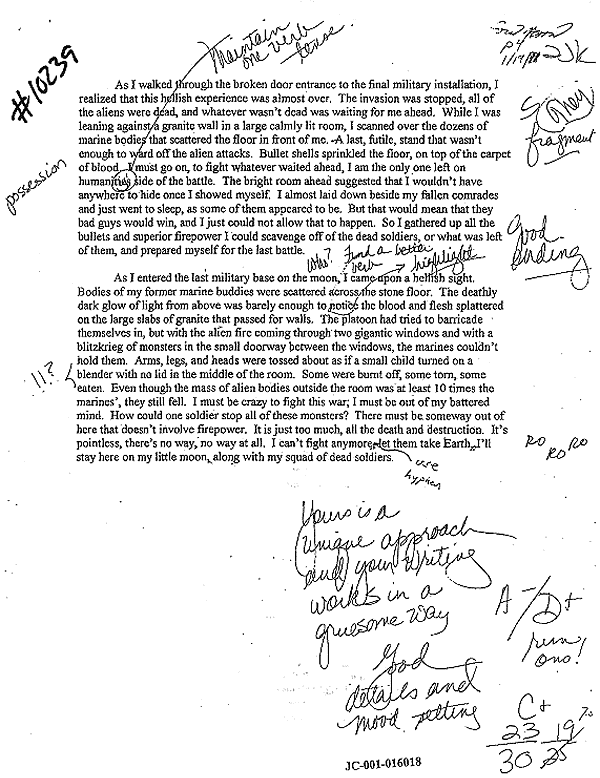
Bibliography
- Brown, Brooks; Merritt, Rob (2002). No Easy Answers: The Truth Behind Death at Columbine. Lantern Books. ISBN 1-59056-031-0.
- Cullen, Dave (2009). Columbine. TwelveBooks. ISBN 978-0-446-54693-5.
- Daggett, Chelsea (November 2015). "Eric Harris and Dylan Klebold: Antiheroes for outcasts" (PDF). Participations: Journal of Audience & Reception Studies. 12 (2). ISSN 1749-8716. Archived from the original (PDF) on June 6, 2020. Retrieved August 23, 2020.
- Larkin, Ralph W. (2007). Comprehending Columbine. Temple University Press. ISBN 978-1-59213-491-5.
- Rico, Andrew Ryan (September 1, 2015). "Fans of Columbine shooters Eric Harris and Dylan Klebold". Transformative Works and Cultures. 20. doi:10.3983/twc.2015.0671.
External links
