Geography (from Ancient Greekγεωγραφίαgeōgraphía; combining gê 'Earth' and gráphō 'write', literally 'Earth writing') is the study of the lands, features, inhabitants, and phenomena of Earth. Geography is an all-encompassing discipline that seeks an understanding of Earth and its human and natural complexities—not merely where objects are, but also how they have changed and come to be. While geography is specific to Earth, many concepts can be applied more broadly to other celestial bodies in the field of planetary science. Geography has been called "a bridge between natural science and social science disciplines."
The history of geography as a discipline spans cultures and millennia, being independently developed by multiple groups, and cross-pollinated by trade between these groups. Geography as a discipline dates back to the earliest attempts to understand the world spatially, with the earliest example of an attempted world map dating to the 9th century BC in ancient Babylon. Origins of many of the concepts in geography can be traced to Greek Eratosthenes of Cyrene, who may have coined the term "geographia" (c. 276 BC – c. 195/194 BC). The first recorded use of the word γεωγραφία was as the title of a book by Greek scholar Claudius Ptolemy (100 – 170 AD). During the Middle Ages, geography was influenced by Islamic scholars, like Muhammad al-Idrisi, producing detailed maps of the world. The Age of Discovery was influential in the development of geography, as European explorers mapped the New World. Modern developments include the development of geomatics and geographic information science.
The core concepts of geography consistent between all approaches are a focus on space, place, time, and scale. Today, geography is an extremely broad discipline with multiple approaches and modalities. The main branches of geography are physical geography, human geography, and technical geography. Physical geography focuses on the natural environment, human geography focuses on how humans interact with the Earth, and technical geography focuses on the development of tools for understanding geography. Techniques employed can generally be broken down into quantitative and qualitative approaches, with many studies taking mixed-methods approaches. Common techniques include cartography, remote sensing, interviews, and surveying. (Full article...)
Featured article -
Featured articles are displayed here, which represent some of the best content on English Wikipedia.
Image 1
Greatest extent of the Chalukya Empire
The Chalukya dynasty (Kannada:[tʃaːlukjɐ]) was a Classical Indian dynasty that ruled large parts of southern and central India between the 6th and the 12th centuries. During this period, they ruled as three related yet individual dynasties. The earliest dynasty, known as the "Badami Chalukyas", ruled from Vatapi (modern Badami) from the middle of the 6th century. The Badami Chalukyas began to assert their independence at the decline of the Kadamba kingdom of Banavasi and rapidly rose to prominence during the reign of Pulakeshin II. After the death of Pulakeshin II, the Eastern Chalukyas became an independent kingdom in the eastern Deccan. They ruled from Vengi until about the 11th century. In the western Deccan, the rise of the Rashtrakutas in the middle of the 8th century eclipsed the Chalukyas of Badami before being revived by their descendants, the Western Chalukyas, in the late 10th century. These Western Chalukyas ruled from Kalyani (modern Basavakalyan) until the end of the 12th century.
The rule of the Chalukyas marks an important milestone in the history of South India and a golden age in the history of Karnataka. The political atmosphere in South India shifted from smaller kingdoms to large empires with the ascendancy of Badami Chalukyas. A Southern India-based kingdom took control and consolidated the entire region between the Kaveri and the Narmada rivers. The rise of this empire saw the birth of efficient administration, overseas trade and commerce and the development of new style of architecture called "Chalukyan architecture". Kannada literature, which had enjoyed royal support in the 9th century Rashtrakuta court found eager patronage from the Western Chalukyas in the Jain and Brahminical traditions. The 11th century saw the patronage of Telugu literature under the Eastern Chalukyas. (Full article...)
Image 2
Mauna Kea in December 2007, with its seasonal snow cap visible
Mauna Kea (/ˌmɔːnəˈkeɪə,ˌmaʊnə-/, Hawaiian:[ˈmɐwnəˈkɛjə]; abbreviation for Mauna a Wākea, 'White Mountain') is a dormant shield volcano on the island of Hawaiʻi. Its peak is 4,207.3 m (13,803 ft) above sea level, making it the highest point in Hawaii and the island with the second highest high point, behind New Guinea. The peak is about 38 m (125 ft) higher than Mauna Loa, its more massive neighbor. Mauna Kea is unusually topographically prominent for its height: its prominence from sea level is 15th in the world among mountains, at 4,207.3 m (13,803 ft); its prominence from under the ocean is 9,330 m (30,610 ft), rivaled only by Mount Everest. This dry prominence is greater than Everest's height above sea level of 8,848.86 m (29,032 ft), and some authorities have labeled Mauna Kea the tallest mountain in the world, from its underwater base. Mauna Kea is ranked 8th by topographic isolation.
It is about one million years old and thus passed the most active shield stage of life hundreds of thousands of years ago. In its current post-shield state, its lava is more viscous, resulting in a steeper profile. Late volcanism has also given it a much rougher appearance than its neighboring volcanoes due to construction of cinder cones, decentralization of its rift zones, glaciation on its peak, and weathering by the prevailing trade winds. Mauna Kea last erupted 6,000 to 4,000 years ago and is now thought to be dormant. (Full article...)
Originally an unused area of grouse moorland, the moss was reclaimed in the latter half of the 19th century for farming and the disposal of Manchester's waste. A system of tramways was built to connect it with the Manchester Ship Canal and a nearby railway line. In the Second World War, the land was used as a Starfish site and in the latter half of the 20th century a large industrial complex was built along its northern edge. More recently, several sporting facilities have been built on Carrington Moss. (Full article...)
Image 4
El Tatio geyser field El Tatio is a geothermal field with many geysers located in the Andes Mountains of northern Chile at 4,320 metres (14,170 ft) above mean sea level. It is the third-largest geyser field in the world and the largest in the Southern Hemisphere. Various meanings have been proposed for the name "El Tatio", including "oven" or "grandfather". The geothermal field has many geysers, hot springs, and associated sinter deposits. The water from these hot springs eventually forms the Rio Salado, a major tributary of the Rio Loa, significantly increasing the amount of arsenic in the river. The geothermal vents are sites of populations of extremophile microorganisms such as hyperthermophiles, and El Tatio has been studied as an analogue for the early Earth and possible past life on Mars.
El Tatio lies at the western foot of a series of stratovolcanoes which runs along the border between Chile and Bolivia. This series of volcanoes is part of the Central Volcanic Zone (one of several volcanic belts in the Andes), and of the Altiplano–Puna volcanic complex (APVC) – a system of large calderas and associated ignimbrites which were the sources of supereruptions between 10 million and 1 million years ago. Some of these calderas may be the source of heat for the El Tatio geothermal system. There are no recorded eruptions of the Tatio volcanoes in the historical period. (Full article...)
Image 5
Screenshot of gameplay (1977 version)
Colossal Cave Adventure (also known as Adventure or ADVENT) is a text-based adventure game, released in 1976 by developer Will Crowther for the PDP-10mainframe computer. It was expanded upon in 1977 by Don Woods. In the game, the player explores a cave system rumored to be filled with treasure and gold. The game is composed of dozens of locations, and the player moves between these locations and interacts with objects in them by typing one- or two-word commands which are interpreted by the game's natural language input system. The program acts as a narrator, describing the player's location and the results of the player's attempted actions. It is the first well-known example of interactive fiction, as well as the first well-known adventure game, for which it was also the namesake.
The original game, written in 1975 and 1976, was based on Crowther's maps and experiences caving in Mammoth Cave in Kentucky, the longest cave system in the world; further, it was intended, in part, to be accessible to non-technical players, such as his two daughters. Woods's version expanded the game in size and increased the number of fantasy elements present in it, such as a dragon and magic spells. Both versions, typically played over teleprinters connected to mainframe computers, were spread around the nascent ARPANET, the precursor to the Internet, which Crowther was involved in developing. (Full article...)
Image 6
The Falkland Islands (/ˈfɔː(l)klənd,ˈfɒlk-/; Spanish: Islas Malvinas[ˈislasmalˈβinas]), commonly referred to as The Falklands, is an archipelago in the South Atlantic Ocean on the Patagonian Shelf. The principal islands are about 300 mi (500 km) east of South America's southern Patagonian coast and 752 mi (1,210 km) from Cape Dubouzet at the northern tip of the Antarctic Peninsula, at a latitude of about 52°S. The archipelago, with an area of 4,700 sq mi (12,000 km2), comprises East Falkland, West Falkland, and 776 smaller islands. As a British Overseas Territory, the Falklands have internal self-governance, while the United Kingdom takes responsibility for their defence and foreign affairs. The capital and largest settlement is Stanley on East Falkland.
The islands are believed to have been uninhabited prior to European discovery in the 17th century. Controversy exists over the Falklands' discovery and subsequent colonisation by Europeans. At various times, the islands have had French, British, Spanish, and Argentine settlements. Britain reasserted its rule in 1833, but Argentina maintains its claim to the islands. In April 1982, Argentine military forces invaded the islands. British administration was restored two months later at the end of the Falklands War. In a 2013 sovereignty referendum, almost all of the votes cast were in favour of remaining a UK overseas territory. The territory's sovereignty status is part of an ongoing dispute between Argentina and the UK. (Full article...)
Image 7
Columbia River from Rowena Crest with Interstate 84 on the right
The Columbia and its tributaries have been central to the region's culture and economy for thousands of years. They have been used for transportation since ancient times, linking the region's many cultural groups. The river system hosts many species of anadromous fish, which migrate between freshwater habitats and the saline waters of the Pacific Ocean. These fish—especially the salmon species—provided the core subsistence for native peoples. (Full article...)
Image 8
The Coventry ring road, designated as the A4053, is a 2.25-mile (3.62 km) ring road in Coventry, England, which forms a complete dual-carriageway loop around the city centre. The road encompasses the old and new Coventry Cathedrals, the city's shopping areas and much of Coventry University. With the exception of one roundabout at junction 1, the ring road's nine junctions are grade separated and closely spaced, with weaving sections between them, some as short as 300 feet (90 m), giving the road a reputation for being difficult to navigate. The junctions include connections with three other A-roads: the A4114, A4600 and A429.
From the 1930s, Coventry City Council began replacing the city's narrow medieval streets with modern roads, to cope with a rapidly growing population. City architect Donald Gibson began work in 1939 on a city centre redevelopment plan which expanded in scope following World War II, during which large areas of the city were destroyed by German bombs. The shopping area was rebuilt first, followed by the ring road, which was constructed in six stages from 1959. Early stages were built with at-grade junctions, cycle tracks and footpaths, envisaged as a surface-level linear park. Following traffic surveys in the early 1960s, however, the council amended the design to include grade separation and the weaving sections. Research by the city engineer indicated that it was the first urban road in the world to use this configuration at such a small scale. The road was completed in 1974, with an overall cost of £14.5 million (equivalent to £190,900,000 in 2023). (Full article...)
The county has an area of 2,653 km2 (1,024 sq mi) and had an estimated population of 798,914 in 2024. A conurbation on the south-east coast contains the towns of Bournemouth, Christchurch, and Poole. The remainder of the county is largely rural, and its principal towns are the seaside resort of Weymouth in the south and Dorchester in the south-centre. For local government purposes Dorset comprises two unitary authority areas: Bournemouth, Christchurch and Poole and Dorset. The county did not historically include Bournemouth and Christchurch, which were part of Hampshire. (Full article...)
Members of the Desert Archaic Culture were the earliest known inhabitants of the region; an archaeological site found along the river dates back 3,000 years. Mormon pioneers led by Brigham Young were the first European American settlers, arriving in July 1847 and establishing farms and settlements along the river and its tributaries. The growing population, needing water for drinking, irrigation, and industrial use in an arid climate, dug ditches and canals, built dams, and installed pumps to create a highly regulated river. (Full article...)
Image 12
A map of the position of the former shorelines of Lake Estancia
Lake Estancia was a lake formed in the Estancia Valley, central New Mexico, which left various coastal landforms in the valley. The lake was mostly fed by creek and groundwater from the Manzano Mountains, and fluctuated between freshwater stages and saltier stages. The lake had a diverse fauna, including cutthroat trout; they may have reached it during a possible past stage where it was overflowing.
Lake Estancia appears to have formed between the Pliocene and Pleistocene, when a previous river system broke up. It reached a maximum water level ("highstand") presumably during the Illinoian glaciation and subsequently fluctuated between fuller stages and a desiccated basin. Around the Last Glacial Maximum (LGM) time interval, several highstands and a low water level state occurred during the "Big Dry" climate interval. Between 16,100 and 14,500 years ago the lake reached its highest stand of the last 30,000 years before drying up again during the Bølling-Allerød climate interval. The lake briefly returned during the Younger Dryas climate interval and eventually desiccated during the Holocene, after about 8,500 years ago. Wind-driven erosion has excavated depressions in the former lakebed that are in part filled with playas (dry lake beds). (Full article...)
Image 13
Allison Guyot (formerly known as Navoceano Guyot) is a tablemount (guyot) in the underwater Mid-Pacific Mountains of the Pacific Ocean. It is a trapezoidal flat mountain rising 1,500 metres (4,900 ft) above the seafloor to a depth of less than 1,500 metres (4,900 ft), with a summit platform 35 by 70 kilometres (22 by 43 mi) wide. The Mid-Pacific Mountains lie west of Hawaii and northeast of the Marshall Islands, but at the time of their formation were located in the Southern Hemisphere.
The tablemount was probably formed by a hotspot in the present-day Southern Pacific before plate tectonics moved it to its current location. Several hotspots, including the Easter, Marquesas and Society hotspots, may have been involved in the formation of the Mid-Pacific Mountains. Volcanic activity is dated to have occurred circa 111–85 million years ago and formed a volcanic island. Subsequently, carbonate deposition commenced as Allison Guyot subsided and eventually buried the island, forming an atoll-like structure and a carbonate platform. Among other animals, crocodilians lived on Allison Guyot. (Full article...)
Image 14
Omayra Sánchez Garzón (August 28, 1972 – November 16, 1985) was a Colombian girl trapped and killed by a landslide when she was 13 years old.
The landslide was caused by the 1985 eruption of the volcano Nevado del Ruiz in Armero, Tolima. Volcanic debris mixed with ice to form massive lahars (volcanically induced mudflows, landslides, and debris flows), which rushed into the river valleys below the mountain, killing about 25,000 people and destroying Armero and 13 other villages. (Full article...)
Image 15
Cameroon, officially the Republic of Cameroon, is a country in Central Africa. It shares boundaries with Nigeria to the west and north, Chad to the northeast, the Central African Republic to the east, and Equatorial Guinea, Gabon, and the Republic of the Congo to the south. Its coastline lies on the Bight of Biafra, part of the Gulf of Guinea, and the Atlantic Ocean. Due to its strategic position at the crossroads between West Africa and Central Africa, it has been categorized as being in both geostrategic locations. Cameroon's population of nearly 31 million people speak 250 native languages, in addition to the national tongues of English and French. The capital city of the country is Yaoundé.
Early inhabitants of the territory included the Sao civilisation around Lake Chad and the Baka hunter-gatherers in the southeastern rainforest. Portuguese explorers reached the coast in the 15th century. Fulani soldiers founded the Adamawa Emirate in the north in the 19th century, and various ethnic groups of the west and northwest established powerful chiefdoms and fondoms. (Full article...)
Vital article
Vital articles to understand Geography.
Africa is the world's second-largest and second-most populous continent after Asia. At about 30.3 million km2 (11.7 million square miles) including adjacent islands, it covers around 20% of Earth's land area and 6% of its total surface area. With nearly 1.4 billion people as of 2021, it accounts for about 18% of the world's human population. Africa's population is the youngest among all the continents; the median age in 2012 was 19.7, when the worldwide median age was 30.4. Based on 2024 projections, Africa's population will exceed 3.8 billion people by 2100. Africa is the least wealthy inhabited continent per capita and second-least wealthy by total wealth, ahead of Oceania. Scholars have attributed this to different factors including geography, climate, corruption, colonialism, the Cold War, and neocolonialism. Despite this low concentration of wealth, recent economic expansion and a large and young population make Africa an important economic market in the broader global context, and Africa has a large quantity of natural resources. (Full article...)
For editor resources and to collaborate with other editors on improving Wikipedia's Geography-related articles, visit WikiProject Geography.
Here are some tasks awaiting attention:
Article requests : See Requested articles/Social sciences/Geography, cities, regions and named places and Missing articles about Locations
Assess : Tag related article talk pages with {{WikiProject Geography}}. To help assess the quality and importance of geography articles, please see: Unassessed geography articles and Unknown-importance geography articles.
Cleanup : See Geography articles needing attention
Deletion sorting : Listed at Geographic related deletion discussions
Geographical coordinates : See Articles missing geocoordinate data by country
Infobox : See Geography articles needing infoboxes
Map : See Wikipedia requested maps
Notability : See Geography articles with topics of unclear notability
Photo : See Wikipedia requested photographs of places
A portolan chart from 1492, the oldest known signed and dated chart of Portuguese origin. Cartography technologies greatly advanced during the Age of Discovery. Iberian mapmakers in particular focused on practical charts to use as navigational aids. Unlike Spanish maps which were regarded as state secrets, Portuguese ones were used by other countries, and Portuguese cartographers drew upon the skill and knowledge of other cultures as well.
The Hammer retroazimuthal projection is a modified azimuthal proposed by Ernst Hermann Heinrich Hammer in 1910. As a retroazimuthal projection, azimuths (directions) are correct from any point to the designated center point. In whole-world presentation, the back and front hemispheres overlap, making the projection a surjective function. Here, the frontside and backside hemispheres, both with a 15° graticule and center point of 45°N, 90°W, are presented side-by-side.
The Lambert conformal conic projection is a conic map projection used for aeronautical charts, portions of the State Plane Coordinate System, and many national and regional mapping systems. It is one of seven projections introduced by Johann Heinrich Lambert in 1772. Conceptually, the projection seats a cone over the sphere of the Earth and projects the surface conformally onto the cone. The cone is unrolled, and the parallel that was touching the sphere is assigned unit scale. By scaling the resulting map, two parallels can be assigned unit scale, with scale decreasing between them and increasing outside them. Unlike other conic projections, no true secant form of this projection exists.
Antarctica, the continent surrounding the Earth's South Pole, is the coldest place on Earth and is almost entirely covered by ice. Antarctica was discovered in late January 1820. Too cold and dry to support virtually any vascular plants, Antartica's flora presently consists of around 250 lichens, 100 mosses, 25-30 liverworts, and around 700 terrestrial and aquatic algal species.
The van der Grinten projection is a compromise map projection that is neither equal-area nor conformal. It projects the entire Earth into a circle, though the polar regions are subject to extreme distortion. The projection was the first of four proposed by Alphons J. van der Grinten in 1904, and, unlike perspective projections, is an arbitrary geometric construction on the plane. It was adopted as the National Geographic Society's reference map of the world from 1922 until 1988.
A world map entitled Nova totius terrarum orbis tabula Amstelodami, created in 1689 by Gerard van Schagen. This map, created in Amsterdam, measures 48.3 by 56.0 centimetres (19.0 by 22.0 in) in size and was made using copper engraving.
An isothermal map of the world, based on the research of Alexander von Humboldt, a German naturalist whose work laid the foundation for the sciences of physical geography and meteorology, among other things. By delineating "isothermal lines", he simultaneously suggested the idea and devised the means of comparing the climatic conditions of various countries.
The Catalan Atlas is a medieval map in the Catalan language, created in 1375. Described as "the zenith of medieval map-work", it is the earliest known chart to use a compass rose. It was produced by the Majorcan cartographic school and is attributed to Abraham Cresques, a Jewish book illuminator described by a contemporary as a master of mappae mundi. It has been in the royal library of France (now the Bibliothèque nationale de France) since the time of King Charles V. The atlas originally consisted of six vellum leaves, each about 64.5 by 50 cm (25.4 by 19.7 in), folded vertically and painted in various colours including gold and silver. This picture is a montage of eight pages (four leaves) of the atlas, depicting Europe, northern Africa and Asia.
He served as a militia officer during the Revolutionary War (1775–1783), which in Kentucky was fought primarily between American settlers and British-allied Indians. In 1778, Boone was captured by the Shawnee and was, according to legend, adopted by the Shawnee Chief and given the name "Sheltowee", or Big Turtle. After months of living with the Shawnee, Boone escaped. He was elected to the first of his three terms in the Virginia General Assembly during the war and fought in the Battle of Blue Licks in 1782, one of the last battles of the American Revolution. He worked as a surveyor and merchant after the war, but went deep into debt as a Kentucky land speculator. He resettled in Missouri in 1799, where he spent most of the last two decades of his life, frustrated with legal problems resulting from his land claims. (Full article...)
You can read about interesting Wikipedia articles about places around you.
Special:Nearby
Top 10 WikiProject Geography Popular articles of the month
This following Geography-related articles is a most visited articles of WikiProject Geography, See complete list at Wikipedia:WikiProject Geography/Popular pages.
Image 1
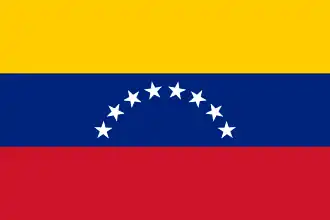
Venezuela, officially the Bolivarian Republic of Venezuela, is a country on the northern coast of South America, consisting of a continental landmass and various islands and islets in the Caribbean Sea. It comprises an area of 912,050 km2 (352,140 sq mi), with a population estimated at 31.8 million in 2025. The capital and largest urban agglomeration is Caracas. The continental territory is bordered on the north by the Caribbean Sea and the Atlantic Ocean, on the west by Colombia, Brazil on the south, Trinidad and Tobago to the north-east, and on the east by Guyana. Venezuela consists of 23 states, the Capital District, and federal dependencies covering Venezuela's offshore islands. Venezuela is among the most urbanized countries in Latin America; the vast majority of Venezuelans live in the cities of the north and in the capital. (Full article...)
Image 2
Dymaxion map of the world with the 30 largest countries and territories by area
This is a list of the world's countries and their dependencies, ranked by total area, including land and water. (Full article...)
Generation Z, often shortened to Gen Z and informally known as Zoomers, is the demographic cohort succeeding Millennials and preceding Generation Alpha. Researchers and popular media use the mid-to-late 1990s as starting birth years and the early 2010s as ending birth years, with the generation typically being defined as people born from 1997 to 2012. Most members of Generation Z are the children of Generation X, and it is predicted that many will be the parents of the proposed Generation Beta. (Full article...)


 Featured article -
 ![Image 1 Greatest extent of the Chalukya Empire The Chalukya dynasty (Kannada: [tʃaːlukjɐ]) was a Classical Indian dynasty that ruled large parts of southern and central India between the 6th and the 12th centuries. During this period, they ruled as three related yet individual dynasties. The earliest dynasty, known as the "Badami Chalukyas", ruled from Vatapi (modern Badami) from the middle of the 6th century. The Badami Chalukyas began to assert their independence at the decline of the Kadamba kingdom of Banavasi and rapidly rose to prominence during the reign of Pulakeshin II. After the death of Pulakeshin II, the Eastern Chalukyas became an independent kingdom in the eastern Deccan. They ruled from Vengi until about the 11th century. In the western Deccan, the rise of the Rashtrakutas in the middle of the 8th century eclipsed the Chalukyas of Badami before being revived by their descendants, the Western Chalukyas, in the late 10th century. These Western Chalukyas ruled from Kalyani (modern Basavakalyan) until the end of the 12th century. The rule of the Chalukyas marks an important milestone in the history of South India and a golden age in the history of Karnataka. The political atmosphere in South India shifted from smaller kingdoms to large empires with the ascendancy of Badami Chalukyas. A Southern India-based kingdom took control and consolidated the entire region between the Kaveri and the Narmada rivers. The rise of this empire saw the birth of efficient administration, overseas trade and commerce and the development of new style of architecture called "Chalukyan architecture". Kannada literature, which had enjoyed royal support in the 9th century Rashtrakuta court found eager patronage from the Western Chalukyas in the Jain and Brahminical traditions. The 11th century saw the patronage of Telugu literature under the Eastern Chalukyas. (Full article...)](./_assets_/c8f24dc75f9c782269c846c9b17e400f/Blank.png)


_at_sunset.jpg)


 Vital article
 Map: Strebe, using GeocartThe Eckert II projection is an equal-area pseudocylindrical map projection presented by Max Eckert-Greifendorff in 1906. In the equatorial aspect (where the equator is shown as the horizontal axis) the network of longitude and latitude lines consists solely of straight lines, and the outer boundary has the distinctive shape of an elongated hexagon.
 Map: Strebe, using GeocartThe Chamberlin trimetric projection is a map projection where three points are fixed on the globe and the points on the sphere are mapped onto a plane by triangulation. It was developed in 1946 by Wellman Chamberlin for the National Geographic Society. It is neither conformal nor equal-area, but rather attempts to minimize distortion of distances everywhere with the side-effect of balancing between areal equivalence and conformality.
 Map: Jorge de AguiarA portolan chart from 1492, the oldest known signed and dated chart of Portuguese origin. Cartography technologies greatly advanced during the Age of Discovery. Iberian mapmakers in particular focused on practical charts to use as navigational aids. Unlike Spanish maps which were regarded as state secrets, Portuguese ones were used by other countries, and Portuguese cartographers drew upon the skill and knowledge of other cultures as well.
 Map: Strebe, using GeocartThe Hammer retroazimuthal projection is a modified azimuthal proposed by Ernst Hermann Heinrich Hammer in 1910. As a retroazimuthal projection, azimuths (directions) are correct from any point to the designated center point. In whole-world presentation, the back and front hemispheres overlap, making the projection a surjective function. Here, the frontside and backside hemispheres, both with a 15° graticule and center point of 45°N, 90°W, are presented side-by-side.
 Map: Strebe, using GeocartThe Lambert conformal conic projection is a conic map projection used for aeronautical charts, portions of the State Plane Coordinate System, and many national and regional mapping systems. It is one of seven projections introduced by Johann Heinrich Lambert in 1772. Conceptually, the projection seats a cone over the sphere of the Earth and projects the surface conformally onto the cone. The cone is unrolled, and the parallel that was touching the sphere is assigned unit scale. By scaling the resulting map, two parallels can be assigned unit scale, with scale decreasing between them and increasing outside them. Unlike other conic projections, no true secant form of this projection exists.
 Photo credit: NASAAntarctica, the continent surrounding the Earth's South Pole, is the coldest place on Earth and is almost entirely covered by ice. Antarctica was discovered in late January 1820. Too cold and dry to support virtually any vascular plants, Antartica's flora presently consists of around 250 lichens, 100 mosses, 25-30 liverworts, and around 700 terrestrial and aquatic algal species.
 Map: Strebe, using GeocartThe van der Grinten projection is a compromise map projection that is neither equal-area nor conformal. It projects the entire Earth into a circle, though the polar regions are subject to extreme distortion. The projection was the first of four proposed by Alphons J. van der Grinten in 1904, and, unlike perspective projections, is an arbitrary geometric construction on the plane. It was adopted as the National Geographic Society's reference map of the world from 1922 until 1988.
 Map: Strebe, using GeocartThe Hobo–Dyer projection is a cylindrical equal-area projection commissioned in 2002 by Bob Abramms and Howard Bronstein. This projection was drafted by cartographer Mick Dyer, who based it on the 1910 Behrmann projection.
 Map: Eric GabaA map showing the geography of Florida, a state in the United States. Situated on a peninsula between the Gulf of Mexico, the Atlantic Ocean, and the Straits of Florida, Florida has an extensive coastline. Its highest point, Britton Hill, is the lowest highpoint of any U.S. state. Florida is home to over 19 million people, living in 410 municipalities.
 Map: Strebe, using GeocartThe Craig retroazimuthal is a modified cylindrical map projection created by James Ireland Craig in 1909. It preserves the direction from any place to one other, predetermined place while avoiding some of the distortion of the Hammer retroazimuthal projection. This projection is sometimes known as the Mecca projection because Craig, who had worked in Egypt as a cartographer, created it to help Muslims find the qibla.
 A world map entitled Nova totius terrarum orbis tabula Amstelodami, created in 1689 by Gerard van Schagen. This map, created in Amsterdam, measures 48.3 by 56.0 centimetres (19.0 by 22.0 in) in size and was made using copper engraving.
 Photo: NASAA composite satellite image of the continent of North America in orthographic projection. North America occupies the northern portion of the landmass generally known as the Americas, with its southern border at the Darién watershed along the Colombia–Panama border. The vast majority of North America rests on the North American Plate, while small parts of California and western Mexico rest on the Pacific Plate; Central America and the Caribbean islands rest on the Caribbean Plate.
 Map: Diego Gutiérrez and Hieronymus CockAmericae Sive Quartae Orbis Partis Nova Et Exactissima Descriptio is an ornate geographical map of the Americas made in 1562 by Spanish cartographer Diego Gutiérrez and Flemish artist Hieronymus Cock. The map encompasses the eastern coast of North America, the whole of Central and South America, and parts of the western coasts of Europe and Africa. This is the earliest scale wall map of the New World and the first to use the name "California". Two extant copies are known.
 Map: William C. Woodbridge; Restoration: Jujutacular and Lise BroerAn isothermal map of the world, based on the research of Alexander von Humboldt, a German naturalist whose work laid the foundation for the sciences of physical geography and meteorology, among other things. By delineating "isothermal lines", he simultaneously suggested the idea and devised the means of comparing the climatic conditions of various countries.
 Map credit: Abraham CresquesThe Catalan Atlas is a medieval map in the Catalan language, created in 1375. Described as "the zenith of medieval map-work", it is the earliest known chart to use a compass rose. It was produced by the Majorcan cartographic school and is attributed to Abraham Cresques, a Jewish book illuminator described by a contemporary as a master of mappae mundi. It has been in the royal library of France (now the Bibliothèque nationale de France) since the time of King Charles V. The atlas originally consisted of six vellum leaves, each about 64.5 by 50 cm (25.4 by 19.7 in), folded vertically and painted in various colours including gold and silver. This picture is a montage of eight pages (four leaves) of the atlas, depicting Europe, northern Africa and Asia.
.jpg)


.svg.png)
.svg.png)

.jpeg)



 Categories
 Commons
 Wikibooks
 Wikidata
 Wikinews
 Wikiquote
 Wikisource
 Wikiversity
 Wikivoyage
 Wiktionary
 List of all portals





 Random portal
 WikiProject Portals