Ukrainian State
Ukrainian State Українська Держава (Ukrainian) | |||||||||
|---|---|---|---|---|---|---|---|---|---|
| 1918 | |||||||||
| Motto: Слава Україні! Гетьманові слава! ("Glory to Ukraine! Glory to the Hetman!") | |||||||||
| Anthem: Ще не вмерла України ("Ukraine has not yet perished") | |||||||||


| |||||||||
| Status | Client state of the German Empire | ||||||||
| Capital | Kyiv 50°27′00″N 30°31′00″E / 50.45°N 30.5167°E | ||||||||
| Common languages | |||||||||
| Religion |
| ||||||||
| Demonym | Ukrainian | ||||||||
| Government | Provisional semi-constitutional monarchy under an authoritarian conservative military dictatorship | ||||||||
| Hetman | |||||||||
• 1918 | Pavlo Skoropadsky | ||||||||
| Otaman | |||||||||
• April–May | Mykola Vasylenko | ||||||||
• May–November | Fedir Lyzohub | ||||||||
• November–December | Serhii Herbel | ||||||||
| Legislature |
| ||||||||
| Historical era | World War I | ||||||||
| 29 April 1918 | |||||||||
| 14 December 1918 | |||||||||
| |||||||||
| Today part of | |||||||||
.svg.png)

| History of Ukraine |
|---|
.jpg) |
| Topics |
| Reference |

The Ukrainian State (Ukrainian: Українська Держава)[b] was the official name of Ukraine used between 29 April and 14 December 1918,[c] following the deposition of the Central Rada of Ukrainian People's Republic. For the entirety of its history, the state was ruled autocratically by Pavlo Skoropadsky, the Hetman of all Ukraine, who took a sharp departure from the earlier democratic and socialist-leaning policies of the Central Rada, instead aligning his government with the interests of large landowners and industrialists.
Established against the backdrop of the Central Powers becoming increasingly dissatisfied with the Ukrainian government's inability to fulfil its obligations to provide large quantities of food and raw goods as per the Treaty of Brest-Litovsk, the Ukrainian State was deeply politically, economically and militarily dependent upon the Central Powers, particularly Germany and Austria-Hungary, who pledged to support Skoropadsky's rule in return for greater control over the state. Despite this dependency, the Ukrainian State pursued a largely independent internal policy and managed to establish a relatively well-functioning bureaucracy, in contrast to the chaos of the previous government.
Failure to complete land reform, a perceived support for often violent German and Austrian methods to extract grain from the countryside and a controversial ethnic policy (which was seen as too Russophilic) led to the Ukrainian population growing dissatisfied by the government of the Ukrainian State. Meanwhile, Skoropadsky's main backers in the form of Germany and Austria had been defeated by the Triple Entente, leaving the Ukrainian State at the mercy of neighbouring countries, particularly the Russian Soviet Federative Socialist Republic. Tensions finally culminated in the Anti-Hetman Uprising, during which the Directorate toppled the Ukrainian State and re-established the Ukrainian People's Republic.
History
Background
On 29 December [O.S. 16 December] 1917, the Bolshevik government Petrograd issued an ultimatum to the Central Rada in Kyiv. The ultimatum, while recognising the autonomy of the Ukrainian People's Republic (often referred to as the UPR) as per the earlier Third Universal, also demanded the Rada agree to the following within 48 hours:
- Cease disarming Soviet troops in its territory.
- Block passage for White sympathisers, who frequently travelled through Ukraine to join the White Don forces.
- Allow Soviet troops to travel to the front through Ukraine.
The Rada refused to comply with the ultimatum.[1]
In response, the Bolshevik diplomats met with Soviet delegates to the Third Congress of Soviets from Kharkiv and Kryvyi Rih in Kharkiv (already controlled by Bolshevik forces) and proclaimed the establishment of the Ukrainian People's Republic of Soviets, effectively creating a rival government to the Rada in Kyiv. On 30 December [O.S. 17 December] 1917, the Soviet Ukrainian government officially declared war upon the Rada, marking the formal beginning of the Ukrainian–Soviet War.[2]
The war proceeded poorly for the UPR. On 29 December [O.S. 16 December] 1917, the Arsenal Uprising began, which forced a large portion of the 16,000 strong Ukrainian garrison in Kyiv to be used for suppressing it. Soviet troops under the command of General Muravyov faced unexpected resistance by the much inferior Ukrainian forces at Kruty, but nevertheless advanced quickly. The Battle of Kyiv began on 23 January [O.S. 5 February] 1918 and was concluded by the Bolshevik capture of the city three days later.[3]
Against the backdrop of complete military defeat, the Central Rada committed to signing the Treaty of Brest-Litovsk on 2 March [O.S. 18 February] 1918, in which the Central Powers recognised the independence of Ukraine and pledged to help liberate its territories from Bolshevik troops. German forces then recaptured much of the Ukrainian territory under the control of the Bolsheviks, including Kyiv itself. The chaos of the previous months had, however, left the Rada in a precarious situation, as it was unable to re-establish control over large parts of the country (primarily in the vast rural areas).
Austria-Hungary and especially the German Empire had expected huge shipments of grain, other foodstuffs and raw industrial materials from Ukraine to alleviate the shortages caused by the wartime blockade, but the Ukrainian government was unable to extract or transport these items. This led to increased friction between the Rada and the Central Powers, as it was thought that the Ukrainian government was not fulfilling its obligations.[4]
Tensions reached a new high on 6 April 1918, when Field Marshal Hermann von Eichhorn, the commander of the German Army Group Kiev, issued his so-called "cultivation order", in which he accused the Ukrainian peasants of not sowing their fields and instructed that Germans must ensure that the fields were sowed, even at the threat of military intervention. This was very unpopular with the local population and greatly angered the Rada, which issued a note of protest on 13 April. Meanwhile, on 18 April, the German ambassador in Kyiv, Alfons von Mumm, informed Berlin that "collaboration with present government, considering its tendencies, is impossible", having earlier recommended that the Rada should be overthrown and a new government put in place.[5]
In mid-April, Mumm stablished contact with a former general of the Russian Imperial Army of Ukrainian origin, Pavlo Skoropadsky. He was deemed to be a suitable candidate for leading a new government in Ukraine.[6] On 26 April, Skoropadsky met with General Wilhelm Groener, the commander of the German I Corps, to discuss specific conditions under which his rule would be supported.[7] These included:
- Acceptance of the Treaty of Brest-Litovsk
- Dissolution of the Central Rada
- Abolition of the Ukrainian Constituent Assembly
- Unlimited export of raw and manufactured goods
- German approval of all cabinet members in government
- German determination of the size of the Ukrainian army
Establishment

German relations with the Rada broke down completely after the so-called Dobryi Affair, in which the wealthy banker Abraham Dobryi, director of the Kyiv section of the Russian Bank for Foreign Trade was abducted on the 24 April 1918. As Dobryi was member of a special commission of the Ukrainian Ministry of Finance which negotiated financial operations with the Central Powers, chiefly Germany, and was thus well-known to the Germans, his sudden and unexplained disappearance resulted in Germany's complete loss of trust in the Ukrainian government.[8] Field Marshal Eichhorn responded to the incident by issuing a decree which granted the German military courts jurisdiction over all criminal offences on 25 April, leaving only the civil cases to the Ukrainian judiciary.[9] This prompted the premier Vsevolod Holubovych to state in the Rada:[10]
Who is this Mr. Dobryi? Is he a subject of the German State? No, he is not a far relative nor a godparent, he is a stranger. And just because that stranger who legally has no connections with Germany and gave no halters to issue a decree of such colossal weight was abducted, the decree was issued.
Worse yet for the Rada, the subsequent German investigation connected the abduction to a secret organisation by the name of Committee for Ukraine's Salvation (Ukrainian: Комітет порятунку України), headed by several high-ranking members of the Ukrainian government, chiefly Mykhailo Tkachenko, the minister of the interior.[11] Already on 26 April, the First Ukrainian Division, also known as the Bluecoat division (a unit formed from Ukrainian prisoners of war in Germany and Austria-Hungary, named so after their blue uniforms.)[12] and units of the artillery regiments were disarmed by the Germans. On 28 April, an armed German detachment raided the Rada, loudly shouting at those present and arresting two officials in connection with the Dobryi Affair, while Tkachenko himself evaded capture due to being absent that day. The final meeting of the Rada then took place on 29 April, during which the constitution of the People's Republic of Ukraine was approved.[6]

Also on 29 April, a congress of the League of Landowners consisting of some 6,500 delegates from all eight governorates of Ukraine took place in the building of the Kyiv circus.[13] The league consisted primarily of wealthy and Russified moderate and large landholders. After receiving information about the situation at the Congress from his couriers, Pavlo Skoropadsky later arrived in his car to the event where he was elected the Hetman of all Ukraine. After Skoropadsky received a standing ovation, the crowd moved to St. Sophia's Square, where Skoropadsky was served a moleben by Nykodym, the Vicar of Kyiv and Galicia (as Metropolitan Vladimir was executed by Bolsheviks). That night, the supporters of the Hetman took over the government building of military and internal affairs as well as the State Bank. The following day, the elite and most loyal formation of the Central Council, the Sich Riflemen, was disarmed.[14]
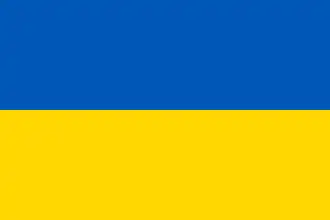
Skoropadsky issued his manifesto (Ukrainian: грамота, romanized: hramota) "To the All-Ukrainian Nation" and the Law of the Provisional State System.[15] Desiring stability, the Austro-Hungarian and German forces welcomed the coup; Skoropadsky cooperated with them, making him unpopular among many Ukrainian peasants. The new state retained the tryzub (coat of arms) and the national flag but reversed the design to light blue over yellow.
Internal opposition
Internal opposition was provoked by the requisitioning of food stocks and restoration of land to the wealthy landowners. Opponents of the Skoropadsky regime committed acts of arson and sabotage and, in July 1918, assassinated Hermann von Eichhorn, the commander of German troops in Ukraine. In August 1918, the anti-Skoropadsky coalition succeeded in forcing him to re-form the Sich Riflemen. By then it was becoming obvious that the Central Powers had lost the war and that Skoropadsky could no longer rely on their support. He thus looked for support from conservative Russian elements in society and proposed joining a federation with Anton Denikin and the White movement. This further eroded his standing among Ukrainians.[16]
Dissolution

Dashed Neutral zone between Russia and Ukraine prescribed by the Treaty of Brest-Litovsk
Almost the entire commanding staff of the Ukrainian State armed forces consisted of officers of the former Imperial Russian Army.[17] Most officers were not supportive of the Ukrainian cause and viewed it as a way to make it through tough times.[17] At the same time, wide masses of the population did not have a developed sense of nationalism and mainly chose to follow socialist and communist principles.[17]
Following the armistice ending World War I, Ukrainian socialists formed the Directorate of Ukraine (the "Directory"), whose forces were mainly composed of the Sich Riflemen and "Greycoats".[18] Although German and Austrian troops had not yet withdrawn from Ukraine, they had no further interest in fighting. Most of Skoropadsky's own forces changed sides and joined the Directory.[17]
On 16 November 1918, starting in Bila Tserkva, fighting broke out in the Hetmanate. Skoropadsky had to turn to the thousands of Russian White Guard officers who had escaped to Ukraine with the intention of joining Denikin's Volunteer Army in the region of the Don river further east. The officers were assembled into a "Special Corps" but proved unable to resist the Directory's forces led by Symon Petliura. Skoropadsky abdicated his position as Hetman on 14 December, as the Ukrainian People's Army took Kyiv. He fled to Switzerland and then Germany under disguise.[19]
Geography
The country lay in Eastern Europe along the middle and lower sections of the Dnieper on the coast of the Black Sea and the Sea of Azov. The Ukrainian State covered most of the territory of modern-day Ukraine, with the exception of most of West Ukraine, Budjak and Crimea. Its territory, however, extended into today's Russia, Belarus, Moldova and Poland.[20]
To its northeast Ukraine established a preliminary demarcation line with the Russian SFSR, on the east it had a border with the Don Republic, to its south were the Black and Azov Seas, while the Crimean peninsula—the Crimean Regional Government—came under the control of Sulkevych. To the southwest along the Dniester lay a border with the Kingdom of Romania, to the west Ukraine bordered the German Empire and Austria-Hungary. To the north were the German-occupied territories of Ober Ost and the Belarusian People's Republic.
Politics
Administrative divisions
Prior to the formation of the Ukrainian State, the Ukrainian People's Republic (UPR) had passed on 6 March 1918 the law on the division of Ukraine into zemlias, which was to replace the earlier Imperial Russian system of administration. Instead of the territory of the UPR being divided into several governorates and those being divided into uezds, the state was to be divided into 32 zemlias (Ukrainian: земля), with lower level subdivisions being volosts (Ukrainian: волость) and hromadas (Ukrainian: громада).[21]
However, in his Manifesto to the Ukrainian People, Skoropadsky declared that all prior laws and decrees of the Rada to be null, thus restoring the basic principle of the earlier division of the state.[22]
According to the Treaty of Brest-Litovsk, Ukraine had gained ownership of the territory of the former Pinsk, Mozyr and Rechitsa uezds. While the UPR had included these into the Volhynia Governorate and Kholm Governorate, they instead formed a separate administrative subdivision in the Ukrainian State, the Polisia okruha (Ukrainian: округа), centred in Mazyr.[23]
Culture and religion

According to the "Laws on the Provisional State System of Ukraine", the leading position of the country was occupied by the Christian Orthodox faith. At the same time, citizens of Ukraine who belonged to other denominations had the right to profess their religion and rites.[24]
The Russian Orthodox Church, and later the Ukrainian Autocephalous Orthodox Church, ruled in Central and Eastern Ukraine. However, in Western Ukraine there was friction between Orthodox, Greek Catholics, Roman Catholics and Jews. In the conflicts, the Ministry of Confessions of the Ukrainian State and the Council of Ministers morally and materially supported the Orthodox clergy.
On 25 June, the government allocated 3 million rubles to help priests who moved to Volhynia, Kholmshchyna, Grodno, Podolia, and Polesia, which were annexed to the Ukrainian State. On 2 July, 120,000 roubles were allocated for the maintenance of the Orthodox clergy in the lands of Kholmshchyna, Podlachia and Polesia.[25]
.jpg)
Notes
- ^ Territory controlled by the Ukrainian State's predecessor state, the Ukrainian People's Republic
- ^ Russian: Украинская Держава; also referred to as the Second Hetmanate (Ukrainian: Другий Гетьманат) or simply The Hetmanate.
- ^ For dates prior to 1 March [O.S. 16 February] 1918, when the Ukrainian People's Republic adopted the Gregorian calendar, both the Julian (Old Style) and Gregorian (New Style) calendar dates are used.
References
- ^ Dornik 2015, p. 91.
- ^ Dornik 2015, p. 92.
- ^ Dornik 2015, p. 95.
- ^ Dornik 2015, p. 97.
- ^ Hunczak 1977, p. 64.
- ^ a b Dornik 2015, p. 98.
- ^ Hunczak 1977, p. 65.
- ^ Hai-Nyzhnyk 2014, p. 214.
- ^ Reshetar 1952, p. 127.
- ^ Verstiuk 1997, p. 316.
- ^ Hai-Nyzhnyk 2014, p. 221.
- ^ "Bluecoats". Encyclopedia of Ukraine. University of Toronto Press / Canadian Institute of Ukrainian Studies. 1984–1993. Retrieved 1 December 2025.
- ^ Subtelny 1988, p. 356.
- ^ "Sich Riflemen". Encyclopedia of Ukraine. University of Toronto Press / Canadian Institute of Ukrainian Studies. 1984–1993. Retrieved 1 December 2025.
- ^ "Закони про тимчасовий державний устрій України" [Laws on the provisional state system of Ukraine]. Державний Вістник [State Herald] (in Ukrainian). No. 1. 16 May 1918. Archived from the original on 8 June 2015. Retrieved 15 November 2022.
- ^ Гай-Нижник, П. П. (2011). "Державний переворот 29 квітня 1918 р.: причини та перебіг захоплення влади П. Скоропадським". Український історичний журнал (4): 132–164. Retrieved 1 December 2025.
- ^ a b c d Rukkas, Andriy (12 April 2013). "The Army and Independence". The Ukrainian Week. Retrieved 29 April 2022.
- ^ "Army of the Ukrainian National Republic". Encyclopedia of Ukraine. University of Toronto Press / Canadian Institute of Ukrainian Studies. 1984. Retrieved 1 December 2025.
- ^ "Skoropadsky, Pavlo". Encyclopedia of Ukraine. University of Toronto Press / Canadian Institute of Ukrainian Studies. 1984–1993. Retrieved 1 December 2025.
- ^ Dornik 2015, p. 78.
- ^ Verstiuk 1997, p. 181.
- ^ Dornik 2015, p. 99.
- ^ Boyko 2009, p. 223.
- ^ Kyrydon 2013, p. 253.
- ^ Boyko 2009, pp. 217–232.
Bibliography
- Pyrih, Ruslan (2016). Дiяльнiсть урядiв гетьманату Павла Скоропадського: персональний вимiр [Actions of the cabinet of Pavlo Skoropadsky's Hetmanate: personal dimension] (in Ukrainian). ISBN 978-966-02-7761-8.
- Dornik, Wolfram (2015). The Emergence of Ukraine: Self-Determination, Occupation, and War in Ukraine, 1917–1922. ISBN 978-1-894865-40-1.
- Hunczak, Taras (1977). The Ukraine, 1917-1921: A Study in Revolution. ISBN 978-0674920095.
- Reshetar, John (1952). The Ukrainian Revolution, 1917-1920: A Study In Nationalism. ISBN 978-1258187910.
{{cite book}}: ISBN / Date incompatibility (help) - Horak, Stephan (1988). The First Treaty of World War I: Ukraine's Treaty with the Central Powers of February 9, 1918. ISBN 088033133X.
- Subtelny, Orest (1988). Ukraine: A History. Toronto: University of Toronto Press. ISBN 0-8020-5808-6.
- Verstiuk, Vladyslav (1997). Українська Центральна рада: Документи і матеріали [Ukrainian Central Rada: Documents and meterials] (in Ukrainian). Vol. 2. ISBN 966-00-0013-8.
- Boyko, Olena (2009). Територія, кордони і адміністративно-територіальний поділ Української Держави гетьмана П. Скоропадського (1918) [Territory, borders and administrative-territorial division of the Ukrainian State of Hetman P. Skoropadsky (1918)] (PDF). Регіональна історія України [Regional History of Ukraine] (in Ukrainian) (3). Archived from the original (PDF) on 1 July 2015. Retrieved 15 November 2022.
- Kyrydon, A. M. (2013). Релігійно-церковне життя в період Гетьманату: проблемне поле взаємодії [Religious and church life during the Hetmanate period: the problematic area of interaction] (PDF). Національна та історична пам'ять [National and Historical Memory] (in Ukrainian) (7): 252–259. Archived from the original (PDF) on 15 March 2022. Retrieved 15 November 2022.
- Hai-Nyzhnyk, Pavlo (2014). "Викрадення банкіра А. Доброго в квітні 1918 року (реконструкція та аналіз подій)" [The Abduction of the Banker A. Dobryi in April 1918 (Reconstruction and Analysis of Events)]. Наукові записки. Серія: Педагогічні науки (in Ukrainian).
External links

- The Ukrainian National Republic and the Struggle for Independence, 1917–1921 at the Internet Encyclopedia of Ukraine