The 1990s (pronounced "nineteen-nineties"; shortened to "the '90s") was a decade of the Gregorian calendar that began on 1 January 1990, and ended on 31 December 1999.
In the absence of world communism, which collapsed in the first two years of the decade, the 1990s was politically defined by a movement towards the right-wing, including increase in support for far-right parties in Europe[1] as well as the advent of the Hindu nationalist Bharatiya Janata Party[2] and cuts in social spending in the United States,[3] Canada,[4] New Zealand,[5] and the UK.[6] The United States also saw a massive revival in the use of the death penalty in the 1990s, which reversed in the early 21st century.[7] During the 1990s the character of the European Union and Euro were formed and codified in treaties.
A combination of factors, including the continued mass mobilization of capital markets through neo-liberalism, the thawing of the decades-long Cold War, the beginning of the widespread proliferation of new media such as the Internet from the middle of the decade onwards, increasing skepticism towards government, and the dissolution of the Soviet Union led to a realignment and reconsolidation of economic and political power across the world and within countries. The dot-com bubble of 1997–2000 brought wealth to some entrepreneurs before its crash between 2000 and 2001.
The 1990s saw extreme advances in technology, with the World Wide Web, the first gene therapy trial, and the first designer babies[8] all emerging in 1990 and being improved and built upon throughout the decade.
At age 16, Armstrong began competing as a triathlete and was a national sprint-course triathlon champion in 1989 and 1990. In 1992, he began his career as a professional cyclist with the Motorola team. Armstrong had success between 1993 and 1996 with the World Championship in 1993, the Clásica de San Sebastián in 1995, Tour DuPont in 1995 and 1996, and a handful of stage victories in Europe, including stage 8 of the 1993 Tour de France and stage 18 of the 1995 Tour de France. In 1996, he was diagnosed with a potentially fatal metastatictesticular cancer. After recovering, Armstrong founded the Lance Armstrong Foundation (now the Livestrong Foundation) to assist other cancer survivors. (Full article...)
Image 35The compact disc reached its peak in popularity in the 1990s, and not once did another audio format surpass the CD in music sales from 1991 throughout the remainder of the decade. By 2000, the CD accounted for 92.3% of the entire market share in regard to music sales. (from 1990s)
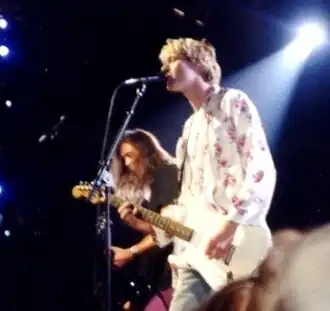
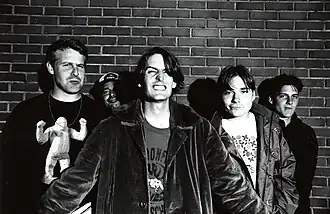
Image 36Pearl Jam is an American rock band formed in 1990 in Seattle, Washington. (from 1990s in music)
Image 61Rwandan genocide: Bones of genocide victims in Murambi Technical School. Estimates put the death toll of the Rwandan genocide as high as 800,000 people. (from 1990s)
Image 64The logo created by The President's Council on the Year 2000 Conversion, for use on Y2K.gov (from 1990s)
Image 65The catsuit became a trend in the late 1990s. Normally made of latex, PVC, or spandex, it was often worn with high-heeled boots. (from 1990s in fashion)
Image 66The 1999 İzmit earthquake, which occurred in northwestern Turkey, killed 17,217 and injured 43,959. (from 1990s)
Image 93Church members exhibiting assorted fashion trends. Amman, 1998. (from 1990s in fashion)
Image 94The Nasdaq Composite displaying the dot-com bubble, which ballooned between 1997 and 2000. The bubble peaked on Friday, 10 March 2000. (from 1990s)
Image 99Go-go boots became fashionable again in 1995. They were worn by women of the hip-hop, alternative, and dance subcultures. (from 1990s in fashion)
Image 100Example of 1990s men's and women's fashion, 1994 (from 1990s in fashion)
Image 114The federal building that was bombed in the Oklahoma City bombing two days after the bombing, viewed from across the adjacent parking lot. (from 1990s)
Image 115D'Angelo is considered a key pioneer of the neo-soul movement. (from 1990s in music)
After numerous unsuccessful attempts to develop a Fantasia sequel, The Walt Disney Company revived the idea shortly after Michael Eisner became chief executive officer in 1984. Development paused until the commercial success of the 1991 home video release of Fantasia convinced Eisner that there was enough public interest and funds for a sequel, to which he assigned Disney as executive producer. The music for six of the film's eight segments is performed by the Chicago Symphony Orchestra conducted by James Levine. The film includes The Sorcerer's Apprentice from the 1940 original. Each new segment was produced by combining traditional animation with computer-generated imagery. Fantasia 2000 is part of the Disney Renaissance, and also commemorates Walt Disney's third animated feature film. (Full article...)
Burton conceived Edward Scissorhands from his childhood upbringing in suburban Burbank, California. During pre-production of Beetlejuice, Thompson was hired to adapt Burton's story into a screenplay, and the film began development at 20th Century Fox after Warner Bros. declined. Edward Scissorhands was then fast-tracked after Burton's critical and financial success with Batman. The film also marks the fourth collaboration between Burton and film score composer Danny Elfman, and was Vincent Price's last film role to be released in his lifetime. (Full article...)
An international co-production between the United States and Mexico, Deep Blue Sea represented a test for Harlin, who had not made a commercially successful film since Cliffhanger (1993). The film was primarily shot at Fox Baja Studios in Rosarito, where the production team constructed sets above the large water tanks that had been built for James Cameron's Titanic (1997). Although the film features some shots of real sharks, most of the sharks used in the film were either animatronic or computer-generated. Trevor Rabin composed the score, while co-star LL Cool J contributed the songs "Deepest Bluest (Shark's Fin)" and "Say What" to the soundtrack. (Full article...)
The film was conceived by writers Scott Alexander and Larry Karaszewski. Alexander first proposed it as a documentary, when he was a student at the USC School of Cinematic Arts. Years later, irritated at being thought of solely as writers for family films with their work on Problem Child (1990) and its 1991 sequel, Alexander and Karaszewski struck a deal with Burton and Denise Di Novi to produce Ed Wood. Initially, Michael Lehmann was chosen to direct the project, but due to scheduling conflicts with his work on the film Airheads (1994), he had to vacate the director's position which was taken over by Tim Burton. (Full article...)
Executive producer Roger Corman acquired the rights to Brosnan's novel in 1991 and the project began filming a year later, after Corman learned that another dinosaur film, Jurassic Park, was entering production. Simon reworked most of the plot elements of the novel. Afforded an $850,000 budget, the special effects were completed with models and animatronics largely designed by John Carl Buechler. (Full article...)
Image 8
The Frighteners is a 1996 supernaturalcomedy horror film directed by Peter Jackson and co-written with Fran Walsh. The film stars Michael J. Fox, Trini Alvarado, Peter Dobson, John Astin, Dee Wallace Stone, Jeffrey Combs, R. Lee Ermey and Jake Busey. The Frighteners tells the story of Frank Bannister (Fox), an architect who develops psychic abilities allowing him to see, hear, and communicate with ghosts after his wife's murder. He initially uses his new abilities to befriend ghosts, whom he sends to haunt people so that he can charge them handsome fees for "exorcising" the ghosts. However, the spirit of a mass murderer appears posing as the Grim Reaper, able to attack the living and the dead, prompting Frank to investigate the supernatural presence.
Jackson and Walsh conceived the idea for The Frighteners during the script-writing phase of Heavenly Creatures. Executive producer Robert Zemeckis hired the duo to write the script, with the original intention of Zemeckis directing The Frighteners as a spin-off film of the television series Tales from the Crypt. With Jackson and Walsh's first draft submitted in January 1994, Zemeckis believed the film would be better off directed by Jackson, produced by Zemeckis and funded/distributed by Universal Studios. The visual effects were created by Jackson's Weta Digital, which had only been in existence for three years. This, plus the fact that The Frighteners required more digital effects shots than almost any movie made until that time, resulted in the eighteen-month period for effects work by Weta Digital being largely stressed. (Full article...)
Krissna initially refused to remake Allari Mogudu because he disliked it but agreed after Rajinikanth told him their next film after Annaamalai (1992) should be different to avoid comparisons. The screenplay of Veera was written to be substantially different from the original; it was tailored to Rajinikanth's style and had logic added to the scenario. Arunachalam, who made script changes, received sole screenwriting credit. The film was produced by Arunachalam's wife Meena, photographed by P. S. Prakash and edited by Ganesh–Kumar. (Full article...)
The Chase was conceived as a direct response to Rifkin's 1991 comedy The Dark Backward, which performed extremely poorly at the box office. The film was shot in Houston, Texas and its soundtrack features alternative artists such as Bad Religion, NOFX, and Rollins Band. Although the film received mixed reviews from critics, it was considered a commercial success. Journalists generally criticized its forced script and subpar characters, but praised the film's use of satire to criticize the television news industry. According to Rollins, the film has attracted a cult following. (Full article...)
Production on A Bug's Life began shortly after the release of Toy Story in 1995. The ants in the film were redesigned to be more appealing, and Pixar's animation unit employed technical innovations in computer animation. Randy Newman composed the music for the film. During production, a controversial public feud erupted between Steve Jobs and Lasseter of Pixar and DreamWorks co-founder Jeffrey Katzenberg due to the parallel production of his similar film Antz, which was released the month prior. (Full article...)
Before Crichton's novel was published, four studios put in bids for its film rights. With the backing of Universal Pictures, Spielberg acquired the rights for $1.5 million. Crichton was hired for an additional $500,000 to adapt the novel for the screen. Koepp wrote the final draft, which left out much of the novel's exposition and violence, and featured numerous changes to the characters. Filming took place in California and Hawaii from August to November 1992. Post-production lasted until May 1993, supervised by Spielberg in Poland as he filmed Schindler's List. The dinosaurs were created with groundbreaking computer-generated imagery by Industrial Light & Magic, and with life-sized animatronic dinosaurs built by Stan Winston's team. To showcase the film's sound design, which included a mixture of various animal noises for the dinosaur sounds, Spielberg invested in the creation of DTS, a company specializing in digital surround sound formats. The film was backed by an extensive $65 million marketing campaign, which included licensing deals with over 100 companies. (Full article...)
Image 13
Parasite Eve (Japanese: パラサイト・イヴ, Hepburn: Parasaito Ivu) is a 1997 Japanese science fiction film that was directed by Masayuki Ochiai and is based on the 1995 novel Parasite Eve by Hideaki Sena. Kiyomi (Riona Hazuki), the wife of Toshiaki Nagashima (Hiroshi Mikami), is left brain dead after a traffic accident on the day of their first wedding anniversary. Nagashima attempts to make Kiyomi live again by making a deal with a doctor who wants to harvest Kiyomi's kidneys for transplanting into a young girl in the same hospital. Nagashima agrees on the condition that he can have his wife's liver. While Nagashima experiments with the organ, the doctor finds one night the samples have emerged as a gelatinous form in the form of Toshiaki's dead wife and reveal themselves as an organization of sentient mitochondria that are bent on making a new species that will wipe out humanity.
In 1997, Kadokawa Shoten decided to use the film production side of its business to develop a film version of Parasite Eve, making it its first film in three years. The film was co-produced by Kadokawa and Fuji TV's Motion Picture Division. Ochiai made his debut as a feature film director, having worked in Japanese television on horror series such as Night Head. Parasite Eve was filmed in eight weeks with a budget of ¥550 million. Ochiai was not entirely pleased with the result of the film, feeling he was pressured to push the love story element of the story, later saying there were "so many compromises I had to make that it couldn't be a true horror movie". The film was released in Japan on February 1, 1997, with limited release outside the country. It received mixed reviews; The Daily Yomiuri found the film "mildly enjoyable at times" and Fangoria called it "flawed but fascinating". (Full article...)
Disney initially envisioned Toy Story 2 as a direct-to-video sequel. The film began production in a building separated from Pixar, on a small scale, as most of the main Pixar staff were busy working on A Bug's Life (1998). When story reels proved promising, Disney upgraded the film to a theatrical release, but Pixar was unhappy with the film's quality. Lasseter and the story team redeveloped the entire plot in one weekend. Although most Pixar features take years to develop, the established release date could not be moved and the production schedule for Toy Story 2 was compressed into nine months. (Full article...)
Following the success of the 1988 short film Tin Toy, Pixar was approached by Disney to produce a computer-animated feature film that was told from a small toy's perspective. Lasseter, Stanton, and Docter wrote early story treatments, which were rejected by Disney, who wanted the film's tone to be "edgier". After several disastrous story reels, production was halted and the script was rewritten to better reflect the tone and theme Pixar desired: "toys deeply want children to play with them, and ... this desire drives their hopes, fears, and actions". The studio, then consisting of a relatively small number of employees, produced Toy Story under minor financial constraints. (Full article...)
You are invited to participate in WikiProject Years, a WikiProject dedicated to developing and improving articles about years, decades, centuries, and millennia.
Associated Wikimedia
The following Wikimedia Foundation sister projects provide more on this subject:


.svg.png)
.svg.png)



.svg.png)

.jpg)


.jpg)


.png)


.JPG)


.JPG)


.jpg)

.jpg)




.jpg)


.jpg)


.jpg)




%252C_woman's_costume%252C_1990s_-_Bunka_Gakuen_Costume_Museum_-_DSC05303.JPG)


.jpg)
.jpg)


.jpg)


_(cropped).jpg)


.jpg)


.jpg)


.jpg)
_12.jpg)


.jpg)


.jpg)


.jpg)




 Commons
 Wikibooks
 Wikidata
 Wikinews
 Wikiquote
 Wikisource
 Wikiversity
 Wiktionary
 List of all portals





 Random portal
 WikiProject Portals