Venetian glass (Italian: vetro veneziano) is glassware made in Venice, typically on the island of Murano near the city. Traditionally it is made with a soda–lime "metal" and is typically elaborately decorated, with various "hot" glass-forming techniques, as well as gilding, enamel, or engraving. Production has been concentrated on the Venetian island of Murano since the 13th century. Today Murano is known for its art glass, but it has a long history of innovations in glassmaking in addition to its artistic fame—and was Europe's major center for luxury glass from the High Middle Ages to the Italian Renaissance. During the 15th century, Murano glassmakers created cristallo—which was almost transparent and considered the finest glass in the world. Murano glassmakers also developed a white-colored glass (milk glass called lattimo) that looked like porcelain. They later became Europe's finest makers of mirrors.
During the Early Middle Ages, Venice was originally controlled by the Eastern Roman Empire before eventually becoming an independent city state. It flourished as a trading center and seaport in the High Middle Ages. Its connections with the Middle East helped its glassmakers gain additional skills, as glassmaking was more advanced in areas such as Syria and Egypt. Although Venetian glassmaking in factories existed as far back as the eighth century, it became concentrated in Murano by law beginning in 1291, in part because glass factories often caught fire, and moving all of them to one island removed much of the possibility of a major fire disaster for the rest of the city. Another reason for moving the glassmakers to Murano was that Venetian glassmakers developed secret recipes and methods for making glass, and the concentration of Venice's glassmaking on the island of Murano enabled better control of those secrets. (Full article...)
...that Umarell[uma'rɛːlː], is an Italianslang term for sidewalk superintendent, popular in Bologna and increasingly used in other part of the country?
Selected fare or cuisine -
Homemade minestrone
Minestrone (/ˌmɪnɪˈstroʊni/MIN-ist-ROH-nee, Italian:[mineˈstroːne]) or minestrone di verdure is a thick vegetable soup of Italian origin. It typically includes onions, carrots, celery, potatoes, cabbage, tomatoes, often legumes, such as beans, chickpeas or fava beans, and sometimes pasta or rice, and is characterized by the mixture of different vegetables and not very fine pieces (otherwise it is called passato di verdure). Minestrone is traditionally made without meat, but it has no precise recipe and can be made with many different ingredients. (Full article...)
Image 10Espresso is a coffee brewed by forcing a small amount of nearly boiling water under pressure through finely ground coffee beans. The term espresso comes from the Italian esprimere, which means 'to express', and refers to the process by which hot water is forced under pressure through ground coffee. (from Culture of Italy)
Image 41The Roman Empire provided an inspiration for the medieval European. Although the Holy Roman Empire rarely acquired a serious geopolitical reality, it possessed great symbolic significance. (from Culture of Italy)
Image 68Alessandro Manzoni is famous for the novel The Betrothed (1827), generally ranked among the masterpieces of world literature. He contributed to the nationwide use of the Italian language. (from Culture of Italy)
^Venetian is either grouped with the rest of the Italo-Dalmatian or the Gallo-Italic languages, depending on the linguist, but the major consensus among linguists is that in the dialectal landscape of northern Italy, Veneto dialects are clearly distinguished from Gallo-Italic dialects.


 The Forma Urbis Romae is a massive marble map of ancient Rome, created under the emperor Septimius Severus between 203 and 211.
 Interior of the Santa Maria della Vittoria in Rome
 View of Piazzetta San Marco toward Grand Canal of Venice, at dawn, with Doges' Palace on the left and Biblioteca Marciana on the right.
 A section of the Sistine Chapel ceiling, painted by Michelangelo
 Porta Soprana is the best-known gate of the ancient walls of Genoa.
.jpg) Dome of Florence Cathedral
Dome of Florence Cathedral Sellajoch, South Tyrol and Trentino (seen from Pordoi Pass), Langkofel on the left, Piz Ciavazes on the right
.jpg)
 South face of the Tofana di Rozes in the Parco naturale regionale delle Dolomiti d'Ampezzo
.jpg)

 The Arch of Constantine in Rome (from Culture of Italy)
 The ingredients of traditional pizza Margherita—tomatoes (red), mozzarella (white), and basil (green)—are held by popular legend to be inspired by the colours of the national flag of Italy. (from Culture of Italy)
 Gelato is Italian ice cream. (from Culture of Italy)
 Antonio Vivaldi, in 1723. His best-known work is a series of violin concertos known as The Four Seasons. (from Culture of Italy)
 Rai Radio 1 (from Culture of Italy)
 The historic seat of the Corriere della Sera in via Solferino in Milan (from Culture of Italy)
 Dario Fo, one of the most widely performed playwrights in modern theatre, received international acclaim for his highly improvisational style. He was awarded the Nobel Prize for Literature in 1997. (from Culture of Italy)

 Espresso is a coffee brewed by forcing a small amount of nearly boiling water under pressure through finely ground coffee beans. The term espresso comes from the Italian esprimere, which means 'to express', and refers to the process by which hot water is forced under pressure through ground coffee. (from Culture of Italy)
 Linguistic map of the Italian language throughout the worldOfficial languageSecondary, widely spoken or understoodUnderstood by some due to former colonisation(from Culture of Italy)
 Scrovegni Chapel. The chapel contains a fresco cycle by Giotto, completed about 1305 and considered to be an important masterpiece of Western art. (from Culture of Italy)
.jpg)
.jpg) Italian folk dance in Molise (from Culture of Italy)
Italian folk dance in Molise (from Culture of Italy)
.jpg) The Uffizi in Florence (from Culture of Italy)
The Uffizi in Florence (from Culture of Italy) Commedia dell'arte troupe I Gelosi performing, by Hieronymus Francken I, c. 1590 (from Culture of Italy)
 Established in 1224 by Frederick II, Holy Roman Emperor, University of Naples Federico II, in Italy, is the world's oldest state-funded university in continuous operation. (from Culture of Italy)
.jpg) The Altare della Patria in Rome, a national symbol of Italy celebrating the first king of the unified country, and resting place of the Italian Unknown Soldier since the end of World War I. It was inaugurated in 1911, on the occasion of the 50th Anniversary of the Unification of Italy. (from Culture of Italy)
The Altare della Patria in Rome, a national symbol of Italy celebrating the first king of the unified country, and resting place of the Italian Unknown Soldier since the end of World War I. It was inaugurated in 1911, on the occasion of the 50th Anniversary of the Unification of Italy. (from Culture of Italy) St. Peter's Basilica, a representation of Renaissance and Baroque architecture (from Culture of Italy)
 Pietà, by Michelangelo, is a key work of Italian Renaissance sculpture. (from Culture of Italy)
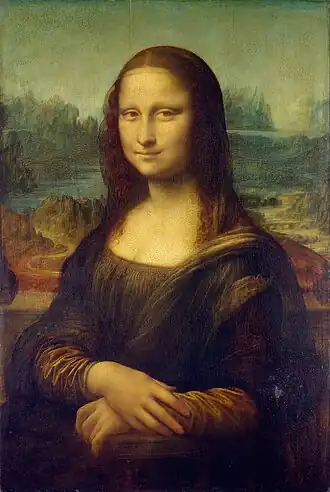 Leonardo da Vinci's Mona Lisa is an Italian art masterpiece worldwide famous. (from Culture of Italy)
 Teatro di San Carlo, Naples. It is the oldest continuously active venue for opera in the world. (from Culture of Italy)
.jpg)
_(4979198162).jpg) The Venice Film Festival is the oldest film festival in the world. (from Culture of Italy)
The Venice Film Festival is the oldest film festival in the world. (from Culture of Italy) Entrance to Cinecittà in Rome, the largest film studio in Europe (from Culture of Italy)
 Dante Alighieri, whose works helped establish modern Italian language, is considered one of the greatest poets of the Middle Ages. His epic poem Divine Comedy ranks among the finest works of world literature. (from Culture of Italy)
.jpg)
 The Jefferson Memorial in Washington, D.C. reflects the president's admiration for classical Roman aesthetics. (from Culture of Italy)
 John Florio is recognised as the most important Renaissance humanist in England. (from Culture of Italy)
 Clockwise from top left: Thomas Aquinas, proponent of natural theology and the Father of Thomism; Giordano Bruno, one of the major scientific figures of the Western world; Cesare Beccaria, considered the Father of criminal justice and modern criminal law; and Maria Montessori, credited with the creation of the Montessori education (from Culture of Italy)
 The statue of Italia turrita in Naples. Italia turrita is the national personification of Italy. (from Culture of Italy)
 David, by Michelangelo (Accademia di Belle Arti, Florence, Italy), is a masterpiece of Renaissance and world art. (from Culture of Italy)
.jpg)
.svg.png) The Roman Empire provided an inspiration for the medieval European. Although the Holy Roman Empire rarely acquired a serious geopolitical reality, it possessed great symbolic significance. (from Culture of Italy)
The Roman Empire provided an inspiration for the medieval European. Although the Holy Roman Empire rarely acquired a serious geopolitical reality, it possessed great symbolic significance. (from Culture of Italy) Valle dei Templi (from Culture of Italy)
 Cover of Corriere dei Piccoli, 11 July 1911, with a strip in the Italian style (no speech bubbles). (from Culture of Italy)
 Leonardo da Vinci, a polymath of the High Renaissance who was active as a painter, draughtsman, engineer, scientist, theorist, sculptor, and architect (from Culture of Italy)
 Roman mosaic of Virgil, the most important Latin poet of the Augustan period (from Culture of Italy)
 The Sagra dell'uva in Marino, Lazio, celebrating grapes (from Culture of Italy)
 Palazzo della Carovana, the current seat of the Scuola Normale Superiore di Pisa (from Culture of Italy)
_20.JPG)
 The Antica trattoria Bagutto in Milan, the oldest restaurant in Italy and the second in Europe. (from Culture of Italy)
 Folkloristic reconstruction of the Company of Death led by Alberto da Giussano who is preparing to carry out the charge during the battle of Legnano at the Palio di Legnano 2014 (from Culture of Italy)
 The Last Supper by Leonardo da Vinci, possibly one of the most famous and iconic examples of Italian art (from Culture of Italy)
 Federico Fellini, considered one of the most influential and widely revered filmmakers in the history of cinema (from Culture of Italy)
 Regional seat of RAI in Cosenza (from Culture of Italy)
.jpg)

_(5904657870).jpg) Palazzo della Civiltà Italiana, an example of modern architecture (from Culture of Italy)
Palazzo della Civiltà Italiana, an example of modern architecture (from Culture of Italy)
 Florence Cathedral, which has the biggest brick dome in the world (from Culture of Italy)
 The Creation of Adam is one of the scenes on the ceiling of the Sistine Chapel of the Vatican, painted by Michelangelo sometime between 1508 and 1512. (from Culture of Italy)
.jpg) Giorgio Moroder, pioneer of Italo disco and electronic dance music, is known as the "Father of disco". (from Culture of Italy)
Giorgio Moroder, pioneer of Italo disco and electronic dance music, is known as the "Father of disco". (from Culture of Italy) Palio di Siena (from Culture of Italy)
.jpg) The president of Italy Sergio Mattarella during his entry into the Sala del Tricolore on the occasion of the Tricolour Day on 7 January 2017 (from Culture of Italy)
The president of Italy Sergio Mattarella during his entry into the Sala del Tricolore on the occasion of the Tricolour Day on 7 January 2017 (from Culture of Italy)_by_William_Hogarth.jpg)
 A wooden puppet depicting the Befana (from Culture of Italy)
 Alessandro Manzoni is famous for the novel The Betrothed (1827), generally ranked among the masterpieces of world literature. He contributed to the nationwide use of the Italian language. (from Culture of Italy)
.jpg)
 The Frecce Tricolori, with the smoke trail representing the national colours of Italy, above the Victor Emmanuel II Monument in Rome during the celebrations of the Festa della Repubblica on 2 June 2022 (from Culture of Italy)
 Anti-fascist demonstration at Porta San Paolo in Rome on the occasion of the Liberation Day on 25 April 2013 (from Culture of Italy)
.jpg)

 Bologna University, established in AD 1088, is the world's oldest university in continuous operation. (from Culture of Italy)
 Holographic copy of 1847 of "Il Canto degli Italiani", the Italian national anthem since 1946 (from Culture of Italy)
 Romulus and Remus, the Lupercal, Father Tiber, and the Palatine on a relief from a pedestal dating to the reign of Trajan (AD 98–117) (from Culture of Italy)
 Pinocchio Disney film is based on The Adventures of Pinocchio by Carlo Collodi. (from Culture of Italy)
 Luciano Pavarotti, considered one of the finest tenors of the 20th century and the "King of the High Cs" (from Culture of Italy)
 The Azzurri in 2012. Football is the most popular sport in Italy. (from Culture of Italy)
 Andrea Palladio is often described as the most influential architect in the Western world. (from Culture of Italy)


 Commons
 Wikibooks
 Wikidata
 Wikinews
 Wikiquote
 Wikisource
 Wikispecies
 Wikiversity
 Wikivoyage
 Wiktionary
 List of all portals





 Random portal
 WikiProject Portals