Michigan consists of two peninsulas: the heavily forested Upper Peninsula (commonly called "the U.P."), which juts eastward from northern Wisconsin, and the more populated Lower Peninsula, stretching north from Ohio and Indiana. The peninsulas are separated by the Straits of Mackinac, which connects Lake Michigan and Lake Huron, and are linked by the 5-mile-long Mackinac Bridge along Interstate 75. Bordering four of the five Great Lakes and Lake St. Clair, Michigan has the longest freshwater coastline of any U.S. political subdivision, measuring 3,288 miles. The state ranks second behind Alaska in water coverage by square miles and first in percentage, with approximately 42%, and it also contains 64,980 inland lakes and ponds.
The Great Lakes region has largely been inhabited for thousands of years by Indigenous peoples such as the Ojibwe, Odawa, Potawatomi, and Wyandot.
Some people contend that the region's name is derived from the Ojibwe word ᒥᓯᑲᒥ (mishigami), meaning "large water" or "large lake". Others say that it comes from the Mishiiken Tribe of Mackinac Island, also called Michinemackinawgo by Ottawa historian Andrew Blackbird, whose surrounding lands were referred to as Mishiiken-imakinakom, later shortened to Michilimackinac.
In the 17th century, French explorers claimed the area for New France. French settlers and Métis established forts and settlements.
After France's defeat in the French and Indian War in 1762, the area came under British control and later the U.S. following the Treaty of Paris (1783), though control remained disputed with Indigenous tribes until treaties between 1795 and 1842. The area was part of the larger Northwest Territory; the Michigan Territory was organized in 1805. (Full article...)
The Supremes were an American girl group formed in Detroit, Michigan, in 1959 as the Primettes. The premier act of Motown Records during the 1960s, the Supremes were the most commercially successful of Motown's acts and the most successful American vocal group, with twelve number 1 singles on the Billboard Hot 100. Most of these hits were written and produced by Motown's main songwriting and production team, Holland–Dozier–Holland. The breakthrough by the Supremes is considered to have made it possible for future African-American R&B and soul musicians to find mainstream success. Billboard ranked the Supremes as the 16th greatest Hot 100 artist of all time.
The Iron Mountain Central Historic District is a historic district, broadly located between Fleshiem and C Streets and between Iron Mountain and Stockbridge Avenues in Iron Mountain, Michigan. The district covers the city's central business district and adjacent areas. It is primarily commercial, but also contains the historic county courthouse complex, and school, library, and church buildings. It was listed on the National Register of Historic Places in 2013. (Full article...)
Image 4Detroit in the mid-twentieth century. At the time, the city was the fourth-largest U.S. metropolis by population, and held about one-third of the state's population. (from Michigan)
Image 14The Detroit–Windsor area is North America's largest cross-border conurbation, with a combined population of approximately six million people (from Michigan)
Image 24Treaty of Paris, by Benjamin West (1783), an unfinished painting of the American diplomatic negotiators of the Treaty of Paris which brought official conclusion to the Revolutionary War and gave possession of Michigan and other territory to the new United States (from Michigan)
Image 28Union members occupying a General Motors body factory during the Flint Sit-Down Strike of 1937 which spurred the organization of militant CIO unions in auto industry (from History of Michigan)
Image 29A map of Michigan by Henry Schenck Tanner, published in 1842, showing such county names as "Negwegon County," "Okkuddo County," and "Unwattin County," prior to an 1843 legislative action renaming sixteen counties in northern Michigan (from History of Michigan)



.jpg)

.jpg)

.png)

.jpg)


.jpg)


.jpg)
.jpg)


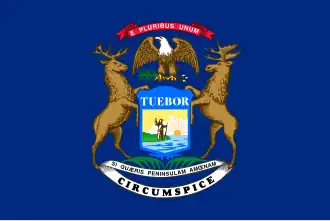
 The Seal of Michigan
 State Quarter – Released in 2004
 Michigan Highways portal
 WikiProject United States
.svg.png) United States Portal
United States Portal Commons
 Wikibooks
 Wikidata
 Wikinews
 Wikiquote
 Wikisource
 Wikiversity
 Wikivoyage
 Wiktionary
 List of all portals





 Random portal
 WikiProject Portals