Portal:Sweden

Welcome to the Sweden Portal! | ||||||||||||
|

|
.svg.png)
| |
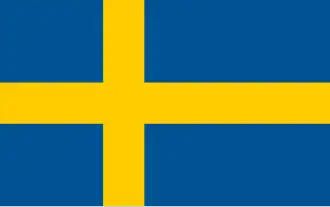
Sweden, formally the Kingdom of Sweden, is a Nordic country located on the Scandinavian Peninsula in Northern Europe. It borders Norway to the west and north, and Finland to the east. At 450,295 square kilometres (173,860 sq mi), Sweden is the largest Nordic country by both area and population, and is the fifth-largest country in Europe. Its capital and largest city is Stockholm. Sweden has a population of 10.6 million, and a low population density of 25.5 inhabitants per square kilometre (66/sq mi); 88% of Swedes reside in urban areas. They are mostly in the central and southern half of the country. Sweden's urban areas together cover 1.5% of its land area. Sweden has a diverse climate owing to the length of the country, which ranges from 55°N to 69°N.
Sweden has been inhabited since prehistoric times around 12,000 BC. The inhabitants emerged as the Geats (Swedish: Götar) and Swedes (Svear), who formed part of the sea-faring peoples known as the Norsemen. A unified Swedish state was established during the late 10th century. In 1397, Sweden joined Norway and Denmark to form the Scandinavian Kalmar Union, which Sweden left in 1523. When Sweden became involved in the Thirty Years' War on the Protestant side, an expansion of its territories began, forming the Swedish Empire, which remained one of the great powers of Europe until the early 18th century. During this era Sweden controlled much of the Baltic Sea. Most of the conquered territories outside the Scandinavian Peninsula were lost during the 18th and 19th centuries. The eastern half of Sweden, present-day Finland, was lost to Imperial Russia in 1809. The last war in which Sweden was directly involved was in 1814, when Sweden by military means forced Norway into a personal union, a union which lasted until 1905.
Sweden is a highly developed country ranked fifth in the Human Development Index. It is a constitutional monarchy and a parliamentary democracy, with legislative power vested in the 349-member unicameral Riksdag. It is a unitary state, divided into 21 counties and 290 municipalities. Sweden maintains a Nordic social welfare system that provides universal health care and tertiary education for its citizens. It has the world's 14th highest GDP per capita and ranks very highly in quality of life, health, education, protection of civil liberties, economic competitiveness, income equality, gender equality and prosperity. Sweden joined the European Union on 1 January 1995 and NATO on 7 March 2024. It is also a member of the United Nations, the Schengen Area, the Council of Europe, the Nordic Council, the World Trade Organization and the Organisation for Economic Co-operation and Development (OECD). (Full article...)
 Good article -

Carl Michael Bellman (Swedish pronunciation: [ˈkɑːɭ ˈmîːkaɛl ˈbɛ̌lːman] ⓘ; 4 February 1740 – 11 February 1795) was a Swedish songwriter, composer, musician, poet, and entertainer. He is a central figure in the Swedish song tradition and remains a powerful influence in Swedish music, as well as in Scandinavian literature, to this day. He has been compared to Shakespeare, Beethoven, Mozart, and Hogarth, but his gift, using elegantly rococo classical references in comic contrast to sordid drinking and prostitution—at once regretted and celebrated in song—is unique.
Bellman is best known for two collections of poems set to music, Fredman's epistles (Fredmans epistlar) and Fredman's songs (Fredmans sånger). Each consists of about 70 songs. The general theme is drinking, but the songs "most ingeniously" combine words and music to express feelings and moods ranging from humorous to elegiac, romantic to satirical. (Full article...)
Selected article -

Örebro (/ˌɜːrəˈbruː/ UR-ə-BROO; Swedish: [œrɛˈbruː] ⓘ) is the seventh-largest city in Sweden, the seat of Örebro Municipality, and capital of Örebro County. It is situated by the Närke Plain, near the lake Hjälmaren, a few kilometers inland along the small river Svartån, and has a population of approximately 126,000 in the city proper. It is one of the largest inland hubs of the country, and a major logistic and commercial operating site.
Örebro is home to Örebro University, a major university hospital, a medieval castle, the water park Gustavsvik as well as several large shopping malls and the Oset and Rynningeviken Nature Reserve adjacent to lake Hjälmaren. (Full article...)
Did you know -

- ... that Lapland school founder Maria Magdalena Mathsdotter turned to Erik Viktor Almquist to improve the rights of the Sami people?
- ... that the first public Swedish orienteering competition, held in 1901, had two churches, Spånga and Bromma kyrka (pictured) as control points?
- ... that the 19th-century Klabböle hydroelectric power plant in northern Sweden is now a museum?
General images -
-
 Swedish tribes in Northern Europe in 814 (from History of Sweden)
 -
 This family crypt and the chapel above it house, in highly ornate coffins, the remains of all four of the Wittelsbach Dynasty monarchs of Sweden whose high-powered period (1654–1720) has been called the Caroline Era for Kings Carl X Gustav, Carl XI and Carl XII. (from History of Sweden)
 -
 The Swedish Empire, 1560–1815 (from History of Sweden)
 -
 Two golden 20 kr coins from the Scandinavian Monetary Union, which was based on a gold standard. The coin to the left is Swedish and the right one is Danish. (from History of Sweden)
 -
 An image made by Gustavus Vasa during his reign showing him (in dark brown clothing and cap) capturing and subduing Catholicism (the woman in orange) (from History of Sweden)
 -
 Gustav Vasa (Gustav I) in 1542 (from History of Sweden)
 -
 The Royal Swedish Opera in Stockholm (Autochrome Lumière 1934) (from History of Sweden)
 -

-

-
 Main line railways built 1860–1930 (from History of Sweden)
 -
 The Swedish Crown Prince Charles John (Bernadotte), who staunchly opposed Norwegian independence, only to offer generous terms of union. (from History of Sweden)
 -

-
 Viking expeditions (blue): depicting the immense breadth of their voyages throughout most of Europe, the North Atlantic and the Mediterranean (from History of Sweden)
 -
.jpg) Self-portrait by Anders Zorn in 1915 (from Culture of Sweden)
Self-portrait by Anders Zorn in 1915 (from Culture of Sweden) -
 Historical provinces of Sweden (from Culture of Sweden)
 -

-
 Coastal defence ship of the Swedish Navy HM Pansarskepp Gustaf V (Agfacolor photo until 1957) (from History of Sweden)
 -
 Homann's map of the Scandinavian Peninsula and Fennoscandia with their surrounding territories: northern Germany, northern Poland, the Baltic region, Livonia, Belarus, and parts of Northwest Russia. Johann Baptist Homann (1664–1724) was a German geographer and cartographer; map dated around 1730. (from History of Sweden)
 -
 Traditional Swedish folk costumes according to Nordisk Familjebok (from Culture of Sweden)
 -
.svg.png) Map of Sweden-Norway (from History of Sweden)
Map of Sweden-Norway (from History of Sweden)
 Featured article -

Martin Rundkvist (born 4 April 1972) is a Swedish archaeologist and associate professor at the University of Łódź in Poland. His research focuses on the Bronze, Iron, and Middle Ages of Scandinavia, including significant excavations in the province of Östergötland.
Rundkvist has studied and excavated various sites in Sweden, particularly in the country's south. In 2003 and 2004, he published a three-volume work which doubled as his PhD dissertation, cataloguing the finds from Barshalder, the largest prehistoric cemetery on the Swedish island of Gotland. A subsequent book identified nine possible regional power centres in Östergötland, and attempted to determine where the "Beowulfian mead halls" of the day once stood. Excavating years later at one of these sites, Aska, Rundkvist uncovered the foundations of a large mead hall, and 30 ornate gold figures that might have represented gods or royals. In other works, Rundkvist has excavated a Viking boat grave, and analysed both the placement of deposited artefacts in the landscape and the lifestyles of the Scandinavian élite during the Middle Ages. (Full article...)
Featured picture -
-
 A small greenhouse with grapevines (Vitis vinifera) escaping from the roof hatch, In Gåseberg, Lysekil Municipality, Sweden
 -
 Mount Helagsfjället (left) and Sylan mountain range, seen from Torkilstöten, Ljungdalen
 -
 Allehandaborgen is a historic office building in Örebro, Sweden that was built 1891.
 -
 Katarina Church and cemetery. Södermalm, Stockholm, Sweden
 -

-
 Tjörnbron (the Tjörn bridge) is one of three bridges along Tjörnbroleden that connects the islands of Tjörn and Orust to the mainland.
 -
 Map of Gothenburg, Sweden, published by N. P. Pehrsson in 1888
 -
 A Life Guard in Stockholm
 -
 A view of the Rådhuset metro station in Central Stockholm
Categories

Main topics
Subdivisions: Counties of Sweden • Municipalities of Sweden • Provinces of Sweden
History: 1975 Occupation of the West German embassy • Ådalen shootings • Consolidation of Sweden • Early Swedish history • Enlightened Absolute Monarchy in Sweden • Early Vasa era • Industrialization of Sweden • Post-war Sweden • Prehistoric Sweden • Rise of Sweden as a Great Power • Suiones • Swedish Empire • Sweden after the Great Northern War • Sweden and the Winter War • Sweden during late 19th century • Sweden during World War II • Swedish allotment system • Swedish emigration to the United States • Union between Sweden and Norway
Politics: Alliance for Sweden • Constitution of Sweden • Foreign relations of Sweden • Government of Sweden • Parliament of Sweden • Riksdag • Swedish general election, 2006 • Swedish general election, 2010 • Swedish neutrality • Swedish welfare
Demographics: Education • Ethnic minorities • Languages • Religion • Subdivisions • Cities • People • Healthcare • Immigration
Culture: Cinema of Sweden • Cuisine of Sweden • Music of Sweden • Sports in Sweden • Swedish literature • Tourism in Sweden
Symbols: Flag • Coat of arms • National anthem
Things you can do
 |
Here are some tasks awaiting attention:
|
Wikipedia in Swedish
 |
There is a Swedish version of Wikipedia, the free encyclopedia. |
 |
WikiProjects
|
|
|
|


Featured and good content

Related portals
Northern Europe
Other countries
Associated Wikimedia
-
 List of all portals
 -

-

-

-

-

-

-

-

-

-
 Random portal
 -
 WikiProject Portals