Terminalia canescens
(DC.) Radlk. ex Durand
Australian almond, Winged nut tree
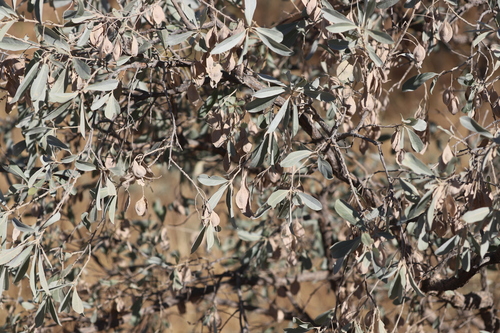
(c) Arthur Chapman, some rights reserved (CC BY-NC-SA), uploaded by Arthur Chapman

(c) teaa981, some rights reserved (CC BY-NC)

(c) teaa981, some rights reserved (CC BY-NC)
What to Eat
Edible parts: Gum
The honey coloured gum is edible and is often warmed before eating. It is highly prized.
Where to Find It
It is a tropical and subtropical plant. It occurs naturally in northern Australia. The tree is sensitive to fire. It grows on hard red, stony or sandy soils. It is often along watercourses.
Australia*,
How to Identify
A shrub or small tree. It often loses many of its leaves during the year. It grows up to 6-10 m tall. The bark is flaky and greyish brown. Branches often hang downwards. The young leaves, fruit and stems can have a silky covering. The leaves are arranged in spirals and are silvery. The leaves are leathery and sword shaped. They are 1-7 cm long by 0.3-3 cm wide. The flowers occur in a spike up to 8 cm long and are cream to green. The fruit is a nut. It is oval and with a distinct wing around the body. The nut can be 0.5-3.5 cm long and 0.3-1.7 cm wide. The wing can be 0.5 cm wide. It can have fine hairs and a bloom which will rub off.
Nutrition Score: 43/100
| Part | Moisture | kJ | kcal | Protein | Vit A | Vit C | Iron | Zinc |
|---|---|---|---|---|---|---|---|---|
| Gum | 12.4 | 1391 | 333 | 2.5 | — | 4 | — | — |
Medicinal Uses
The leaves, bark and stems of this plant are used in Australian native tea known as "Jilungin tea". This tea is promoted as aiding relaxation and sleep. The tea is said to have a mild, earthy flavour and aroma, similar to green tea or grass. This tea is used by the Indigenous Nyul Nyul people of the Kimberley in Western Australia to promote deep sleep, and as a digestive tonic to provide energy during the day. A 2017 report by the Centre for Nutrition and Food Sciences, Queensland Alliance for Agriculture and Food, showed antioxidant levels similar to or exceeding those of green tea in a sample of Terminalia canescens prepared as Jilungun Tea.
Wikipedia
Source ↗Terminalia canescens, commonly known as joolal, winged nut tree, or wingnut, and also known by its Aboriginal name djilanydjin in north-western Australia, is a tree of the family Combretaceae native to northern parts of Australia.
Production
The tree flowers January to June and fruits from April to August.
Other Information
The gum is highly prized.
Notes
There are about 200-250 Terminalia species. They are tropical.
Names & Synonyms
Bendee, Djulal, Joolal, Wingnut Tree
References (14)
- Dunlop, C.R., Leach, G.J. & Cowie, I.D., 1995, Flora of the Darwin Region. Vol 2. Northern Territory Botanical Bulletin No 20. p 145
- Hardwick, G., 2001, Economically Useful Plants for Northern Australia: Master Species List. Crusader eBooks.
- Kenneally, K.E., Edinger, D. C., and Willing T., 1996, Broome and Beyond, Plants and People of the Dampier Peninsula, Kimberley, Western Australia. Department of Conservation and Land Management. p 87
- Lazarides, M. & Hince, B., 1993, Handbook of Economic Plants of Australia, CSIRO. p 234
- Milson. J., 2000, Trees and Shrubs of north-west Queensland. DPI p 48
- Petheram, R.J. and Kok, B., 2003, Plants of the Kimberley Region of Western Australia. UWA Press p 527
- Smith, M & Kalotas, A. C., 1985, Bardi Plants: An Annotated List of Plants and Their Use by the Bardi Aborigines of Dampierland, in North-western Australia. Rec. West Aust. Mus. 1985, 12(3): 317-359
- Smith, N. M., 1991, Ethnobotanical Field Notes from the Northern Territory, Australia, J. Adelaide Bot. Gard. 14(1): 1-65
- Smith, Nicholas et al. 1993, Ngarinyman Ethnobotany: Aboriginal Plant Use from the Victoria River Area Northern Australia. Northern Territory Botanical Bulletin No 16. Parks and Wildlife Commission of the Northern Territory. p 45
- Vigilante, T., et al, 2013, Island country: Aboriginal connections, values and knowledge of the Western Kimberley islands in the context of an island biological survey. Records of the Western Australian Museum Supplement 81: 145-182
- Wheeler, J.R.(ed.), 1992, Flora of the Kimberley Region. CALM, Western Australian Herbarium, p 554
- Wightman, Glenn et al. 1991, Alawa Ethnobotany: Aboriginal Plant Use from Minyerri, Northern Australia. Northern Territory Botanical Bulletin No 11. Parks and Wildlife Commission of the Northern Territory. p 25
- Wightman, Glenn et al. 1992. Mudburra Ethnobotany: Aboriginal Plant Use from Kulumindini (Elliott) Northern Australia. Northern Territory Botanical Bulletin No 14. Parks and Wildlife Commission of the Northern Territory. p 32
- Wightman, Glenn et al. 1992, Mangarrayi Ethnobotany: Aboriginal Plant Use from the Elsey Area Northern Australia. Northern Territory Botanical Bulletin No 15. Parks and Wildlife Commission of the Northern Territory. p 44


