Terminalia citrina
(Gaertn.) Roxb. ex Fleming
Citron myrobalan, Haranut
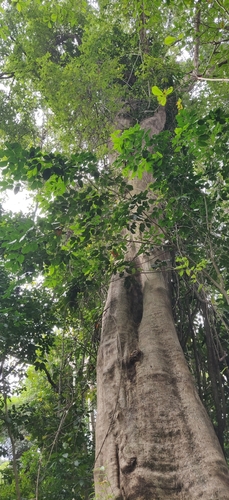
(c) T R Shankar Raman, some rights reserved (CC BY), uploaded by T R Shankar Raman
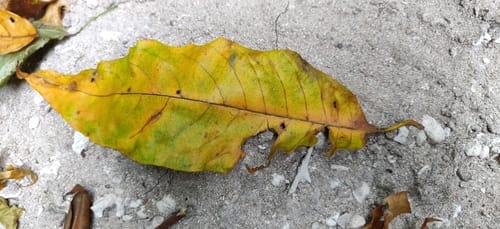
(c) T R Shankar Raman, some rights reserved (CC BY)
What to Eat
Edible parts: Fruit
The oblong fleshy fruit are eaten raw, dried, or chewed.
Where to Find It
A tropical plant. It grows along sea shores up to 200 m above sea level.
Asia, Bangladesh, Himalayas, India, Indochina, Indonesia, Laos, Malaysia, Myanmar, Northeastern India, Pacific, Philippines, SE Asia,
How to Identify
A large tree. It grows 40 m tall. The trunk can be 2.1 m across. It rests on or climbs other trees. It can have buttresses up to 3 m tall. The leaves are almost opposite and sword shaped. They are hairy when young. The flowers are in spikes in the axils of leaves and near the ends of branches. The fruit is oblong and fleshy with 5 ridges.
Nutrition Score: 17/100
| Part | Moisture | kJ | kcal | Protein | Vit A | Vit C | Iron | Zinc |
|---|---|---|---|---|---|---|---|---|
| Fruit | 75.5 | — | — | 0.9 | — | 53.5 | — | — |
How to Grow
The fruits are similar to and often mistaken for the commercial myrobalans (Terminalia chebula).
Medicinal Uses
The fruit contains tannins and is astringent. It is used in the treatment of thrush and obstinate diarrhoea.
Other Uses
Tannin is extracted from the fruits. The bark gives a blue dye. The heartwood is irregular in outline, grayish or brownish with dark purplish brown streaks; it is not clearly demarcated from the 5 - 10cm wide band of sapwood that is yellowish white when fresh, turning to pale grayish brown. The texture is fine and smooth; the grain straight. The wood is hard; heavy; somewhat durable, even the sapwood is not attacked by beetles. It seasons well and works very smoothly. It is used for posts above stumps; beams, joists, rafters; floors; sheathing; ceiling;boats, masts, furniture and cabinetwork. In Indo-China beautiful furniture is said to be made from it.
Other Information
They are sold in local markets.
Notes
There are about 200-250 Terminalia species. They are tropical.
Names & Synonyms
Antoi puteh, Antoi, Belawan, Cheluka, Haritaki, Hatiyal, Hilika, Kayu rajah, Kyasu, Llikand, Manahi, Monalu, Pelawai, Pohon ketapang blabah, Pokok belang rimau, Samaw di ngu, Samaw liem, Samaw muk, Selakhai, Silikha
References (12)
- Ambasta, S.P. (Ed.), 2000, The Useful Plants of India. CSIR India. p 628
- Asiat. Res. 11:183. 1810
- Burkill, I.H., 1966, A Dictionary of the Economic Products of the Malay Peninsula. Ministry of Agriculture and Cooperatives, Kuala Lumpur, Malaysia. Vol 2 (I-Z) p 2179
- Coronel, R.E., 1982, Fruit Collections in the Philippines. IBPGR Newsletter p 10
- Hedrick, U.P., 1919, (Ed.), Sturtevant's edible plants of the world. p 645
- Meitei, L. R., et al, 2022, An ethnobotanical study on the wild edible plants used by forest dwellers in Yangoupokpi Lokchao Wildlife Sanctuary, Manipur, India. Ethnobotany Research and Application 23:15
- Murtem, G. & Chaudhrey, P., 2016, An ethnobotanical note on wild edible plants of Upper Eastern Himalaya, India. Brazilian Journal of Biological Sciences, 2016, v. 3, no. 5, p. 63-81
- Pullaiah, T., et al, Ethnobotany of India, Volume 1: Eastern Ghats and Deccan.
- Patiri, B. & Borah, A., 2007, Wild Edible Plants of Assam. Geethaki Publishers. p 54
- Sarma, H., et al, 2010, Updated Estimates of Wild Edible and Threatened Plants of Assam: A Meta-analysis. International Journal of Botany 6(4): 414-423
- Srivastava, R. C., 2010, Traditional knowledge of Nyishi (Daffla) tribe of Arunachal Pradesh. Indian Journal of Traditional Knowledge. 9(1):26-37
- Sukarya, D. G., (Ed.) 2013, 3,500 Plant Species of the Botanic Gardens of Indonesia. LIPI p 546


