Terminalia cunninghamii
C.A.Gardner
Pindan walnut, Pindan quandong, Kalumburu almond
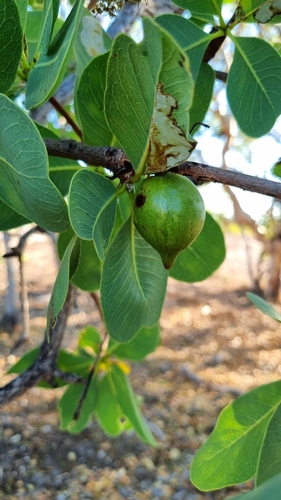
(c) Dr Melissa Staines, some rights reserved (CC BY-NC), uploaded by Dr Melissa Staines

(c) Genevieve Early, some rights reserved (CC BY)

(c) Genevieve Early, some rights reserved (CC BY)
What to Eat
Edible parts: Seeds, Nuts
The seed kernel is eaten raw.
Where to Find It
It is a tropical plant. It occurs in northwest Western Australia in Australia. It is mostly on coastal plains. It is mostly on sandy soils.
Australia*,
How to Identify
A small tree which loses its leaves. It grows up to 6-8 m tall. The bark is light grey to brown and corky with cracks along its length. The small branches are thickened at the nodes where the leaves join. The leaves are light dull green. They are arranged in spirals and crowded together on short thick small branches. The leaf blade is leathery and of one colour. Leaves are sword shaped and blunt at the tip. They taper towards the base. They are 2.5-10 cm long by 1-4.5 cm wide. The flowers are small and white. They are gathered into spikes. The spikes can be 8 cm long. The fruit are large and tinged deep red-brown. They become bluish black when mature. They are oval to round with a distinct short beak. They can be 4 cm long by 3.5 cm wide. They are smooth and juicy. Inside there is a thick walled woody shell with a large kernel inside it. The shell can be 2-3 cm across. The kernel is edible.
Nutrition Score: 42/100
| Part | Moisture | kJ | kcal | Protein | Vit A | Vit C | Iron | Zinc |
|---|---|---|---|---|---|---|---|---|
| Nuts | 9.7 | — | — | 35.2 | — | 3 | 2.4 | 5.3 |
Wikipedia
Source ↗Terminalia cunninghamii, commonly known as pindan quondong, pindan walnut or kalumburu almond, is a tree or shrub of the family Combretaceae native to Western Australia. Some Aboriginal people know the plant as kumpaja. The tree or shrub typically grows to a height of 1.5 to 8 metres (5 to 26 ft) in height and is deciduous. It blooms between January and October producing white-yellow flowers. It will fruit after two or three years, the nut that is produced is edible and when uncooked tastes like almond but when roasted tastes more like cashew nuts. It is found among sandstone outcrops and on dunes in the Kimberley region of Western Australia growing in sandy soils. A project is under way as of 2021 to cultivate the tree alongside orchards of gubinge (Terminalia ferdinandiana, aka Kakadu plum) in the Broome area.
Production
Plants flower and fruit August to October in Australia.
Other Information
The seed is a valued food.
Notes
There are about 200-250 Terminalia species. They are tropical.
References (6)
- Hardwick, G., 2001, Economically Useful Plants for Northern Australia: Master Species List. Crusader eBooks.
- Hiddins, L., 1999, Explore Wild Australia with the Bush Tucker Man. Penguin Books/ABC Books. p 147
- Kenneally, K.E., Edinger, D. C., and Willing T., 1996, Broome and Beyond, Plants and People of the Dampier Peninsula, Kimberley, Western Australia. Department of Conservation and Land Management. p 87
- Paczkowska, G. & Chapman, A.R., 2000, The Western Australian Flora. A Descriptive Catalogue. Western Australian Herbarium. p 215
- Ulian, T., et al, 2020, Unlocking plant resources to support food security and promote sustainable agriculture. Plants, People, Planet. 2020;2:421–445.
- Wheeler, J.R.(ed.), 1992, Flora of the Kimberley Region. CALM, Western Australian Herbarium, p 554


