Terminalia litoralis
Panch. & Guillaumin
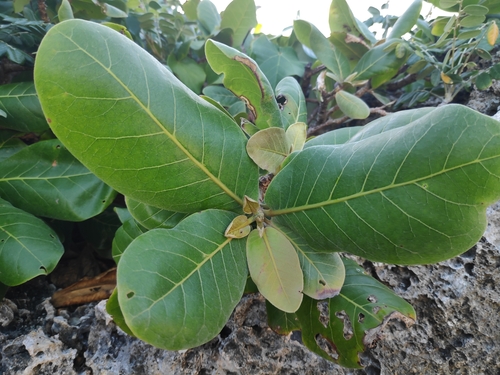
iNaturalist · cc-by-nc
(c) Hyongchan Kim, some rights reserved (CC BY-NC), uploaded by Hyongchan Kim
(c) Hyongchan Kim, some rights reserved (CC BY-NC), uploaded by Hyongchan Kim

iNaturalist · cc-by-nc
(c) rwpurdie, some rights reserved (CC BY-NC)
(c) rwpurdie, some rights reserved (CC BY-NC)

iNaturalist · cc-by-nc
(c) rwpurdie, some rights reserved (CC BY-NC)
(c) rwpurdie, some rights reserved (CC BY-NC)
What to Eat
Edible parts: Kernels, Seeds, Nuts, Fruit
The fleshy fruit is eaten, and the kernel of the nut is consumed, especially by children.
Where to Find It
A tropical plant. It grows near the coast. It can withstand strong winds and spray.
Africa, Caroline Islands, Fiji, Nigeria, Pacific, Rotuma, Samoa, Tonga, West Africa,
Countries: Angola, Australia, Burkina Faso, Burundi, Benin, Botswana, Congo (DRC), Central African Republic, Congo (Republic), Cote d'Ivoire, Cameroon, Cape Verde, Djibouti, Algeria, Egypt, Eritrea, Ethiopia, Fiji, Micronesia, Gabon, Ghana, Gambia, Guinea, Equatorial Guinea, Guinea-Bissau, Kenya, Kiribati, Comoros, Liberia, Lesotho, Libya, Morocco, Madagascar, Marshall Islands, Mali, Mauritania, Mauritius, Malawi, Mozambique, Namibia, Niger, Nigeria, Nauru, New Zealand, Papua New Guinea, Palau, Rwanda, Solomon Islands, Seychelles, Sudan, Sierra Leone, Senegal, Somalia, South Sudan, Sao Tome & Principe, Eswatini, Chad, Togo, Tunisia, Tonga, Tuvalu, Tanzania, Uganda, Vanuatu, Samoa, South Africa, Zambia, Zimbabwe
How to Identify
A tree. It is like coastal almond. It grows 35 m tall. The branches are horizontal. The flowers are white. The fruit are 3.5-5 cm long. They are greenish-yellow and then turn red.
Other Information
The kernels are eaten especially by children.
Notes
There are about 200-250 Terminalia species. They are tropical.
Names & Synonyms
Tavoli-lali, Tog ai, Win
Terminalia moluccana sensu A. GrayTerminalia glabrata sensu A. Gray
References (9)
- Elevitch, C.R.(ed.), 2006, Traditional Trees of the Pacific Islands: Their Culture, Environment and Use. Permanent Agriculture Resources, Holualoa, Hawaii. p 731
- Franklin, J., Keppel, G., & Whistler, W., 2008, The vegetation and flora of Lakeba, Nayau and Aiwa Islands, Central Lau Group, Fiji. Micronesica 40(1/2): 169–225, 2008
- Hedrick, U.P., 1919, (Ed.), Sturtevant's edible plants of the world. p 645
- Menninger, E.A., 1977, Edible Nuts of the World. Horticultural Books. Florida p 62
- Parham, B. E. V., 1972, Plants of Samoa. New Zealand Department of Scientific and Industrial Research. Information Series. No. 85 p 118
- Smith, A.C., 1985, Flora Vitiensis Nova: A New flora of Fiji, Hawai Botanical Gardens, USA Vol 3 p 434
- Walter, A. & Sam C., 2002, Fruits of Oceania. ACIAR Monograph No. 85. Canberra. p 254, 281
- Wickens, G.E., 1995, Edible Nuts. FAO Non-wood forest products. FAO, Rome. p 117
- Yuncker, T.G., 1959, Plants of Tonga, Bernice P. Bishop Museum, Hawaii, Bulletin 220. p 199


