Terminalia macroptera
Guill. & Perr
Kandare
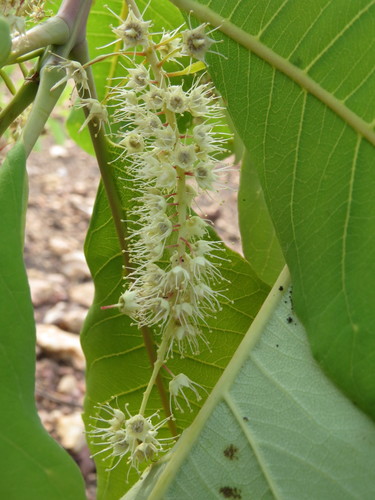
(c) ASSEDE Eméline S.P., some rights reserved (CC BY-NC), uploaded by ASSEDE Eméline S.P.

(c) Luke Smith, some rights reserved (CC BY-NC)

(c) Luke Smith, some rights reserved (CC BY-NC)
What to Eat
Edible parts: Fruit, Vegetable
The fruit and leaves are eaten as vegetables.
Where to Find It
A tropical plant. Kano State Northern Nigeria. It grows in moist situations in the savannah.
Africa, Benin, Burkina Faso, East Africa, Ghana, Guinea, Guinée, Guinea-Bissau, Mali, Nigeria, Sahel, Senegal, Sudan, Togo, Uganda, West Africa,
How to Identify
A shrub or small tree. It grows 8-13 m high. The crown is open and spreading. The leaves are light green.
How to Grow
A plant of drier areas in the tropics, it is found in areas with a mean annual rainfall of 700 - 1,500mm. Found on a range of soils in the wild, it can tolerate seasonal inundation of the soil and compacted soils. The tree has a deeply fissured corky bark that gives it a degree of fire resistance.
Medicinal Uses
In several African countries Terminalia macroptera is used in traditional herbal medicine for infectious diseases, tuberculosis, hepatitis, and dysentery. Extracts of the plant have shown in vitro activity against Helicobacter pylori and Neisseria gonorrhoeae. Parts of the plant are also used to make dye and perfumes.
Other Uses
The aromatic bark is used to make a perfume. The heart-wood is scented and is used in Senegal in a perfume called amulguéné, amu, and suma-diala. The leaves, stem and root bark contains tannin. The root-bark yields a yellow-brownish dye used for dyeing cloth. The leaves provide a deep-black dye used for cloth, and to make ink. The tree is said to contain a gum. The wood is yellowish or light brown. It has a coarse uneven grain, is hard and very durable. It is rarely straight and difficult to work, though it is said to be valued for carpentry, and to have an attractive appearance somewhat resembling teak. It has a reputation for resistance to borers and termites, and is used for house-posts, the frames of boats etc. The thicker branches are hollowed out to use as beehives and storage boxes. The wood is said to produce a very good charcoal. The wood as fuel is said to be avoided by the Mandinka of The Gambia as the fumes are alleged to affect young children, the antidote to which is a decoction made from the same tree’s roots. The tree has been recommended as a desirable species for reforestation, especially where it was formerly abundant.
Wikipedia
Source ↗Terminalia macroptera is a species of flowering plant in the White Mangrove Family (Combretaceae) known by the Hausa common name kwandari. It is native to Africa, where it can be found in Benin, Burkina Faso, Ghana, Senegal, Sudan, Uganda, Niger and Nigeria. Its most notable botanical feature is its very large winged seed or samara up to 13 cm (5.1 in) long by 3.75 cm (1.48 in) width.
Notes
There are about 200-250 Terminalia species. They are tropical. It is used in medicine.
Names & Synonyms
Bero, Betali, Betchali, Beteledje, Bode, Boi, Bolobo, Braqui, Bulofor, Djamba-catam, Fadi, Holo-foro, Karkone, Kwandari, Macete, Macite, N'kone, N'tulam, Teleje, Untulam, Woloba
References (6)
- Bonou, A., et al, 2013, Valeur economique des Produits Forestiers Non Ligneux (PFNL) au Benin. Editions Universitaires Europeennes p 91
- A. Guillemin et al., Fl. Seneg. tent. 1:276, t. 63. 1832
- Grubben, G. J. H. and Denton, O. A. (eds), 2004, Plant Resources of Tropical Africa 2. Vegetables. PROTA, Wageningen, Netherlands. p 565
- Maydell, H. von, 1990, Trees and shrubs of the Sahel: their characteristics and uses. Margraf. p 393
- MORTIMORE,
- World Checklist of Useful Plant Species 2020. Royal Botanic Gardens, Kew


