Terminalia microcarpa
Decne.
The Philippine star tree
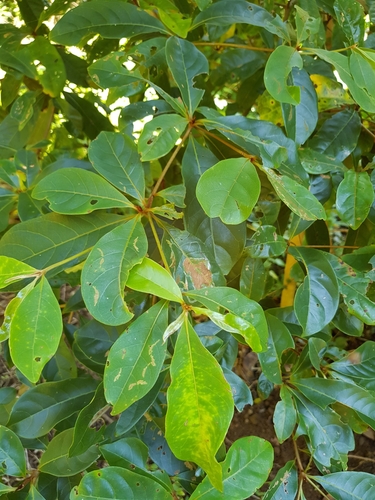
(c) Nick Lambert, some rights reserved (CC BY-NC-SA), uploaded by Nick Lambert

(c) Russell Cumming, some rights reserved (CC BY-NC)

(c) Russell Cumming, some rights reserved (CC BY-NC)
What to Eat
Edible parts: Kernels, Fruit, Nuts
The ripe fruits are eaten raw, made into jam, or boiled and cooked with sugar; they have little flesh but are very sweet. The kernels and nuts are also edible.
Where to Find It
It is a tropical plant. It grows naturally in monsoon vine forests. Very common and widely distributed in the forests throughout the islands of the Philippines. It grows up to 1,350 m above sea level.
Asia, Australia, East Timor, Indonesia, Malaysia, Pacific, Papua New Guinea, PNG, Philippines*, SE Asia, Timor-Leste,
How to Identify
A large tree. It grows 12-30 m high. The trunk can be 1 m across. The branches spread widely. It can have buttresses 4 m tall. It loses its leaves during the year. The leaves are bunched near the ends of the twigs. The leaves are smooth and pointed at both ends. They are 6-15 cm long by 3-5 cm wide. The flowers are yellowish white, on slender flower stalks which grow from the axils of leaves. The fruit are about 3 cm across, smooth, dark red and fleshy.
How to Grow
Plants can be grown by seeds or grafting.
Medicinal Uses
The fruit is used in eyewashes in the same manner as the fruit of aroma (Acacia farnesiana). It is also used in lotions in cases of humid herpetism or eczema.
Other Uses
The tree is a source of tannins.The bark contains 42% tannins. The wood colours water yellow. The heartwood is dark yellow, it is not clearly demarcated from the light yellow sapwood. The texture is medium; the grain as a whole straight, but slightly crossed and often with a short, very regular wave. The wood is moderately heavy; moderately hard; tough; not very durable for outdoor use, but fairly durable indoors. It can be used for cabinet work, furniture, ship planking, internal construction, flooring and turnery. A potentially useful fuel. The tree can be used in mixed shelterbelts.
Wikipedia
Source ↗Terminalia microcarpa is a tree species in the family Combretaceae. It occurs throughout the Philippines, in parts of Malaysia and Indonesia (Java, Sulawesi, Borneo, Timor, and the Maluku Islands), Papua New Guinea, possibly the Bismarck Archipelago, and northern Australia. It is cultivated on a small scale in the Philippines, where the edible sweet and tart plum-like fruits are eaten as is or are traditionally made into jams, jellies, and wines. The species was formally described in 1834 by French botanist Joseph Decaisne. In the Australian Plant Census, Terminalia sericocarpa F.Muell. is regarded as a synonym of this species. Common names in Australia include bandicoot, sovereignwood, damson and damson plum. It is known as kalumpit in the Philippines. The tree typically grows to a height of 12 to 30 metres (39 to 98 ft) in height and is deciduous. It blooms between September and October producing cream flowers. It is found around springs and creeks and in rocky creek beds in the Kimberley region of Western Australia and extending across the top end of the Northern Territory and tropical areas of Queensland growing in sandy-loam-clay soils.
Production
The fruit are generally collected from the ground.
Notes
There are about 200-250 Terminalia species. They are tropical. There are 3 Terminalia microcarpa species with different authorities and unresolved.
Names & Synonyms
Alupi, Alutek, Ambobok, Ambobonat, Ganurru, Kalumpit, Kalupi, Kalusit, Pohon ketapang selumpi, Pohon kunyit-kunyit
References (14)
- Arora, R. K., 2014, Diversity in Underutilized Plant Species - An Asia-Pacific Perspective. Bioversity International. p 90
- Carig, Elizabeth T., 2020, Guidebook on Native Trees within the Quirino Forest Landscape. Plaridel, Bulacan, St. Andrew Publishing House. p 70
- Coode, M.J.E., in Womersley, J.S., (Ed), 1978, Handbooks of the Flora of Papua New Guinea. Melbourne University Press. Vol 1. p 92
- Dunlop, C.R., Leach, G.J. & Cowie, I.D., 1995, Flora of the Darwin Region. Vol 2. Northern Territory Botanical Bulletin No 20. p 148
- Flora Malesiana Vol 13 p 562
- Monsalud, M.R., Tongacan, A.L., Lopez, F.R., & Lagrimas, M.Q., 1966, Edible Wild Plants in Philippine Forests. Philippine Journal of Science. p 452
- Nouv. Ann. Mus. Hist. Nat. 3:457. 1834
- Paczkowska, G. & Chapman, A.R., 2000, The Western Australian Flora. A Descriptive Catalogue. Western Australian Herbarium. p 216
- Polinag, M. A., 2003, Food from the Wilderness. Department of Environment and Natural Resources. Laguna.
- Reis, S. V. and Lipp, F. L., 1982, New Plant Sources for Drugs and Foods from the New York Botanical Garden herbarium. Harvard. p 210
- Sukarya, D. G., (Ed.) 2013, 3,500 Plant Species of the Botanic Gardens of Indonesia. LIPI p 548
- Wickens, G.E., 1995, Edible Nuts. FAO Non-wood forest products. FAO, Rome. p 117
- World Checklist of Useful Plant Species 2020. Royal Botanic Gardens, Kew
- Yunupinu Banjgul, Laklak Yunupinu-Marika, et al. 1995, Rirratjinu Ethnobotany: Aboriginal Plant Use from Yirrkala, Arnhem Land, Australia. Northern Territory Botanical Bulletin No 21. Parks and Wildlife Commission of the Northern Territory. p 74


