Terminalia muelleri
Benth.
Mueller’s damson, Blue Cherry, Australian almond
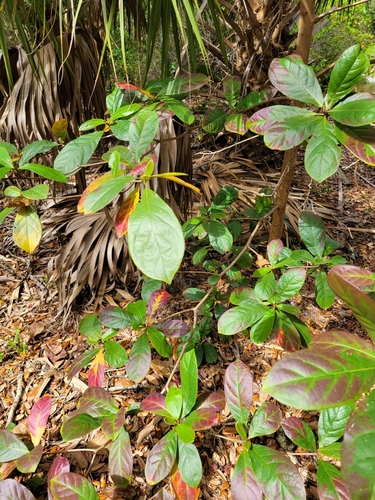
(c) Samantha Elliott, some rights reserved (CC BY-NC)
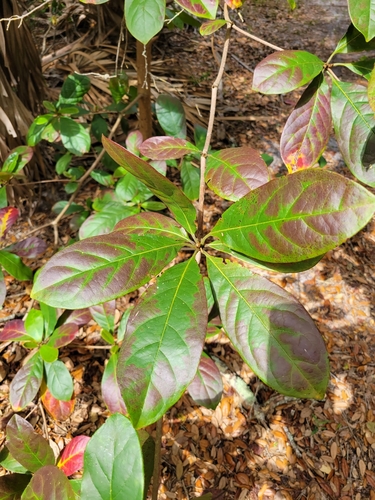
(c) Samantha Elliott, some rights reserved (CC BY-NC)
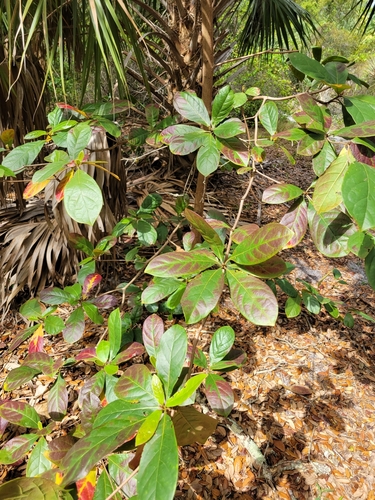
(c) Samantha Elliott, some rights reserved (CC BY-NC)
What to Eat
Edible parts: Fruit
The fruit flesh is edible, though the fruit are known to be bitter.
Where to Find It
A tropical plant. They grow in the lowland rainforest in NE Queensland in Australia. It suits monsoonal climates. They favour sunny places. They grow in areas with high summer rainfall. They can be near sea level behind the sand dunes. It grows from sea level to 100 m above sea level. In the Cairns Botanical Gardens. Mt Cootha Botanical Gardens.
Asia, Australia*, India, North America, USA,
How to Identify
A deciduous tree up to 6-10 m tall. The bark is dark grey and rough. It loses its leaves during the year. The leaves are smooth and broadly oval. They are simple and 5-15 cm long by 4-6 cm wide. They are alternate or clumped together in rings. They are normally near the ends of twigs. There are usually 1 or 2 flat glands at the base of the leaf. The flowers are white and contain both sexes. They occur in loose spikes. The fruit is 12-20 mm long by 8-15 mm wide. They occur in spikes in the axils of leaves. They can hang along stalks. There is one seed inside. The seed is 8-9 mm by 2 mm. The flesh is edible.
How to Grow
Plants can be grown by fresh seeds.
Wikipedia
Source ↗Terminalia muelleri, commonly known as Mueller's damson or the Australian almond, is a deciduous species of tree in the family Combretaceae. It is native to the Cobourg Peninsula of the Northern Territory, and to northern and eastern Queensland, Australia, and it has been introduced to India, Florida, and the Central Americas. It is used as a street tree in a number of cities, including Hong Kong, Singapore, and Cairns, Australia.
Notes
There are about 200-250 Terminalia species. They are tropical. It is regarded as a weed in Florida.
Names & Synonyms
References (17)
- Barwick, M., 2004, Tropical and Subtropical Trees. A Worldwide Encyclopedic Guide. Thames and Hudson p 410
- Beasley, J., 2011, Plants of Tropical North Queensland - the compact guide. Footloose publications. p 24
- Calvert, G., 2010, The Burdekin Delta Tree Guide. Lower Burdekin Landcare Association., Inc., Ayr p 149
- Cooper W & Cooper W T, 1994, Fruits of the Rain Forest. RD Press p 284
- Cooper, W. and Cooper, W., 2004, Fruits of the Australian Tropical Rainforest. Nokomis Editions, Victoria, Australia. p 129
- Fl. austral. 2:500. 1864
- Hardwick, G., 2001, Economically Useful Plants for Northern Australia: Master Species List. Crusader eBooks.
- Holliday, I., 1989, A Field Guide to Australian Trees. Hamlyn. p 304
- Isaacs, J., 1987, Bush Food, Aboriginal Food and Herbal Medicine. Weldons. p 73
- Jackes, B.R., 2001, Plants of the Tropics. Rainforest to Heath. An Identification Guide. James Cook University. p 47
- Krishen P., 2006, Trees of Delhi, A Field Guide. DK Books. p 152
- Scarth-Johnson, V., 2000, National Treasures. Flowering Plants of Cooktown and Northern Australia. Vera Scarth-Johnson Gallery Association. Cooktown, Australia. p 105
- Smith, Nicholas et al. 1993, Ngarinyman Ethnobotany: Aboriginal Plant Use from the Victoria River Area Northern Australia. Northern Territory Botanical Bulletin No 16. Parks and Wildlife Commission of the Northern Territory. p 45
- Townsend, K., 1994, Across the Top. Gardening with Australian Plants in the tropics. Society for Growing Australian Plants, Townsville Branch Inc. p 355
- Wightman, Glenn et al. 1991.Alawa Ethnobotany: Aboriginal Plant Use from Minyerri, Northern Australia. Northern Territory Botanical Bulletin No 11. Parks and Wildlife Commission of the Northern Territory. p 25
- Wightman, Glenn et al. 1992, Mangarrayi Ethnobotany: Aboriginal Plant Use from the Elsey Area Northern Australia. Northern Territory Botanical Bulletin No 15. Parks and Wildlife Commission of the Northern Territory. p 46
- Wightman, Glenn et al. 1994, Gurindji Ethnobotany: Aboriginal Plant Use from Daguragu Northern Australia. Northern Territory Botanical Bulletin No 18. Parks and Wildlife Commission of the Northern Territory. p 52


