Ternstroemia cherryi
(F. M. Bailey) Merr.
Cherry beech
(c) Hakim, some rights reserved (CC BY-NC)

(c) Hakim, some rights reserved (CC BY-NC)

(c) Hakim, some rights reserved (CC BY-NC)
What to Eat
Edible parts: Fruit
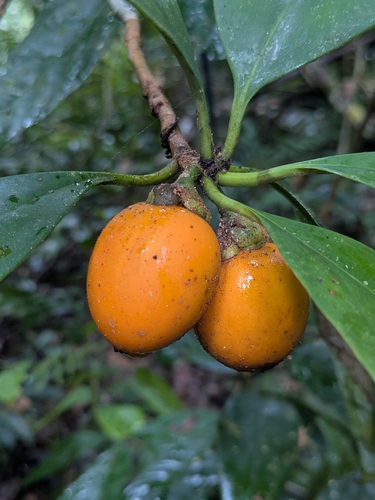
The flesh of ripe fruit is edible.
Known Hazards
Where to Find It
A tropical and subtropical plant. Plants require some protection when young. In Papua New Guinea it grows from sea level to 1200 m altitude.
Australia*, Pacific, Papua New Guinea, PNG,
How to Identify
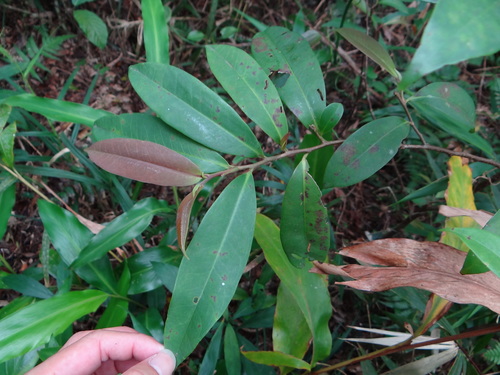
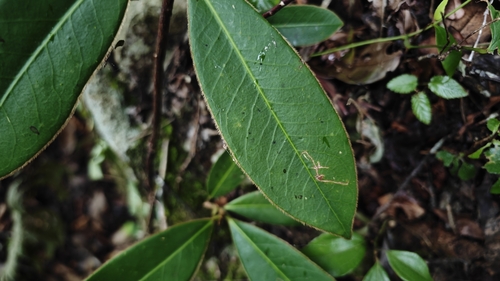
A compact tree. It grows to 8-15 m tall. New shoots are bronze coloured. The leaves are sword shaped and 6-16 cm long by 3-8 cm wide. They are dark green and thick textured. Sometimes the leaves are in ringed layers. Male and female flowers can be on separate trees or the same tree. The flowers are thick, waxy and cream coloured. They are 2 cm across. They are produced in the axils of leaves. The fruit is large and fleshy and orange. It is 3-5 cm long by 2-3 cm across. Fruit are produced singly. Ripe fruit can open in an irregular shape revealing pink-red seeds. There are 4 seeds which are 1.5-2 cm long. The flesh of the fruit is edible.
How to Grow
Plants can be grown from fresh seed.
Production
Plants are slow growing. Flowering and fruiting occurs between August and March (April to October) in Australia.
Notes
There are about 60-85 Ternstroemia in tropical America. There are 2 in Africa. They have also been Ternstroemiaceae.
Names & Synonyms
References (8)
- Cooper W & Cooper W T, 1994, Fruits of the Rain Forest. RD Press p 284 (Picture)
- Cribb, A.B. & J.W., 1976, Wild Food in Australia, Fontana. p 75
- Henty, E.E., 1980, Harmful Plants in Papua New Guinea. Botany Bulletin No 12. Division Botany, Lae, Papua New Guinea. p 129
- Jones D, L, 1986, Ornamental Rainforest Plants in Australia, Reed Books, p 247 (Drawing)
- Morley, B.D., & Toelken, H.R., (Eds), 1983, Flowering Plants in Australia. Rigby. p 89, 90
- Nicholson, N & H., 1996, Australian Rainforest Plants 3, Terania Rainforest Publishing. NSW. p 62
- Radke, P & A, Sankowsky, G & N., 1993, Growing Australian Tropical Plants. Frith & Frith, Australia. p 66
- Townsend, K., 1994, Across the Top. Gardening with Australian Plants in the tropics. Society for Growing Australian Plants, Townsville Branch Inc. p 356