Thalictrum minus
L.
Lesser meado-rue

(c) aa22, some rights reserved (CC BY-NC)
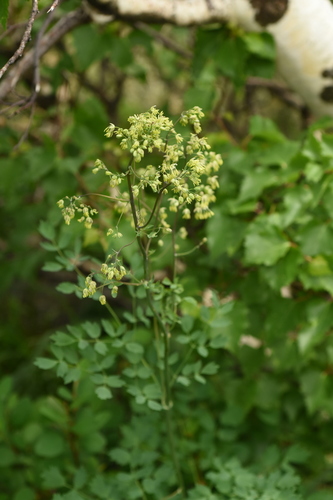
(c) Petr Kosachev, some rights reserved (CC BY-NC), uploaded by Petr Kosachev

(c) Aleš Zvára, some rights reserved (CC BY-NC)
What to Eat
Edible parts: Leaves
Young leaves are edible when cooked. Some caution is advised — see notes on toxicity.
Known Hazards
Where to Find It
It is a temperate plant. It suits hardiness zones 6-9.
Africa, Asia, Australia, Europe, India, Ireland, Korea, Lesotho, Mongolia, Slovenia, South Africa, Southern Africa, Turkey, Türkiye,
How to Identify
An erect herb. It grows 0.9-1.5 m high and spreads 50-80 cm wide. The leaves are finely divided and have leaflets along the stalk. The flowers are yellow but sometimes with a purple tint. They are in panicles.
How to Grow
Succeeds in most fairly good humus rich well-drained soils in sun or semi-shade. Plants can be invasive when grown in light soils but do not spread so much in heavy soils. Members of this genus are rarely if ever troubled by browsing deer. A greedy plant, inhibiting the growth of nearby plants, especially legumes. A highly polymorphic species, difficult to treat taxonomically. Some forms are dwarf and usually make dense clumps in the garden, larger forms are more invasive, especially in light soils, and can be a nuisance.
Propagation: Seed is best sown as soon as it is ripe in autumn in a cold frame. Prick out seedlings into individual pots when large enough to handle and plant out the following summer. Seed can also be sown in an outdoor seedbed in spring, with plants moved to permanent positions the following spring. Divide in spring as new growth begins or in autumn. Larger divisions can go directly to permanent positions; smaller ones are best potted up and grown on in light shade in a greenhouse or cold frame until established, then planted out in summer or the following spring.
Medicinal Uses
An infusion of the leaves or a decoction of the root is used in the treatment of fevers.
Other Uses
Plants can be used as ground cover when spaced approximately 60cm apart in each direction.
Wikipedia
Source ↗Thalictrum minus, known as lesser meadow-rue, is a perennial herb in the family Ranunculaceae that is native to Europe, Northwest Africa, Yemen, Ethiopia, South Africa, Southwest Asia, and Siberia. It grows on sand dunes, shingle, coastal rocks or calcareous grassland, cliffs and rocky gullies at up to 1,600 to 3,000 m (5,200 to 9,800 ft) elevation at southern latitudes. It grows to 30 cm (0.98 ft) tall with erect stems and 1 cm (0.39 in) leaves that are highly subdivided, 3-4 ternate to pinnate. The plant contains an alkaloid 'Thalidasine', which is also present in other Thalictrum species.
Notes
There are about 120 Thalictrum species.
Names & Synonyms
Gaytaran, Lefokotsane, Mali talin, Pigamo minore
References (17)
- Ambasta, S.P. (Ed.), 2000, The Useful Plants of India. CSIR India. p 632
- Bodkin, F., 1991, Encyclopedia Botanica. Cornstalk publishing, p 975
- Cakir, E. A., 2017, Traditional knowledge of wild edible plants of Iğdır Province (East Anatolia, Turkey). Acta Soc Bot Pol. 2017;86(4):3568
- Cundall, P., (ed.), 2004, Gardening Australia: flora: the gardener's bible. ABC Books. p 1408
- Guillarmod, J., 1966, 1971, (As Thalictrum caffrum)
- Grivetti, L. E., 1980, Agricultural development: present and potential role of edible wild plants. Part 2: Sub-Saharan Africa, Report to the Department of State Agency for International Development. p 65
- Hibbert, M., 2002, The Aussie Plant Finder 2002, Florilegium. p 298
- http://www.botanic-gardens-ljubljana.com/en/plants
- Jardin, C., 1970, List of Foods Used In Africa, FAO Nutrition Information Document Series No 2.p 106
- Letsela, T., et al, 2003, Plant Resources Used for Subsistence in Tsehlanyane and Boking in Lesotho. Economic Botany 57(4): 619-639 (As Thalictrum caffrum)
- Martin, F.W. & Ruberte, R.M., 1979, Edible Leaves of the Tropics. Antillian College Press, Mayaguez, Puerto Rico. p 215
- Peters, C. R., O'Brien, E. M., and Drummond, R.B., 1992, Edible Wild plants of Sub-saharan Africa. Kew. p 165 (As Thalictrum caffrum)
- Plants for a Future database, The Field, Penpol, Lostwithiel, Cornwall, PL22 0NG, UK. http://www.scs.leeds.ac.uk/pfaf/
- Ruiters-Welcome, A. K., 2019, Food plants of southern Africa. Ph.D. thesis. Univ. of Johannesburg p 93
- Sp. pl. 1:546. 1753
- Urgamal, M., Oyuntsetseg, B., Nyambayar, D. & Dulamsuren, Ch. 2014. Conspectus of the vascular plants of Mongolia. (Editors: Sanchir, Ch. & Jamsran, Ts.). Ulaanbaatar, Mongolia. “Admon“ Press. 334pp. (p. 79-90).
- Welcome, A. K. & Van Wyk, B.-E., 2019, An inventory and analysis of the food plants of southern Africa. South African Journal of Botany 122 (2019) 136–179


