Thamnocalamus spathiflorus
(Trin.) Munro
Spathe bamboo
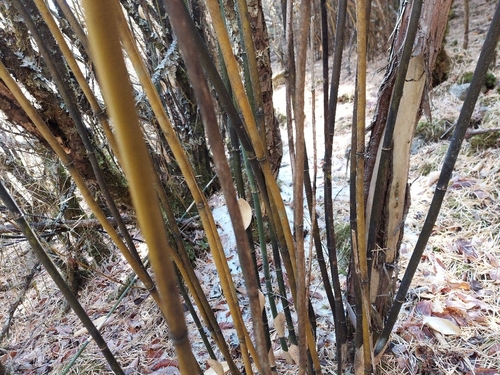
(c) Phuentsho, some rights reserved (CC BY-NC), uploaded by Phuentsho

(c) Patricia Rose, some rights reserved (CC BY)
What to Eat
Edible parts: Seeds, Stem, Cereal, Shoots
Young shoots are edible when cooked. The seed can be cooked and used as a cereal, though the plants only flower and set seed at intervals of several years.
Where to Find It
It is a temperate plant. It grows in conifer and mixed subalpine forests between 2,500-2,900 m above sea level in Tibet.
Asia, Bhutan, China, Himalayas, India, Nepal, Northeastern India, Sikkim, Tibet,
How to Identify
A bamboo grass. It has a rhizome neck 6 cm long. The culms are 3-4 m tall and 1-2 cm wide. The internodes are 15-18 cm long. There are 3-6 branches.
How to Grow
Propagation: Surface sow fresh seed in a greenhouse at around 20°C, keeping the compost consistently moist. Germination is usually fairly prompt with good-quality seed, though it can take 3–6 months. Grow on in light shade in the greenhouse until large enough to plant out. Seed is rarely available. Division in spring as new growth begins is the more common method — take divisions with at least three canes, disturbing the main plant's roots as little as possible. Grow divisions in light shade in a greenhouse in pots of high-fertility sandy medium, misting the foliage regularly until established. Plant out when a good root system has developed, which can take a year or more. Basal cane cuttings are also an option.
Medicinal Uses
None known
Other Uses
The species is valuable for screen planting in wet areas. The canes are used for making baskets and pipes and can serve as plant supports. However, the canes are quite brittle and not well suited to weaving; in their native range they are used only when better species are unavailable.
Wikipedia
Source ↗Thamnocalamus spathiflorus is a hardy evergreen bamboo reaching 6 meters tall. It grows year-round in UK zone 6 and adapts to light sandy, medium loamy, and heavy clay soils across mildly acidic to basic pH ranges. The plant thrives in semi-shade or full sun and prefers consistently moist conditions. It is wind-pollinated and hermaphroditic.
Other Information
It is sold in local markets.
Notes
See notes in Flora of China Vol. 22, p 79
Names & Synonyms
Babain, Babam, Ban nigalo, Bhebham, Deoningal, Garu, Myoosay, Parikh, Purmick, Ratonigalo, Ringal, Rue, Tham
References (8)
- Ambasta, S.P. (Ed.), 2000, The Useful Plants of India. CSIR India. p 633 (Also as Thamnocalamus aristatus)
- Dangol, D. R. et al, 2017, Wild Edible Plants in Nepal. Proceedings of 2nd National Workshop on CUAOGR, 2017.
- Joshi, N., et al, 2007, Traditional neglected vegetables of Nepal: Their sustainable utilization for meeting human needs. Tropentag 2007. Conference on International Agricultural Research for Development. (As Thamnocalamus aristatus)
- Plants for a Future database, The Field, Penpol, Lostwithiel, Cornwall, PL22 0NG, UK. http://www.scs.leeds.ac.uk/pfaf/ (Also as Thamnocalamus aristatus)
- Trans. Linn. Soc. London 26:34. 1868
- Tsering, J., et al, 2017, Ethnobotanical appraisal on wild edible plants used by the Monpa community of Arunchal Pradesh. Indian Journal of Traditional Knowledge. Vol 16(4), October 2017, pp 626-637
- Wild edible plants of Himachal Pradesh (As Thamnocalamus aristatus)
- www.guaduabamboo.com


