Themeda triandra
Forsskal
Kangaroo Grass, Red oat grass
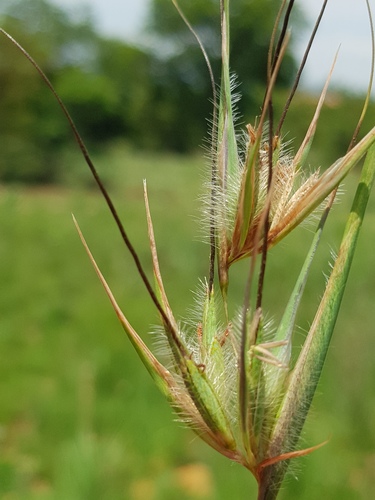
(c) Richard Gill, some rights reserved (CC BY-NC), uploaded by Richard Gill
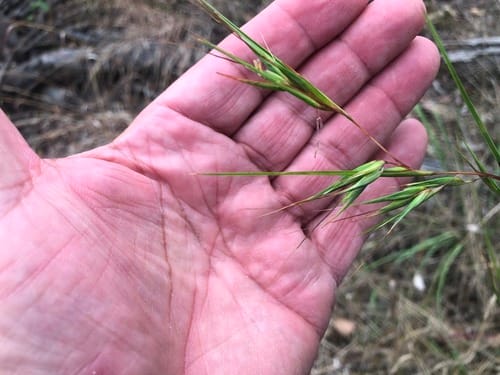
(c) Martin Bennett, some rights reserved (CC BY-NC)
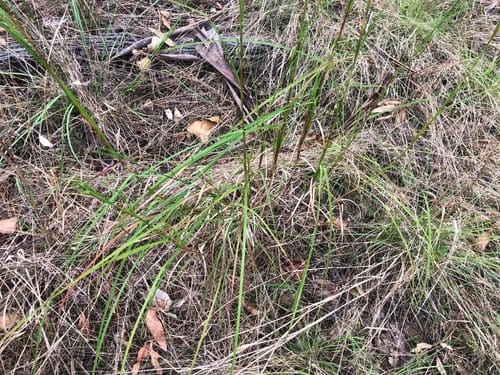
(c) Martin Bennett, some rights reserved (CC BY-NC)
What to Eat
Edible parts: Seeds, Grains, Cereal, Leaves
It can survive on land depleted by farming. It is very drought-resistant. It tolerates extreme changes in temperature. It is a perennial grass. It can help to restore already degraded grasslands. It contains 40 per cent more protein than traditional grains used for making bread. Because of the way it grows, forming a very dense tussock with its leaves bending outwards, it protects the soil and creates its own little ecosystem – it conserves moisture, creating habitat for small animals such as native insects and invertebrates. However, at present the commercial viability of kangaroo grass is limited by low seed yields and poor knowledge of broadacre crop management. The project will draw heavily on the knowledge of the traditional owners of the land, and there will be ongoing communication with farmers and Landcare Australia groups. The project follows a smaller, crowdfunded project undertaken in 2017 by writer Bruce Pascoe on his own property in Gipsy Point, eastern Victoria, managed by volunteers, to develop several Indigenous Australian food crops, including murnong (yam daisy), kangaroo grass and native raspberries. In 2020 Pascoe established the not-for-profit Aboriginal social enterprise Black Duck Foods in Mallacoota, Victoria. Black Duck Foods conducts research into native foods and is currently working on a roadmap for the native grains industry. They have small quantities of kangaroo and spear grass flour for sale on their website. The University of Sydney has undertaken research into the nutritional value of kangaroo grass, finding that it is high in protein and minerals.
Known Hazards
Where to Find It
It is a temperate plant. It grows in most types of soils. It is drought resistant. It grows in tropical and temperate places. It grows in the Upper Nile. It grows best with temperatures of 25-35°C. It grows in hot arid areas. It grows in areas with an annual rainfall between 375-6,250 mm. It grows from sea level to 3,000 m above sea level. It will re-grow after fire. It can grow in arid places. Melbourne Botanical gardens.
Africa, Algeria, Angola, Argentina, Asia, Australia*, Bhutan, Botswana, Burkina Faso, Burundi, Cameroon, Central Africa, China, Congo, East Africa, Egypt, Eswatini, Ethiopia, Ghana, Guinea, Guinée, Guyana, Himalayas, India, Indochina, Indonesia, Japan, Kenya, Korea, Laos, Lebanon, Lesotho, Madagascar, Malawi, Malaysia, Mali, Mediterranean, Middle East, Morocco, Mozambique, Myanmar, Namibia, Nepal, Netherlands, New Caledonia, New Zealand, Nigeria, North Africa, Pacific, Papua New Guinea, PNG, Philippines, Rwanda, SE Asia, Senegal, Solomon Islands, Somalia, South Africa, Southern Africa, Sri Lanka, Sudan, Swaziland, Syria, Tanzania, Tasmania*, Thailand, Tunisia, Turkey, Türkiye, Uganda, Uruguay, Vanuatu, Vietnam, West Africa, Yemen, Zambia, Zimbabwe,
How to Identify
A herb. It is a grass which grows in dense tufts. It keeps growing from year to year. It grows about 1 m high. The leaves are coarse and narrow. They are 30 cm long. The stems are slightly flattened and smooth. The flower heads occur in stalked clusters. They are green and purple. They turn a rusty brown as they ripen.
How to Grow
Plants can be grown from seed. The seed need to be stored for 6-11 months.
Propagation: Seed - there is some after-ripening dormancy and it takes approximately 12 months storage before the full germination potential of the seed is realized. Dormancy results from a combination of embryo dormancy and mechanically resistant glumes. Successful germination of the spikelets entails the splitting of the tough upper glumes by radicles. Glume removal, plus treatment with gibberellic acid increases germination rates and reduces germination time.
Medicinal Uses
The young growth is palatable to livestock. It serves as a food source for several avian species, including the long-tailed widowbird, and is occasionally used as an ornamental plant. Traditionally, in Uganda, the hollow stems of the grass are used as a thatch in hut construction, and for creating pulp for paper. T. triandra seed has also been used as a famine food in Africa. In West Africa, the root are used in the creation of a medicine used to treat dysmenorrhoea (painful periods). In Australia, it is sometimes used as an ornamental plant in rockeries, as a substitute for a lawn, and in cooking. It has also been found to be useful in treating horses for obesity, insulin resistance, and foot inflammation, because it is lower in carbohydrates such as sugar, starch, and fructans than introduced grasses. Before the colonisation of Australia, kangaroo grass used to be harvested by Aboriginal Australians, who used the leaves and stems for making string, the basis for fishing nets, as well as for food. The grains were harvested and ground into flour and porridge; the flour was used to make a traditional bread (later referred to as damper, although that term is mostly used for the bread made by non-Indigenous Australians), said to have a nutty flavour. Evidence has been found of this food production occurring around 30,000 years ago, with the grain considered to be a staple food and especially valuable in arid areas. In recent years kangaroo grass has been looked upon as a weed which is sometimes eaten by livestock. As of 2021, a four-year research project supported by the Australian Government is being undertaken by researcher Dylan Male, at La Trobe University in collaboration with the Dja Dja Wurrung Aboriginal Clans Corporation of central Victoria, investigating the possibility of developing it as a food crop. It is hoped that kangaroo grass would be able to be grown on a commercial scale and become a regular food source. They have found tussocks of the grass estimated to be over 50 years old, an possibly unique among Australian grasses. The plant has several advantages over currently farmed grains:
Other Uses
The culms are used in Uganda for hut-building. Ubiquitously they serve as thatch, but in Lesotho the quality is said to be poor and not lasting. The culms are suitable for producing paper-pulp. The presence of this grass is considered in S Africa to be an indication of the suitability of the land for growing pineapples.
Wikipedia
Source ↗Themeda triandra is a species of C4 perennial tussock-forming grass widespread in Africa, Australia, Asia and the Pacific. In Australia it is commonly known as kangaroo grass and in East Africa and South Africa it is known as red grass and red oat grass or as rooigras in Afrikaans. Kangaroo grass was formerly thought to be one of two species, and was named Themeda australis. The plant has traditional uses as food and medicine in Africa and Australia. Indigenous Australians harvested it to make bread and string for fishing nets around 30,000 years ago. It was used as livestock feed in early colonial Australia, but this use was largely replaced by introduced plants. As of 2021 there is a large government-funded project underway to investigate the possibility of growing kangaroo grass commercially in Australia for use as a regular food source for humans.
Other Information
The seeds are a famine food.
Names & Synonyms
Bettanchi hullu, Bhatdi, Bhatolu, Bhimana-hanchi, Buunhu, Chigora, Chindindi, Daba shabeel, Erigai thattu pullu, Fuliu, Garaarr, Ggaraarr, Gondamanchi hullu, Kankululu, Myauk-mi, Myet-swe-le, Peddayerra-kallakasurn, Red Grass, Thodda anji hullu, Umukeenke, Wuuloitch, Wuulot
References (33)
- Ambasta, S.P. (Ed.), 2000, The Useful Plants of India. CSIR India. p 634
- Anon., 2003, Native Plants for the Fitzroy basin. Society for Growing Australian Plants Inc. (Rockhampton Branch) p 76
- Bodkin, F., 1991, Encyclopedia Botanica. Cornstalk publishing, p 978 (As Themeda australis)
- Burkill, H. M., 1985, The useful plants of west tropical Africa, Vol. 2. Kew.
- Cherikoff V. & Isaacs, J., The Bush Food Handbook. How to gather, grow, process and cook Australian Wild Foods. Ti Tree Press, Australia p 191 (As Themeda australis)
- Curtis, W.M., & Morris, D.I., 1994, The Student's Flora of Tasmania. Part 4B St David's Park Publishing, Tasmania, p 358
- Dashorst, G.R.M., and Jessop, J.P., 1998, Plants of the Adelaide Plains & Hills. Botanic Gardens of Adelaide and State Herbarium. p 180
- De Angelis, D., 2005, Aboriginal Plant Use of the Greater Melbourne Area. La Trobe University Environment Collective
- Forsskal, Fl. aegypt.-arab. 178. 1775
- Fowler, D. G., 2007, Zambian Plants: Their Vernacular Names and Uses. Kew. p 73
- Hastings Advance Community College, 2017, Uses for Native Plants of the Mornington Peninsula. 86pp. p 76
- Hedrick, U.P., 1919, (Ed.), Sturtevant's edible plants of the world. p 59 (As Themeda imberbis)
- Hibbert, M., 2002, The Aussie Plant Finder 2002, Florilegium. p 298
- Hibbert, M., 2002, The Aussie Plant Finder 2002, Florilegium. p 298 (As Themeda australis)
- Hunter, J.T., 2017, Is there a relationship between contemporary high Aboriginal plant resource locations and mapped vegetation communities? Cunninghamia 17:27-34. The Royal Botanic Garden Sydney. ISSN 2200 - 405X
- Jackes, B. R., 2010, Plants of Magnetic Island. 3rd Edition. James Cook University, Australia. p 36
- Lamp, C.A., Forbes, S.J. and Cade, J.W., 1990, Grasses of Temperate Australia. Inkata Press. p 282
- Lazarides, M. & Hince, B., 1993, Handbook of Economic Plants of Australia, CSIRO. p 236 (As Themeda australis)
- Lazarides, M. & Hince, B., 1993, Handbook of Economic Plants of Australia, CSIRO. p 236
- McKerney, M. & White, H., 2011, Bush Tucker, Boomerangs & Bandages. Border River-Gwyder Catchment Management Authority p 145
- Nash, D., 2004, Aboriginal Plant Use in south-eastern Australia. Australian National Botanic Gardens. p 9
- National Research Council, 1996, Lost crops of Africa. Volume 1 grains, p 271
- Paczkowska, G. & Chapman, A.R., 2000, The Western Australian Flora. A Descriptive Catalogue. Western Australian Herbarium. p 117
- Peters, C. R., O'Brien, E. M., and Drummond, R.B., 1992, Edible Wild plants of Sub-saharan Africa. Kew. p 29
- Petheram, R.J. and Kok, B., 2003, Plants of the Kimberley Region of Western Australia. UWA Press p 225
- Royal Botanic Gardens, Kew (1999). Survey of Economic Plants for Arid and Semi-Arid Lands (SEPASAL) database. Published on the Internet; http://www.rbgkew.org.uk/ceb/sepasal/internet [Accessed 4th June 2011]
- Ruiters-Welcome, A. K., 2019, Food plants of southern Africa. Ph.D. thesis. Univ. of Johannesburg p 90
- Swaziland's Flora Database http://www.sntc.org.sz/flora
- Tasmanian Herbarium Vascular Plants list p 90
- Welcome, A. K. & Van Wyk, B.-E., 2019, An inventory and analysis of the food plants of southern Africa. South African Journal of Botany 122 (2019) 136–179
- Wheeler, J.R.(ed.), 1992, Flora of the Kimberley Region. CALM, Western Australian Herbarium, p 1228
- Woolmore, E et al, 2002, King Island Flora: A Field Guide. p 107
- World Checklist of Useful Plant Species 2020. Royal Botanic Gardens, Kew


