Platycladus orientalis
(L.) Franco
Oriental cedar
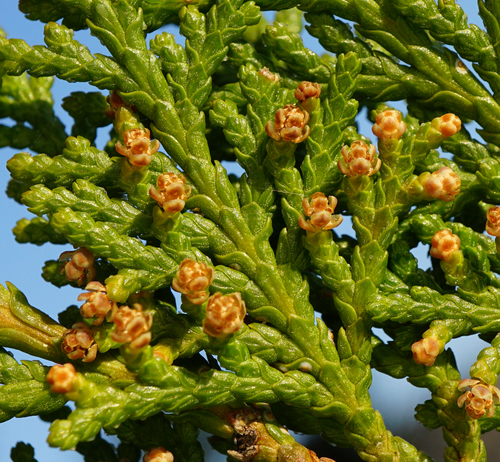
(c) Patrick Hacker, some rights reserved (CC BY), uploaded by Patrick Hacker

(c) naturalist_club, some rights reserved (CC BY-NC)

(c) Joel Chamberlain, some rights reserved (CC BY-NC), uploaded by Joel Chamberlain
What to Eat
Edible parts: Seeds, Leaves - tea
Resistant to drought, it is very often used as an ornamental tree, both in its homeland, where it is associated with long life and vitality, and very widely elsewhere in temperate climates. It is suitable for form cuts and year-round opaque hedges, but also forms impressive slender solitary trees. Several cultivars have been selected, of which 'Aurea Nana' has gained the Royal Horticultural Society's Award of Garden Merit. The wood is used in Buddhist temples both for (lavairos) construction work, and chipped, for incense burning. Its twigs and leaves contain 0.12% essential oil containing pinene and probably caryophyllene. Its use as a memorial tree dates back to the Zhou dynasty in China, where it was the official memorial tree of princes.
Where to Find It
It is a temperate plant. It is frost hardy. It grows in swampy areas on limestone rocks. It cannot stand stagnant water around its roots. It can also grow on dry shallow soils. It can tolerate salt spray. In Hobart Botanical gardens. National Arboretum Canberra. It suits plant hardiness zone 7.
Africa, Albania, Asia, Australia, Austria, Bangladesh, Bulgaria, Canada, China*, Czech Republic, East Africa, Hungary, India, Indochina, Iran, Japan, Korea, Manchuria, Marquesas, Mauritius, Middle East, Mongolia, Mozambique, North America, Reunion, Romania, Russia, SE Asia, Spain, Tajikistan, Tasmania, USA, Uzbekistan, Vietnam, Yugoslavia, Zimbabwe,
How to Identify
A small tree. It grows 9-15 m high and spreads 3-4.5 m wide. It has an irregular rounded crown. The bark is fibrous. The leaves are pale green and do not have a scent. Leaves turn bronze in the winter. They grow in vertical flattened sprays. Scale like leaves are 1-2 mm long with resin glands and sword shaped leaves are 4-5 mm long. The twigs are flattened and leaf covered. The cones are egg shaped and covered with a bloom. They are 7-12 mm long and upright. There are 4-5 pairs of thick fleshy scales. They ripen to brown. The seeds do not have wings.
How to Grow
Plants can be grown from seed or stem cuttings.
Production
It is slow growing.
Other Information
It is sold in local markets in China. It is cultivated.
Notes
There is only one species of Platycladus. This one has been included in Thuja in the past.
Names & Synonyms
Biota, Book-leaf Pine, Chinese Arbor-Vitae, Ko-no-tegashiwa, Mayuroankh, Morepankhi, Oriental Arborvitae, Pian bai, Trac-ba
References (20)
- Ambasta, S.P. (Ed.), 2000, The Useful Plants of India. CSIR India. p 637
- Bodkin, F., 1991, Encyclopedia Botanica. Cornstalk publishing, p 982
- Brickell, C. (Ed.), 1999, The Royal Horticultural Society A-Z Encyclopedia of Garden Plants. Convent Garden Books. p 1009
- Farrar, J.L., 1995, Trees of the Northern United States and Canada. Iowa State University press/Ames p 27
- Hearne, D.A., & Rance, S.J., 1975, Trees for Darwin and Northern Australia. AGPS, Canberra p 114, Pl 35
- Hibbert, M., 2002, The Aussie Plant Finder 2002, Florilegium. p 299
- Joyce, D., 1998, The Garden Plant Selector. Ryland, Peters and Small. p 174
- Kew Plants of the World Online
- Krishen P., 2006, Trees of Delhi, A Field Guide. DK Books. p 165 (As Platycladus orientalis)
- Levy-Yamamori, R., & Taaffe, G., 2004, Garden Plants of Japan. Timber Press. p 183
- Li, D. et al, 2017, Ethnobotanical survey of herbal tea plants from the traditional markets in Chaoshan, China. Journal of Ethnopharmacology. 205 (2017) 195-206
- Little, E.L., 1980, National Audubon Society Field Guide to North American Trees. Alfred A. Knopf. p 313
- Lord, E.E., & Willis, J.H., 1999, Shrubs and Trees for Australian gardens. Lothian. p 90
- Pham-Hoang Ho, 1999, An Illustrated Flora of Vietnam. Nha Xuat Ban Tre. p 225
- Plants for a Future database, The Field, Penpol, Lostwithiel, Cornwall, PL22 0NG, UK. http://www.scs.leeds.ac.uk/pfaf/
- Portugaliae Acta Biol., Ser. B, Sist. vol. Julio Henriques, 33. 1949
- READ,
- Schuler, S., (Ed.), 1977, Simon & Schuster's Guide to Trees. Simon & Schuster. No. 43
- Staples, G.W. and Herbst, D.R., 2005, A tropical Garden Flora. Bishop Museum Press, Honolulu, Hawaii. p 67
- World Checklist of Useful Plant Species 2020. Royal Botanic Gardens, Kew


