Thymus capitatus
(L.) Hoffmanns & Link
Headed savory, Headed thyme
(c) John E. Christensen, some rights reserved (CC BY-NC)

(c) Joey Bom, some rights reserved (CC BY-NC)
(c) keir, some rights reserved (CC BY-NC)
What to Eat
Edible parts: Leaves, Flowers, Spice
The leaves are used as a condiment, eaten raw in salads or added as a flavouring to cooked foods. An essential oil from the plant, known as 'Spanish oregano oil', is used to flavour baked goods, condiments, beverages, and ice creams. An aromatic tea can also be made from the leaves. For drying, harvest plants in early and late summer just before the flowers open and dry the leaves quickly.
Where to Find It
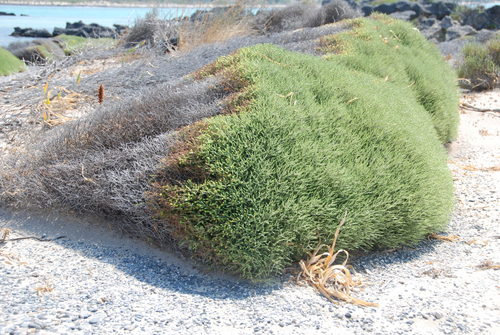
It is a Mediterranean climate plant. It grows on dry hills and rocky places. It can be on sand dunes.
Africa, Australia, Britain, Cyprus, Egypt, Europe, Greece, Iraq, Italy, Jordan, Libya, Mediterranean, Middle East, North Africa, Portugal, Spain, Tunisia,
How to Identify
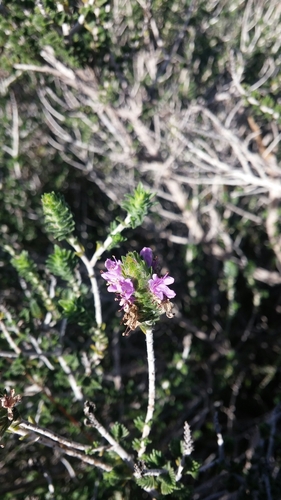
A small herb. It has a smell. It grows 50 cm high. It has many branches. It has leaf clusters in the axils. The leaves are narrow and fleshy. They have a flat edge. The flowers are purplish-pink. They are 7-10 mm long. They are in clusters at the ends of branches. The bracts are green. These overlap to form a cone-like head.
How to Grow
Propagation: Sow seed in spring in a cold frame, or in autumn in a greenhouse. Surface sow or barely cover the seed, as germination can be erratic. Prick seedlings into individual pots when large enough to handle and grow on under glass for at least their first winter, then plant out in late spring or early summer after the last expected frosts. Divide plants in spring or autumn; larger divisions can go directly into permanent positions, while smaller ones are best potted up and grown on in light shade until well established, then planted out in summer or the following spring. Take cuttings of young shoots 5–8cm with a heel in May/June in a frame, or half-ripe cuttings 5–8cm with a heel in July/August in a frame. Layering is also possible.
Medicinal Uses
The leaves, and particularly their essential oil, are strongly antiseptic, deodorant, and disinfectant. The plant can be used fresh year-round, or harvested as it comes into flower for distillation of the oil or drying for later use. The essential oil should not be used in aromatherapy as it is highly irritant to the mucous membranes.
Other Uses
The essential oil — known as 'Spanish oregano oil' — obtained from the leaves is used in perfumery, soaps, and as a mouthwash, as well as medicinally. The plant can be used as a ground cover and attracts pollinators; its aromatic properties may also repel certain pests, making it useful as a companion plant.
Wikipedia
Source ↗Thymus capitatus is a compact, woody perennial native to Mediterranean Europe and Turkey, more commonly known as conehead thyme, Persian-hyssop and Spanish oregano. It is also known under the name Thymbra capitata.
Notes
There are between 220 and 400 Thymus species.
Names & Synonyms
Conehead Thyme, Jatrakiwilka, Persian hyssop, Spanish-oregano, Tulumbe, Yabani kekik, Za'atar farsi
References (16)
- Al-Qura'n, S. A., 2010, Ethnobotanical and Ecological Studies of Wild Edible Plants in Jordan. Libyan Agriculture Research Center Journal International 1(4):231-243
- Bidak, L. M., et al, 2015, Goods and services provided by native plants in desert ecosystems: Examples from the northwestern coastal desert of Egypt. Global Ecology and Conservation 3 (2015) 433–447
- Blamey, M and Grey-Wilson, C., 2005, Wild flowers of the Mediterranean. A & C Black London. p 398
- Ciftcioglu, C. G., 2015, Sustainable wild-collection of medicinal and edible plants in Lefke region of North Cyprus. Agroforest Syst. Springer
- Della, A., et al, 2006, An ethnobotanical survey of wild edible plants of Paphos and Larnaca countryside of Cyprus. J. Ethnobiol. Ethnomed. 2:34
- Facciola, S., 1998, Cornucopia 2: a Source Book of Edible Plants. Kampong Publications, p 137
- Fl. portug. 1:123. 1809
- Galalaey, A. M. K., et al, 2021, Ethnobotanical study of some wild edible plants in Hujran Basin, Kurdistan Region of Iraq. ZANCO Journal of Pure and Applied Sciences. Salahaddin University-Erbil p 27
- Hedrick, U.P., 1919, (Ed.), Sturtevant's edible plants of the world. p 649
- Hibbert, M., 2002, The Aussie Plant Finder 2002, Florilegium. p 299
- http://cypruswildflowers.com
- Lentini, F. and Venza, F., 2007, Wild food plants of popular use in Sicily. J Ethnobiol Ethnomedicine. 3: 15
- Mahklouf, M. H., 2019, Ethnobotanical Study of Edible Wild Plants in Libya. European Journal of Ecology. 5(2): 30-40
- Oran, S. A. S., 2015, Selected Wild Aromatic Plants in Jordan. International Journal of Medicinal Plants. Photon 108 (2015) 686-699
- Plants for a Future database, The Field, Penpol, Lostwithiel, Cornwall, PL22 0NG, UK. http://www.scs.leeds.ac.uk/pfaf/
- Wiersema, J. H. & Leon, B., 2013, World Economic Plants. A Standard Reference CRC Press. 2nd Ed. p 200