Toona sinensis
(A. Juss.) M. Roem.
Chinese cedar
(c) cpumerci, some rights reserved (CC BY-NC), uploaded by cpumerci

(c) Andrew Conboy, some rights reserved (CC BY)

(c) Andrew Conboy, some rights reserved (CC BY)
What to Eat
Edible parts: Fruit, Leaves, Buds, Leaves - tea, Vegetable
Young shoots and leaves are cooked — a highly esteemed food in China said to resemble onions in flavour, usually prepared by boiling. The leaves are rich in vitamin A and contain approximately 6% protein, 1% fat, 6.6% carbohydrate, and 1.5% ash. They can also be used as a tea substitute. The fruit is edible, though no further details are recorded.
Where to Find It
A subtropical plant. It is native to China. It grows on mountains between 800 and 2,000 m altitude. It suits subtropical and temperate climates. It needs deep loamy-sandy soil. It suits a pH of 5.5-8 and does well on calcareous soils. It suits hardiness zones 6-11. In Yunnan. In Sichuan. National Arboretum Canberra.
Asia, Australia, Bhutan, Britain, China, Europe, Himalayas, India, Indochina, Indonesia, Inner Mongolia, Japan, Korea, Korea N, Laos, Malaysia, Myanmar, Nepal, SE Asia, Sri Lanka, Taiwan, Tasmania, Thailand, Tibet, USA, Vietnam,
How to Identify
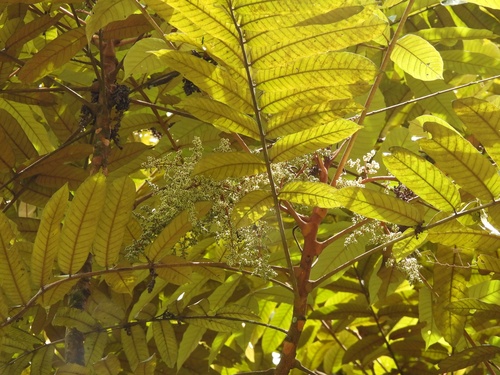
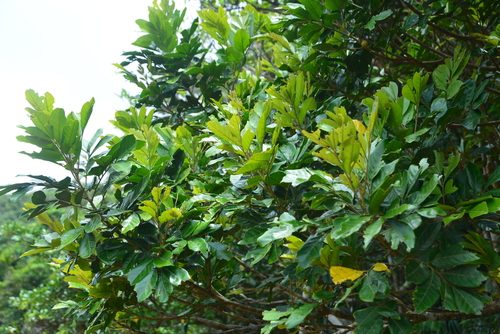
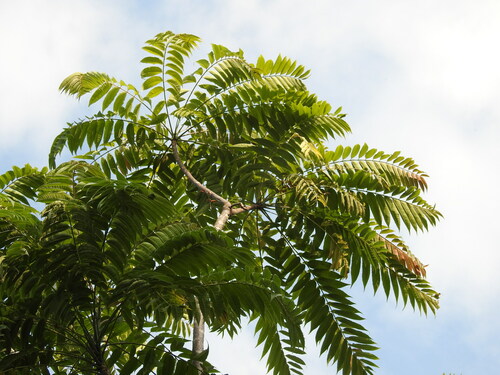
A deciduous tree. It grows 20-30 m tall. The trunk is 60-100 cm across. The trunk is straight with few branches. The leaves are 60 cm long. There are 10-24 leaflets along the stalks. The leaves have teeth along the edge. The leaflets are red-bronze when young and turn yellow before they fall. The flowers are cream and small. They have a scent. They occur in drooping panicles. These are 30 cm long. The fruit is a woody brown capsule. It is 3 cm long. There are several winged seeds.
Nutrition Score: 39/100
| Part | Moisture | kJ | kcal | Protein | Vit A | Vit C | Iron | Zinc |
|---|---|---|---|---|---|---|---|---|
| Leaves raw | 83.6 | 213 | 51 | 6 | — | — | 3.2 | — |
How to Grow
Plants can be grown from seeds. Seeds need extensive cold treatment for 2-3 months. Then they are soaked in warm water for 24 hours before sowing. They are best grown in a nursery and then transplanted. They can be grown by root cuttings.
Propagation: Seed is best sown as soon as it is ripe in a cold frame. Stored seed germinates better after 3 months of cold stratification. When large enough to handle, prick seedlings out into individual pots and grow them on in the greenhouse for at least their first winter. Plant out in late spring or early summer, with some protection from cold recommended during their first winter outdoors. Root cuttings 4–5cm long can be taken in December and potted up horizontally in a greenhouse.
Medicinal Uses
The bark is astringent, carminative, febrifuge, ophthalmic, and styptic. A decoction is used to treat diarrhoea, chronic dysentery, flatulence, bloody stools, seminal emissions, leucorrhoea, metrorrhagia, and gonorrhoea.
Other Uses
The wood is very durable, easily worked, and takes a good polish. It is a valuable timber resembling mahogany, used for furniture, window frames, and similar items. The wood is delicately scented and is burned in temples as incense.
Wikipedia
Source ↗Toona sinensis, commonly called Chinese mahogany, Chinese cedar, Chinese toon, beef and onion plant, or red toon (Chinese: 香椿; pinyin: xiāngchūn; Korean: 참죽, romanized: chamjuk; Hindi: डारलू, romanized: ḍāralū; Malay: suren; Vietnamese: hương xuân) is a species of Toona native to eastern and southeastern Asia, ranging from northern Korean peninsula through most of eastern, central, and southwestern China, in Nepal, northeastern India, Burma (Myanmar), Thailand, and even present in Malaysia and western Indonesia.
Production
Trees grow quickly. Leaves are continually harvested.
Other Information
It is a cultivated food plant. It is sold in local markets.
Notes
There are 4 or 5 Toona species. They occur in Asia. Now Cedrela is an American genus and Toona is Asia and elsewhere. Chemical composition: Protein = 5.97%. Fat = 1.02%. Carbohydrate = 6.57%. Ash = 1.48%. Vitamin A = large quantities. Vitamin C = trace.
Names & Synonyms
Cedrela, Ch'amjuknamu, Chanchin, Chinese mahogany, Chinese toon, Chun Tsei Shue, Daaraluu, Fragrant chun, Fu mei rong, Gushi, Jimu, Main chen, Maiyoneng, Red toon, Suren, Surian tanam, Tong du, Tsaizime, Xianchun, Xiangchuan, Xuan su, Ye bu, Zong
References (42)
- Aiguo, C. & Zhiling, D., 2001, Managing Agricultural Resources for Biodiversity Conservation. Case Study Yunnan, Southwest China. Environment Liaison Center International. p 40
- Altschul, S.V.R., 1973, Drugs and Foods from Little-known Plants. Notes in Harvard University Herbaria. Harvard Univ. Press. Massachusetts. no. 2003 (As Cedrela sinensis)
- Ambasta, S.P. (Ed.), 2000, The Useful Plants of India. CSIR India. p 641
- AVRDC files
- Bodkin, F., 1991, Encyclopedia Botanica. Cornstalk publishing, p 230 (As Cedrela sinensis)
- Brickell, C. (Ed.), 1999, The Royal Horticultural Society A-Z Encyclopedia of Garden Plants. Convent Garden Books. p 1017
- Cao, Y., et al, 2020, Ethnobotanical study on wild edible plants used by three trans-boundary ethnic groups in Jiangcheng County, Pu’er, Southwest China. Journal of Ethnobiology and Ethnomedicine (2020) 16:66
- Chao, Pi-Yu, et al, 2014, Antioxidant Activity in Extracts of 27 Indigenous Taiwanese Vegetables. Nutrients 2014, 6, 2115-2130
- Chaudhury, R.H.N., et al, 1980, Ethnobotanical Uses of Herbaria - 2. J. Econ, Tax Bot Vol 1 p 167 (As Cedrela longifolia Wall.)
- Cheng, Z., et al, 2022, Ethnobotanical study on wild edible plants used by Dulong people in northwestern Yunnan, China. Journal of Ethnobiology and Ethnomedicine (2022) 18:3
- Coombes, A.J., 2000, Trees. Dorling Kindersley Handbooks. p 217
- Cundall, P., (ed.), 2004, Gardening Australia: flora: the gardener's bible. ABC Books. p 1423
- Facciola, S., 1998, Cornucopia 2: a Source Book of Edible Plants. Kampong Publications, p 150
- Fam. nat. syn. monogr. 1:139. 1846
- Flora of China. www.eFloras.org
- Food Composition Tables for use in East Asia FAO http://www.fao.org/infoods/directory No. 447 (As Cedrela sinensis)
- Forest Inventory and Planning Institute, 1996, Vietnam Forest Trees. Agriculture Publishing House p 524
- Ghorbani, A., et al, 2012, A comparison of the wild food plant use knowledge of ethnic minorities in Naban River Watershed Nature Reserve, Yunnan, SW China. Journal of Ethnobiology and Ethnomedicine; 8:17
- Hariyadi, B., 2008, The Entwined Tree: Traditional Natural Resource Management of Serampas, Jambi, Indonesia. Ph. D thesis. Univ. or Hawaii. p 444
- Hibbert, M., 2002, The Aussie Plant Finder 2002, Florilegium. p 301
- Hu, Shiu-ying, 2005, Food Plants of China. The Chinese University Press. p 508
- Jackes, D. A., 2007, Edible Forest Gardens
- Jia, X., et al, 2022, Ethnobotany of wild edible plants in multiethnic areas of the Gansu–Ningxia–Inner Mongolia junction zone. Journal of Ethnobiology and Ethnomedicine 18:53
- Kang, Y., et al, 2012, Wild food plants and wild edible fungi in two valleys on the Qinling Mountains (Shaanxi, central China) Journal of Ethnobiology and Ethnomedicine; 9:26
- Kang, Y., et al, 2014, Wild food plants used by the Tibetans of Gongba Valley (Zouqu country, Gansu, China) Journal of Ethnobiology and Ethnomedicine 10:20
- Kim, H. & Song, M., 2013, Ethnobotanical analysis for traditional knowledge of wild edible plants in North Jeolla Province (Korea). Genetic. Resour. Crop Evol. (2013) 60:1571-1585 (As Cedrela sinensis)
- Lord, E.E., & Willis, J.H., 1999, Shrubs and Trees for Australian gardens. Lothian. p 49 (As Cedrela sinensis)
- Martin, F.W. & Ruberte, R.M., 1979, Edible Leaves of the Tropics. Antillian College Press, Mayaguez, Puerto Rico. p 205 (As Cedrela sinensis)
- Pemberton, R. W. & Lee, N. S., 1996, Wild Food Plants in South Korea: Market Presence, New Crops, and Exports to the United States. Economic Botany, Vol. 50, No. 1, pp. 57-70 (As Cedrela sinensis)
- Plants for a Future database, The Field, Penpol, Lostwithiel, Cornwall, PL22 0NG, UK. http://www.scs.leeds.ac.uk/pfaf/
- READ, (As Cedrela sinensis)
- Ryan, S., 2008, Dicksonia. Rare Plants Manual. Hyland House. p 59
- UPHOF, (As Cedrela sinensis)
- Valder, P., 1999, The Garden Plants of China. Florilegium. p 330
- Wang, J. et al, 2013, A Study on the Utilization of Wild Plants for Food in Liangshan Yi Autonomous Prefecture. Plant Diversity and Resources. 35(4): 416-471
- Wang, J., et al, 2020, An ethnobotanical survey of wild edible plants used by the Yi people of Liangshan Prefecture, Sichuan Province, China. Journal of Ethnobiology and Ethnomedicine 16:10 p 8
- Weckerle, C. S., et al, 2006, Plant Knowledge of the Shuhi in the Hengduan Mountains, Southwest China. Economic Botany 60(1):2-23
- Wiersema, J. H. & Leon, B., 2013, World Economic Plants. A Standard Reference CRC Press. 2nd Ed. p 688
- Wongprasert, T. et al, 2011, A Synoptic Account of the Meliaceae of Thailand. Thai For. Bull. 39:210-266
- Woo, Y., et al, 2017, Antioxidant Potential of Selected Korean Edible Plant Extracts. Hindawi BioMed Research International Volume 2017, Article ID 7695606
- Xu, You-Kai, et al, 2004, Wild Vegetable Resources and Market Survey in Xishuangbanna, Southwest China. Economic Botany. 58(4): 647-667.
- Yang, R., et al, 2008, Content and distribution of flavonoids among 91 edible plant species. Asia Pac. J. Clin. Nutru. 17(S1): 275-279