Triticum compactum
Host
Club wheat, Cluster wheat, Dwarf wheat

Wikimedia Commons - Triticum_compactum0.jpg
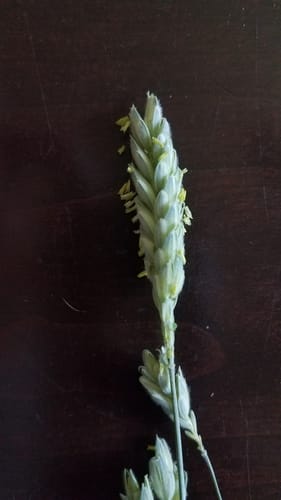
(c) Rob Irwin, some rights reserved (CC BY-NC)
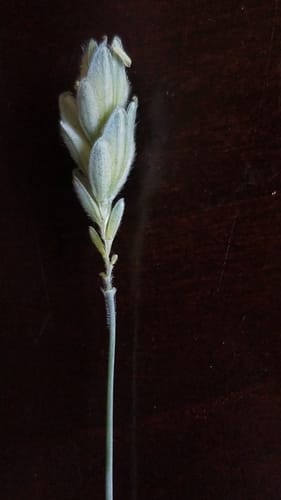
(c) Rob Irwin, some rights reserved (CC BY-NC)
What to Eat
Edible parts: Seeds, Cereal
The grain is milled into flour for bread, biscuits, and breakfast foods.
Where to Find It
It is native to Pakistan.
Afghanistan, Asia, Austria, Central Asia, North America, Pakistan, Switzerland, Tajikistan, USA,
How to Identify
A cultivated grass native to Pakistan, bred as a dwarf wheat variety used primarily for flour production.
Wikipedia
Source ↗Triticum compactum or club wheat is a species of wheat adapted to low-humidity growing conditions. T. compactum is similar enough to common wheat (T. aestivum) that it is often considered a subspecies, T. aestivum compactum. It can be distinguished by its more compact ear due to shorter rachis segments, giving it its common name. In the United States of America, nearly all T. compactum is grown in dry areas of the Pacific Northwest. T. compactum is a hexaploid with 42 chromosomes. T. compactum, like other club wheats, has been selectively bred for its lower protein content. Due to the process of selective breeding T. compactum has fewer HMW-glutenin genes than other species of wheat. Flour made from T. compactum is thus better suited for the production of cookies. T. compactum like other bread wheats have never been observed to grow in the wild.
Other Information
It is a cultivated food plant.
Notes
It is about 4% protein. The seeds are rich in gluten.
Names & Synonyms
References (8)
- Facciola, S., 1998, Cornucopia 2: a Source Book of Edible Plants. Kampong Publications, p 181 (As Triticum compactum)
- Haq, N., Anthony, K., Sarwar, M., and Ahmad, Z. (eds.), 1998, Underutilized Crops of Pakistan. Plant Genetic Resources Institute. p 12
- Kermath, B. M., et al, 2014, Food Plants in the Americas: A survey of the domesticated, cultivated and wild plants used for Human food in North, Central and South America and the Caribbean. On line draft. p 880
- Plants for a Future database, The Field, Penpol, Lostwithiel, Cornwall, PL22 0NG, UK. http://www.scs.leeds.ac.uk/pfaf/
- Svensk Bot. Tidskr. 48:586. 1954
- Uphof,
- Wiersema, J. H. & Leon, B., 2013, World Economic Plants. A Standard Reference CRC Press. 2nd Ed. p 698 (As Triticum aestivum subsp. compactum)
- Zeven, A. C. & de West, J. M. J., 1982, Dictionary of cultivated plants and their regions of diversity. Wageningen. p 83, 93


