Triticum spelta
(L.) Thell.
Dinkel wheat, Spelt
(c) deadolus, some rights reserved (CC BY-NC-SA)
(c) deadolus, some rights reserved (CC BY-NC-SA)
(c) deadolus, some rights reserved (CC BY-NC-SA)
What to Eat
Edible parts: Seeds, Cereal
Seeds are eaten cooked, typically ground into flour for use in cereals, bread, muffins, and cookies. The seeds can also be roasted as a coffee substitute.
Known Hazards
Where to Find It
It is a temperate plant. It needs well drained soil. It needs to be in a sunny position. It can grow on poor soils. It is often grown in areas of extreme climate. Under low temperatures and soil moisture shortage spelt can still yield well.
Asia, Australia, Bangladesh, Canada, Europe, Finland, Germany, India, Iran, Iraq, Italy, Mediterranean, Middle East, North America, Scandinavia, Serbia, Slovenia, Spain, Switzerland, Tasmania, USA,
How to Identify
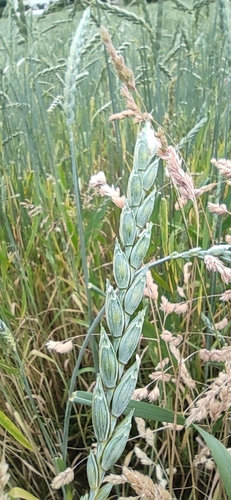
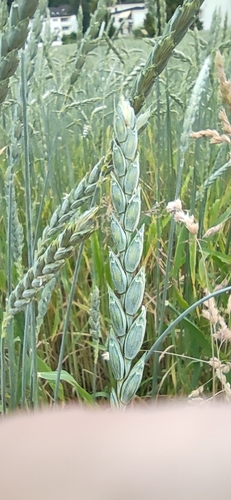
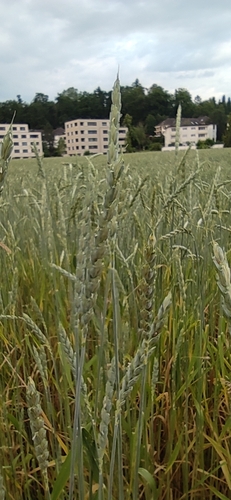
An annual grass plant. It is related to wheat. It grows to 1 m high. The ears are slender, long, lax and somewhat four sided. The spikelets have 2 grains. The grains are long, pointed and flinty.
How to Grow
Seed is sown just below the soil surface as spring approaches. Seed germinate in a few days. Seeding rates of 90-112 kg/ha are recommended.
Production
It takes 6-7 months to reach maturity and seeds ripen by 8-9 months. The spelt kernels do not thresh free of the glumes. There have been wide variations in yield (7000-1000 kg/ha), test weight (462-315 kg/m3), days to heading (154-166 days), plant height (97-140 cm), and kernel protein content (15.8-19.2%). Spelt yields are given as harvested with the kernel in the hull, and kernel yield only as estimated for a 60% kernel weight thresh out.
Other Information
It is a cultivated food plant.
Notes
It has higher protein than wheat. Spelt is a hexaploid plant (AABBDD) having 6 sets of chromosomes from 3 different origins. Some of the earliest recordings of spelt appear in the Bible (Exodus 9:30, Isaiah 28:25, and Ezekiel 4:9)
Names & Synonyms
Farro, Hulled wheat, Pira, Speltz
References (15)
- Ambasta, S.P. (Ed.), 2000, The Useful Plants of India. CSIR India. p 654 (As Triticum spelta)
- Facciola, S., 1998, Cornucopia 2: a Source Book of Edible Plants. Kampong Publications, p 182 (As Triticum spelta)
- Feldman, M., 1979, Wheats, in Simmonds N.W.,(ed), Crop Plant Evolution. Longmans. London. p 120 (As Triticum spelta)
- Hedrick, U.P., 1919, (Ed.), Sturtevant's edible plants of the world. p 657 (As Triticum spelta)
- http://www.botanic-gardens-ljubljana.com/en/plants
- Jardin, C., 1970, List of Foods Used In Africa, FAO Nutrition Information Document Series No 2.p 10 (As Triticum spelta)
- Kermath, B. M., et al, 2014, Food Plants in the Americas: A survey of the domesticated, cultivated and wild plants used for Human food in North, Central and South America and the Caribbean. On line draft. p 881
- Kiple, K.F. & Ornelas, K.C., (eds), 2000, The Cambridge World History of Food. CUP p 1856 (As Triticum spelta)
- Naturwiss. Wochenschr. 17:471. 1918
- Plants for a Future database, The Field, Penpol, Lostwithiel, Cornwall, PL22 0NG, UK. http://www.scs.leeds.ac.uk/pfaf/
- Purseglove, J.W., 1972, Tropical Crops. Monocotyledons. Longmans p 290 (As Triticum spelta)
- USDA, ARS, National Genetic Resources Program. Germplasm Resources Information Network - (GRIN). [Online Database] National Germplasm Resources Laboratory, Beltsville, Maryland. Available: www.ars-grin.gov/cgi-bin/npgs/html/econ.pl (10 April 2000)
- Vaughan, J. C. & Geissler, C. A., 2009, The new Oxford Book of Food Plants. Oxford University Press. p 4
- Wiersema, J. H. & Leon, B., 2013, World Economic Plants. A Standard Reference CRC Press. 2nd Ed. p 699
- Zeven, A. C. & de West, J. M. J., 1982, Dictionary of cultivated plants and their regions of diversity. Wageningen. p 93


