Triticum durum
(Desf.) Husn.
Durum wheat, Hard wheat, Macaroni wheat

(c) nulepia, some rights reserved (CC BY-NC)

(c) txgirl, some rights reserved (CC BY-NC)
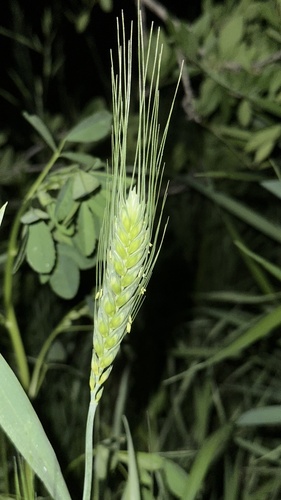
(c) uyarbrough, some rights reserved (CC BY-NC)
What to Eat
Edible parts: Seeds, Cereal
Commercially produced dry pasta, or pasta secca, is made almost exclusively from durum semolina. Most home-made fresh pastas also use durum or a combination of soft and hard wheats. Its hardness makes it favorable for semolina and pasta and less practical for flour, which requires more work to mill than with hexaploid wheats such as common bread wheats. Husked but unground, or coarsely ground, it is used to produce the semolina in the couscous of North Africa and the Levant. It is also used for Levantine dishes such as tabbouleh, kashk, kibbeh, bitfun, and the bulgur for pilafs. In North African and Levantine cuisines, it forms the basis of many soups, gruels, stuffings, puddings, and pastries. When ground as fine as flour, it is used for making bread. In the Middle East, it is used for flat, round breads, and in Europe and elsewhere, it can be used for pizza or torte. In South Asia, bombay rava is used widely for puddings and flatbreads. The use of wheat to produce pasta was described as early as the 10th century by Ibn Wahshīya of Cairo. The North Africans called the product itrīya, from which Italian sources derived the term tria (or aletría in the case of Spanish sources) during the 15th century.
Known Hazards
Where to Find It
It has drought resistance. It suits hardiness zones 9-11.
Afghanistan, Africa, Argentina, Asia, Australia, Balkans, Central Asia, China, East Africa, Egypt, Ethiopia, Europe, Finland, France, India, Iran, Iraq, Italy, Jordan, Kyrgyzstan, Macedonia, Mali, Mauritania, Mediterranean, Middle East, Morocco, Niger, Nigeria, North Africa, North America, Pakistan, Russia, Scandinavia, Serbia, South Africa, Southern Africa, Syria, Tajikistan, Togo, Turkey, Türkiye, USA, West Africa,
How to Identify
A clumping grass. It grows 0.9-1.5 m high and spreads 30-50 cm wide. The leaves are narrow, flat and rough. They are strap like. The flower stems are smooth and hollow. The flowers are in dense, somewhat flattened spikelets. These do not have stalks. The seed heads usually have beards. The seed are hard and oval and can be white, red or yellow.
Other Information
It is a staple food of North Africa. It is a cultivated food plant.
Notes
It is rich in gluten.
Names & Synonyms
Ble dur, Flint wheat, Grano duro, Gyon, Tama-gauk-gyon, Trio duro
References (25)
- Akinola, R., et al, 2020, A Review of Indigenous Food Crops in Africa and the Implications for more Sustainable and Healthy Food Systems. Sustainability 2020, 12, 3493;
- Ambasta, S.P. (Ed.), 2000, The Useful Plants of India. CSIR India. p 654 (As Triticum durum)
- Cundall, P., (ed.), 2004, Gardening Australia: flora: the gardener's bible. ABC Books. p 1433 (As Triticum durum)
- Dalziel, (As Triticum durum)
- Facciola, S., 1998, Cornucopia 2: a Source Book of Edible Plants. Kampong Publications, p 181 (As Triticum durum)
- Flora of Pakistan. www.eFloras.org (As Triticum durum)
- Graminees 4:80. 1899
- Haq, N., Anthony, K., Sarwar, M., and Ahmad, Z. (eds.), 1998, Underutilized Crops of Pakistan. Plant Genetic Resources Institute. p 12 (As Triticum durum)
- http://www.botanic-gardens-ljubljana.com/en/plants
- Jardin, C., 1970, List of Foods Used In Africa, FAO Nutrition Information Document Series No 2.p 9 (As Triticum durum)
- Kermath, B. M., et al, 2014, Food Plants in the Americas: A survey of the domesticated, cultivated and wild plants used for Human food in North, Central and South America and the Caribbean. On line draft. p 880
- Moerman, D. F., 2010, Native American Ethnobotany. Timber Press. p 570
- Peters, C. R., O'Brien, E. M., and Drummond, R.B., 1992, Edible Wild plants of Sub-saharan Africa. Kew. p 29 (As Triticum durum)
- Plants for a Future database, The Field, Penpol, Lostwithiel, Cornwall, PL22 0NG, UK. http://www.scs.leeds.ac.uk/pfaf/
- Purseglove, J.W., 1972, Tropical Crops. Monocotyledons. Longmans p 289 (As Triticum durum)
- Ruiters-Welcome, A. K., 2019, Food plants of southern Africa. Ph.D. thesis. Univ. of Johannesburg p 90
- Uphof, (As Triticum durum)
- Tanaka, (As Triticum durum)
- USDA, ARS, National Genetic Resources Program. Germplasm Resources Information Network - (GRIN). [Online Database] National Germplasm Resources Laboratory, Beltsville, Maryland. Available: www.ars-grin.gov/cgi-bin/npgs/html/econ.pl (10 April 2000)
- van Wyk, B., 2005, Food Plants of the World. An illustrated guide. Timber press. p 370 (As Triticum durum)
- van Wyk, Be, & Gericke, N., 2007, People's plants. A Guide to Useful Plants of Southern Africa. Briza. p 14
- Vaughan, J. C. & Geissler, C. A., 2009, The new Oxford Book of Food Plants. Oxford University Press. p 2
- Welcome, A. K. & Van Wyk, B.-E., 2019, An inventory and analysis of the food plants of southern Africa. South African Journal of Botany 122 (2019) 136–179
- Wiersema, J. H. & Leon, B., 2013, World Economic Plants. A Standard Reference CRC Press. 2nd Ed. p 700
- Zeven, A. C. & de West, J. M. J., 1982, Dictionary of cultivated plants and their regions of diversity. Wageningen. p 56


