Typhonium brownii
Schott
Black Arum lily
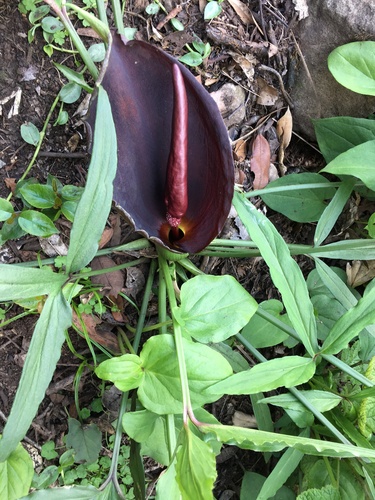
(c) senelles, some rights reserved (CC BY-NC)
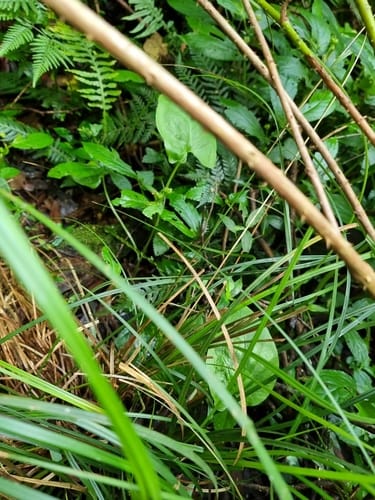
(c) John, some rights reserved (CC BY-NC)
What to Eat
Edible parts: Root
Root - cooked. A rich source of starch but, unless it is very thoroughly cooked to destroy the toxins, it can cause severe discomfort in the mouth and digestive tract. Traditionally, the Aborigines would bake it and pound it several times before eating it.
Known Hazards
Where to Find It
A tropical plant. It grows in rainforest vine thickets. In tropical Queensland it grows from sea level to 500 m altitude. Melbourne Botanical gardens.
Australia*,
How to Identify
An erect lily like herb. It grows 30 cm high. It has a creeping underground stem or rhizome that is 1 cm long by 2-3 cm wide. There are 1 to 3 arrow shaped leaflets on long leaf stalks. The central lobe is 20 cm by 12 cm and the side lobes are 12 cm by 1-6 cm. The flowers are large. They are deep red-brown and almost black. They are made up of small flowers in a spike is the axils of the leaves. This is in a dark purple to brown spathe. This is green on the outside. The tubers have yellow flesh. The flower has an unpleasant smell which attracts blowflies for pollination. The plant dies back to a tuber each year. The fruit are red berries about 1 cm across.
How to Grow
Plants can be grown from seed or by division of the tubers.
Propagation: Seed - Division of offsets in the dormant season
Wikipedia
Source ↗Typhonium brownii, also known as the black arum lily, is a species of plant in the Araceae family that is endemic to Australia.
Notes
There are about 50 Typhonium species.
References (9)
- Bodkin, F., 1991, Encyclopedia Botanica. Cornstalk publishing, p 997
- Brown, D., 2000, Aroids. Plants of the Arum family. Timber Press. (Second edition) p 270
- Cherikoff V. & Isaacs, J., The Bush Food Handbook. How to gather, grow, process and cook Australian Wild Foods. Ti Tree Press, Australia p 191, 197, 201
- Cooper, W. and Cooper, W., 2004, Fruits of the Australian Tropical Rainforest. Nokomis Editions, Victoria, Australia. p 63
- Cribb, A.B. & J.W., 1976, Wild Food in Australia, Fontana. p 155
- Jones D, L, 1986, Ornamental Rainforest Plants in Australia, Reed Books, p 258
- Lavelle, M., 2008, Wild Flowers of Australia and Oceania. Southwater. p 109
- Lim, T. K., 2015, Edible Medicinal and Non Medicinal Plants. Volume 9, Modified Stems, Roots, Bulbs. Springer p 84
- Ratcliffe D & P., 1987, Australian Native Plants for Indoors. Little Hills press. p 138


