Arum dioscoridis
Sibth et Sm.
Spotted arum
(c) Robert Blackhall-Miles and Ben Ram, some rights reserved (CC BY-NC), uploaded by Robert Blackhall-Miles and Ben Ram
(c) yelena_antipova, some rights reserved (CC BY), uploaded by yelena_antipova

(c) keep_going, some rights reserved (CC BY-NC)
What to Eat
Edible parts: Root, Corm, Tuber, Leaves
Edible Parts: Root Edible Uses: Tuber - cooked and used as a vegetable. It must be thoroughly dried or cooked before being eaten, see the notes above on toxicity.
Known Hazards
Where to Find It
It is a Mediterranean climate plant. It is frost hardy. It needs full sun. It often grows on rocky slopes and near the edges of streams.
Australia, Europe, Greece, Iraq, Jordan, Mediterranean, Middle East, Tasmania, Turkey, Türkiye,
How to Identify
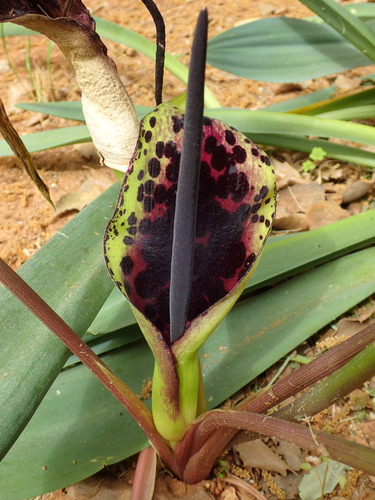
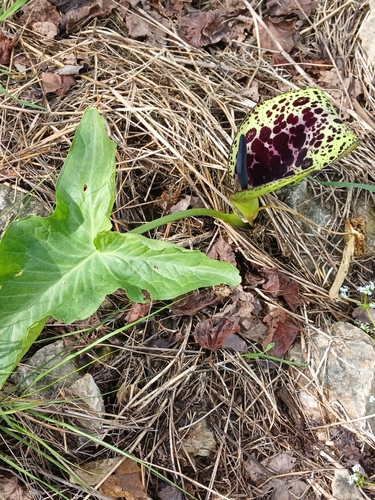
A tuber (corm) plant. It keeps growing from year to year. It grows 20-30 cm high. The leaves are narrow and spearhead shaped. The leaf blades are pointed. They are 13-45 cm long. The leaf stalks are 50 cm long. The flowers have a bad smell. The leaf bract is constricted. It is pale green. It is sometimes tinged purple on the outside. It is red inside. The flower stalk is fleshy and erect. It is black-purple to dark red. It is 28 cm long.
How to Grow
Prefers a humus rich soil and abundant water in the growing season. Grows well in woodland conditions. Succeeds in sun or shade. This species is not hardy in the colder areas of the country, it tolerates temperatures down to between -5 and -10°c. Because it comes into growth in the late autumn it is best grown by a warm wall or in a bulb frame A polymorphic species. The inflorescence is pollinated by flies and it smells of dung and carrion in order to attract the flies. It also has the remarkable ability to heat itself above the ambient air temperature to such a degree that it is quite noticeable to the touch. This probably protects the flowers from damage by frost, or allows it to penetrate frozen ground. Members of this genus are rarely if ever troubled by browsing deer.
Propagation: Seed - best sown in a greenhouse or cold frame as soon as it is ripe. The seed usually germinates in 1 - 6 months at 15°c. Stored seed should be sown in the spring in a greenhouse and can be slow to germinate, sometimes taking a year or more. A period of cold stratification might help to speed up the process. Sow the seed thinly, and allow the seedlings to grow on without disturbance for their first year, giving occasional liquid feeds to ensure that they do not become mineral deficient. When the plants are dormant in the autumn, divide up the small corms, planting 2 - 3 in each pot, and grow them on in light shade in the greenhouse for a further year, planting out when dormant in the autumn. Division of the corms in summer after flowering. Larger corms can be planted out direct into their permanent positions, though it is best to pot up the smaller corms and grow them on for a year in a cold frame before planting them out.
Medicinal Uses
Abortifacient The root is abortifacient.
Other Uses
None known Special Uses Scented Plants
Wikipedia
Source ↗Arum dioscoridis, commonly known as the Spotted arum, is a plant of the arum family (Araceae). The plant was described by James Edward Smith in Flora Graeca (1816). The species is named after the ancient Greek physician and botanist Pedanius Dioscorides. The plant is native to forests in the east of the Mediterranean in southern Turkey, Cyprus, Greece and the Middle East.
Notes
There are 12-26 Arum species.
Names & Synonyms
Luf murakkatm, Sarmalik, Yilan bicagi, Yilan ekmegi, Yilan pancari
References (13)
- Al-Qura'n, S. A., 2010, Ethnobotanical and Ecological Studies of Wild Edible Plants in Jordan. Libyan Agriculture Research Center Journal International 1(4):231-243
- Bircher, A. G. & Bircher, W. H., 2000, Encyclopedia of Fruit Trees and Edible Flowering Plants in Egypt and the Subtropics. AUC Press. p 44
- Blamey, M and Grey-Wilson, C., 2005, Wild flowers of the Mediterranean. A & C Black London. p 504
- Brown, D., 2000, Aroids. Plants of the Arum family. Timber Press. (Second edition) p 318
- Dogan, Y., et al, 2015, Of the importance of a leaf: the ethnobotany of sarma in Turkey and the Balkans. Journal of Ethnobiology and Ethnomedicine, 11:56
- Ertug, F, Yenen Bitkiler. Resimli Türkiye Florası -I- Flora of Turkey - Ethnobotany supplement
- Gunes, S. et al, 2018, Survey of wild food plants for human consumption in Karaisali (Adana-Turkey). Indian Journal of Traditional Knowledge. Vol. 17(2), April 2018, pp 290-298
- Hedrick, U.P., 1919, (Ed.), Sturtevant's edible plants of the world. p 78
- Hibbert, M., 2002, The Aussie Plant Finder 2002, Florilegium. p 33
- Marinelli, J. (Ed), 2004, Plant. DK. p 225
- Plants for a Future database, The Field, Penpol, Lostwithiel, Cornwall, PL22 0NG, UK. http://www.scs.leeds.ac.uk/pfaf/
- Ryan, S., 2008, Dicksonia. Rare Plants Manual. Hyland House. p 121
- Slocum, P.D. & Robinson, P., 1999, Water Gardening. Water Lilies and Lotuses. Timber Press. p 109


