Viola acuminata
Ledeb.
Chicken leg violet
(c) Andrey Efremov, some rights reserved (CC BY-NC), uploaded by Andrey Efremov

(c) Tatyana Petrenko, some rights reserved (CC BY)

(c) Tatyana Petrenko, some rights reserved (CC BY)
What to Eat
Edible parts: Flowers, Leaves
Young leaves and flower buds can be eaten raw or cooked. When added to soup they act as a thickener in much the same way as okra. The flowers are usually purplish or whitish — caution is advised if the plant bears yellow flowers, as these can cause diarrhoea if eaten in large quantities. The leaves can be used to make a tea.
Where to Find It
It is a temperate climate plant. It grows in northeastern China. It grows in moist grassland in valleys near streams between 400-2,500 m above sea level. In Sichuan.
Asia, China, Japan, Korea, Mongolia, Russia, Siberia,
How to Identify
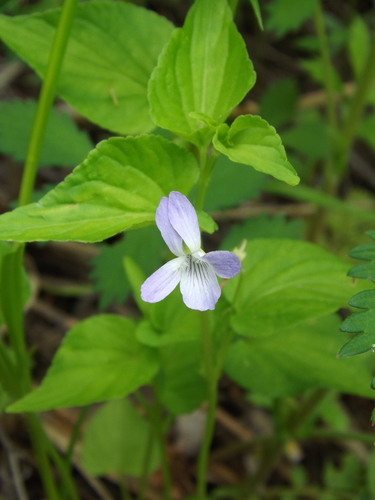
An erect herb. It keeps growing from year to year. It grows 15-40 cm high. The rootstock is stout. There are 2-6 erect stems. These emerge in the spring. The leaves are oval or heart shaped and 4-6 cm long by 3-4 cm wide. There are rounded teeth along the edge. The flowers occur singly and are white or light purple. They are on slender stalks 4-6 cm long.
How to Grow
We have very little information on this species and do not know if it will be hardy in Britain, though judging by its native range it should succeed outdoors in most parts of the country. The following notes are based on the general needs of the genus. Prefers a cool moist well-drained humus-rich soil in partial or dappled shade and protection from scorching winds. Tolerates sandstone and limestone soils but becomes chlorotic if the pH is too high. Prefers a pH between 6 and 6.5. All members of this genus have more or less edible leaves and flower buds, though those species with yellow flowers can cause diarrhoea if eaten in large quantities.
Propagation: Seed is best sown in autumn in a cold frame. Stored seed can be sown in early spring in a cold frame. Prick seedlings into individual pots when large enough to handle and plant out during summer. Divide plants in autumn or just after flowering. Larger divisions can go directly into permanent positions, but smaller divisions do best potted up and grown on in light shade in a greenhouse or cold frame until established, then planted out in summer or the following spring.
Medicinal Uses
None known
Other Uses
None known Special Uses
Wikipedia
Viola acuminata is a perennial growing to 0.3 m tall. Flowers May to June with seeds ripening July to September. Hermaphroditic and insect-pollinated. Tolerates light sandy, medium loamy, and heavy clay soils, preferring well-drained conditions and mildly acidic to neutral pH. Grows in semi-shade to full sun and prefers moist soil.
Notes
There are about 500 Viola species.
Names & Synonyms
Cholbangjebikkot
References (7)
- Fl. ross. 1:252. 1842
- Hu, Shiu-ying, 2005, Food Plants of China. The Chinese University Press. p 561
- Hwang, H., et al, 2013, A Study on the Flora of 15 Islands in the Western Sea of Jeollanamdo Province, Korea. Journal of Asia-Pacific Biodiversity Vol. 6, No. 2 281-310
- Hwang, HS, et al, 2014, Distribution characteristics of plant in the Ungseokbong Mountain, Gyeongsangnam-do, Korea. Journal of Asia-Pacific Biodiversity. 7(2014) e164-e178
- Pemberton, R. W. & Lee, N. S., 1996, Wild Food Plants in South Korea: Market Presence, New Crops, and Exports to the United States. Economic Botany, Vol. 50, No. 1, pp. 57-70
- Plants for a Future database, The Field, Penpol, Lostwithiel, Cornwall, PL22 0NG, UK. http://www.scs.leeds.ac.uk/pfaf/
- Wujisguleng, W., & Khasbagen. K., 2010, An integrated assessment of wild vegetable resources in Inner Mongolian Autonomous Region, China. Journal or Ethnobiology and Ethnomedicine 6:34