Viola cornuta
L.
Horned violet, Bedding pansy
(c) Joan Simon, some rights reserved (CC BY-SA)

(c) emilio2020, some rights reserved (CC BY-NC), uploaded by emilio2020
(c) Laurent Quéno, some rights reserved (CC BY-NC), uploaded by Laurent Quéno
What to Eat
Edible parts: Flowers, Leaves
Young leaves and flower buds can be eaten raw or cooked. Added to soup, they thicken it in much the same way as okra. The flowers can be eaten raw. The leaves also make a pleasant tea.
Where to Find It
It is a temperate plant. It is frost hardy. It suits hardiness zones 7-10.
Asia, Australia, Britain, Europe, India, Pyrenees, Slovenia, Spain,
How to Identify
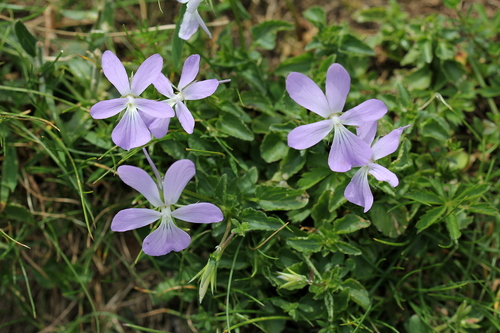
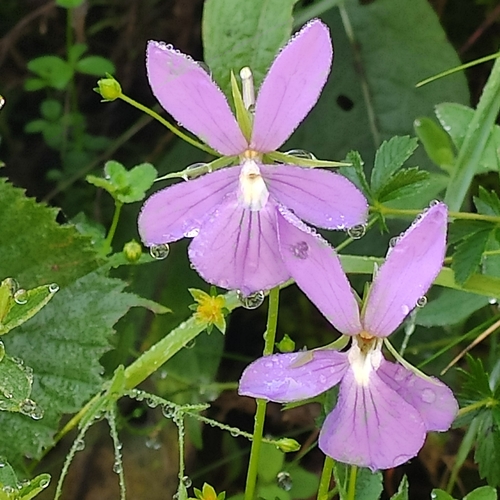
A perennial plant. It grows 15-30 cm high and 38-60 cm wide. It has underground stems or rhizomes. The leaves are oval and 25 mm long. They have shallow teeth. The flowers are 18 mm wide and violet or mauve-blue. They have broad petals and are spurred. The veins are darker and they are yellow in the centre.
How to Grow
Easily grown in any fertile soil in full sun or partial shade. Prefers a well-drained moisture-retentive soil. Tolerates sandstone and limestone soils but becomes chlorotic if the pH is too high. Prefers a pH between 6 and 6.5. A very ornamental plant, there are many named forms. If the plants are cut back after flowering they will flower again in late summer. All members of this genus have more or less edible leaves and flower buds, though those species with yellow flowers can cause diarrhoea if eaten in large quantities. This species has deep-violet flowers.
Propagation: Sow seed in autumn in a cold frame for best results, or sow stored seed in early spring in a cold frame. Prick out seedlings into individual pots once large enough to handle, then plant out during summer. Divide plants in autumn or just after flowering. Larger divisions can go directly into their permanent positions, but smaller divisions are best potted up and grown on in light shade in a greenhouse or cold frame until establishing well, then planted out in summer or the following spring.
Medicinal Uses
None known
Other Uses
Makes a useful ground cover for a cool, open situation. It requires some weeding during the first year or two but then forms an effective weed-excluding carpet. Space plants approximately 60cm apart in each direction.
Wikipedia
Source ↗Viola cornuta, known as horned pansy or horned violet, is a species of flowering plant in the violet family Violaceae, native to the Pyrenees and the Cordillera Cantábrica of northern Spain at an altitude of 1,000–2,300 metres (3,300–7,500 ft). It is a low-growing, clump-forming temperate evergreen perennial, reaching 50 cm (20 in) in height and spread. It has mid-green ovate leaves with rounded teeth, and masses of delicate pale violet flowers in early summer. The flower consists of five strap-shaped petals with a slender spur. This plant, and the white-flowered Alba Group, have gained the Royal Horticultural Society's Award of Garden Merit. It is a known host of the pathogenic fungus Puccinia violae.
Notes
There are about 500 Viola species.
Names & Synonyms
Rogata vijolica
References (9)
- Ambasta, S.P. (Ed.), 2000, The Useful Plants of India. CSIR India. p 679
- Benvenuti, S. & Mazzoncini, M., 2021, The Biodiversity of Edible Flowers: Discovering New Tastes and New Health Benefits. Frontiers in Plant Science Article 569499.
- Cundall, P., (ed.), 2004, Gardening Australia: flora: the gardener's bible. ABC Books. p 1473
- Hibbert, M., 2002, The Aussie Plant Finder 2002, Florilegium. p 307
- http://www.botanic-gardens-ljubljana.com/en/plants
- Joyce, D., 1998, The Garden Plant Selector. Ryland, Peters and Small. p 278
- Morley, B. & Everard, B., 1970, Wild Flowers of the World. Ebury press. Plate 34
- Plants for a Future database, The Field, Penpol, Lostwithiel, Cornwall, PL22 0NG, UK. http://www.scs.leeds.ac.uk/pfaf/
- Sp. pl. ed. 2, 2:1325. 1763