Viola hederacea
Labillardierre
Native violet, Ivy-leaf Violet, Australian violet
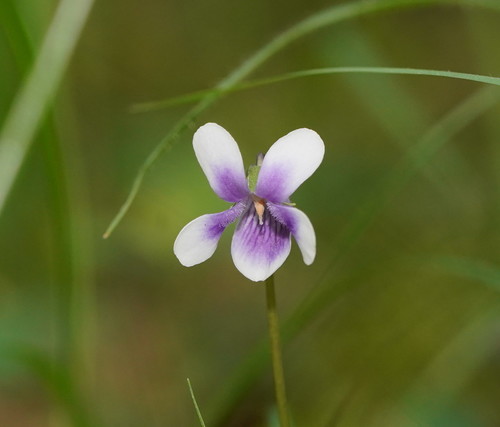
(c) Reiner Richter, some rights reserved (CC BY-NC-SA), uploaded by Reiner Richter
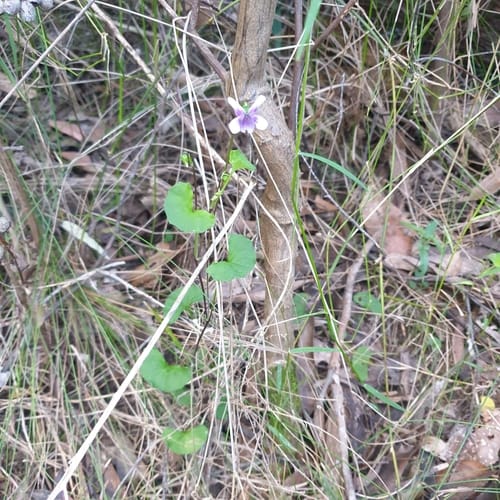
(c) light-up-gold, some rights reserved (CC BY-NC)

(c) Reiner Richter, some rights reserved (CC BY-NC-SA), uploaded by Reiner Richter
What to Eat
Edible parts: Flowers
The flowers are sweet and edible, used in salads.
Where to Find It
It grows in temperate regions. It can grow in the subtropics. It needs well drained soil. It needs to grow in light shade. It can stand light frosts. It grows in woodland and dry forest. It grows up to 2100 m altitude in mountains in S Australia. It suits hardiness zones 8-10. Tasmania Herbarium. Arboretum Tasmania.
Asia, Australia*, China, Hawaii, Malaysia, Myanmar, Pacific, SE Asia, Tasmania*, USA,
How to Identify
A low creeping plant. It grows 5-8 cm high. It spreads 1-2 m wide. It spreads by runners. These produce roots at the nodes. The leaves are like ivy. They are round to kidney shaped and dark green. They are scalloped along the edge. The flowers are purple and white violets and on long stems. The fruit are egg shaped.
How to Grow
Plants are usually grown by separating the plantlets. These develop along creeping stolons. They can be grown from seed. It can be grown by diving the clump.
Wikipedia
Source ↗Viola hederacea, the Australian violet, is a species of flowering plant in the family Violaceae, native to Australia.
Notes
There are about 500 Viola species.
Names & Synonyms
Nila-pan
References (37)
- Anon., 2003, Native Plants for the Fitzroy basin. Society for Growing Australian Plants Inc. (Rockhampton Branch) p 76
- Blomberry, A.M., 1979, Australian Native Plants. Angus and Robertson p 191
- Bodkin, F., 1991, Encyclopedia Botanica. Cornstalk publishing, p 1019
- Brickell, C. (Ed.), 1999, The Royal Horticultural Society A-Z Encyclopedia of Garden Plants. Convent Garden Books. p 1053
- Cameron, M., (Ed.) 1981, A Guide to Flowers & Plants of Tasmania. Reed p 82
- Cherikoff V. & Isaacs, J., The Bush Food Handbook. How to gather, grow, process and cook Australian Wild Foods. Ti Tree Press, Australia p 197
- Collier, P., 1992, Rainforest Plants of Tasmania. Plant Identikit. Society for growing Australian Plants. Tasmania. p 45
- Cronin, L., 1989, The Concise Australian Flora. Reed. p 92
- Cundall, P., (ed.), 2004, Gardening Australia: flora: the gardener's bible. ABC Books. p 1474
- Curtis, W.M., 1956, The Students Flora of Tasmania Vol 1 p 51
- De Angelis, D., 2005, Aboriginal Plant Use of the Greater Melbourne Area. La Trobe University Environment Collective
- Edible and Useful Native Plants (off internet)
- Flora of Australia, Volume 8, Lecythidales to Batales, Australian Government Publishing Service, Canberra (1982) p 96
- Gilfedder, L et al, 2003, The Nature of the Midlands. Midlands Bushweb. PO Box 156 Longford, Tasmania. p 76
- Greig, D., 1996, Flowering Natives for Home Gardens. Angus & Robertson. p 320
- Grieg, D., 2002, A photographic guide to Wildflowers of South-eastern Australia. New Holland. p 136
- Heywood, V.H., Brummitt, R.K., Culham, A., and Seberg, O. 2007, Flowering Plant Families of the World. Royal Botanical Gardens, Kew. p 333
- Hibbert, M., 2002, The Aussie Plant Finder 2002, Florilegium. p 307
- Jackes, B.R., 2001, Plants of the Tropics. Rainforest to Heath. An Identification Guide. James Cook University. p 85
- Jones D, L, 1986, Ornamental Rainforest Plants in Australia, Reed Books, p 281
- Kirkpatrick, J., 1997, Alpine Tasmania, An Illustrated guide to the flora and vegetation. Oxford, p 99
- Lavelle, M., 2008, Wild Flowers of Australia and Oceania. Southwater. p 78
- Lazarides, M. & Hince, B., 1993, Handbook of Economic Plants of Australia, CSIRO. p 247
- Minchin, R.F., Tasmanian Wildflowers. A Field Guide. Volume one. Regal Publications, Launceston p 164
- Molyneux, B. and Forrester, S., 1997, The Austraflora A-Z of Australian Plants. Reed. p 155
- Morley, B. & Everard, B., 1970, Wild Flowers of the World. Ebury press. Plate 130
- Morley, B.D., & Toelken, H.R., (Eds), 1983, Flowering Plants in Australia. Rigby. p 93
- Nicholson, N & H., 1996, Australian Rainforest Plants, Terania Rainforest Publishing. NSW. p 67
- Nov. Holl. pl. 1:66, t. 91. 1805
- Ratcliffe D & P., 1987, Australian Native Plants for Indoors. Little Hills press. p 139
- Ryan, M. (Ed.), 2003, Wild Plants of Greater Brisbane. Queensland Museum. p 55
- Staples, G.W. and Herbst, D.R., 2005, A tropical Garden Flora. Bishop Museum Press, Honolulu, Hawaii. p 570 (Drawing)
- Townsend, K., 1994, Across the Top. Gardening with Australian Plants in the tropics. Society for Growing Australian Plants, Townsville Branch Inc. p 362
- Whiting, J. et al, 2004, Tasmania's Natural Flora. Tasmania's Natural Flora Editorial Committee PO Box 194, Ulverstone, Tasmania, Australia 7315 p 340
- Woolmore, E et al, 2002, King Island Flora: A Field Guide. p 79
- www.ceres.org.au/bushfoodcatalogue
- Yallakool Reserve Plant List July 1, 2009 Off internet