Viola mandshurica
W. Becker
Manchurian violet

(c) Alexander Ganse, some rights reserved (CC BY-NC), uploaded by Alexander Ganse
(c) sergey_stefanov, some rights reserved (CC BY-NC)
(c) sergey_stefanov, some rights reserved (CC BY-NC)
What to Eat
Edible parts: Flowers, Leaves, Root
Young leaves and flower buds can be eaten raw or cooked. Added to soup, they thicken it in much the same way as okra. The root is also edible when cooked. A tea can be made from the leaves.
Where to Find It
It grows on grassy slopes and the edges of forests below 1,000 m above sea level.
Asia, China, Japan, Korea, Manchuria, Russia, Taiwan,
How to Identify
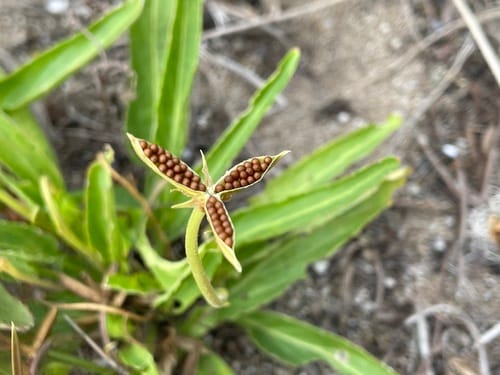
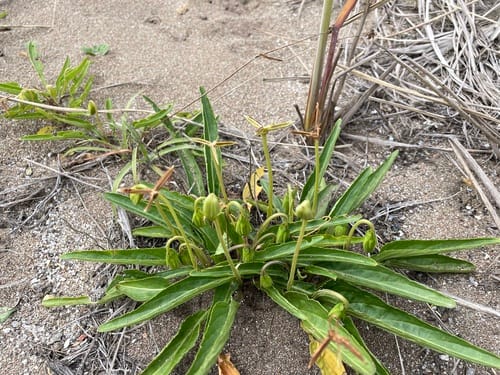
A herb. It keeps growing from year to year. It is 6-18 cm tall. The leaves are narrowly oval and 2-6 cm long by 1-2 cm wide. The flowers are purple to violet. They are 2 cm across.
How to Grow
Prefers a cool moist well-drained humus-rich soil in partial or dappled shade and protection from scorching winds. Tolerates sandstone and limestone soils but becomes chlorotic if the pH is too high. Prefers a pH between 6 and 6.5. All members of this genus have more or less edible leaves and flower buds, though those species with yellow flowers can cause diarrhoea if eaten in large quantities.
Propagation: Sow seed in autumn in a cold frame for best results, or sow stored seed in early spring in a cold frame. Prick out seedlings into individual pots once large enough to handle, then plant out during summer. Divide plants in autumn or just after flowering. Larger divisions can go directly into their permanent positions, but smaller divisions are best potted up and grown on in light shade in a greenhouse or cold frame until establishing well, then planted out in summer or the following spring.
Medicinal Uses
None known
Other Uses
None known
Wikipedia
Source ↗Viola mandshurica is a perennial species of violet known by the common names dōng běi jǐn cài (zh:东北堇菜) meaning 'northeastern violet' in China, jebikkot (ko:제비꽃) meaning 'sparrow flower' in Korea, and sumire (ja:菫, ja:スミレ) meaning 'violet' in Japan. In Japan, V. mandshurica is considered to be the basic species and other violet species have additional descriptors such as himesumire or nojisumire. Its specific name is derived from Manchuria, an area of its native habitat which has at different times in history included parts of modern China, Korea, Mongolia and the Russian Far East.
Notes
There are about 500 Viola species.
Names & Synonyms
Jebikkot
References (7)
- BARANOV,
- Bot. Jahrb. Syst. 54:179. 1917
- Chen, B. & Qiu, Z., Consumer's Attitudes towards Edible Wild Plants, Ishikawa Prefecture, Japan. p 26 www.hindawi.com/journals/ijfr/aip/872413.pdf
- Hwang, H., et al, 2013, A Study on the Flora of 15 Islands in the Western Sea of Jeollanamdo Province, Korea. Journal of Asia-Pacific Biodiversity Vol. 6, No. 2 281-310
- Hwang, HS, et al, 2014, Distribution characteristics of plant in the Ungseokbong Mountain, Gyeongsangnam-do, Korea. Journal of Asia-Pacific Biodiversity. 7(2014) e164-e178
- Kim, H. & Song, M., 2013, Ethnobotanical analysis for traditional knowledge of wild edible plants in North Jeolla Province (Korea). Genetic. Resour. Crop Evol. (2013) 60:1571-1585
- Plants for a Future database, The Field, Penpol, Lostwithiel, Cornwall, PL22 0NG, UK. http://www.scs.leeds.ac.uk/pfaf/