Arum maculatum
L.
Cuckoo Pint, Lords and Ladies, Portland arrowroot

(c) cassandra_li, some rights reserved (CC BY-NC)

(c) Kai-Philipp Schablewski, some rights reserved (CC BY-NC), uploaded by Kai-Philipp Schablewski
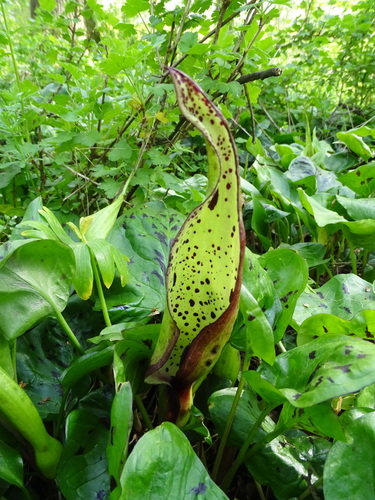
(c) Grzegorz Grzejszczak, some rights reserved (CC BY-SA), uploaded by Grzegorz Grzejszczak
What to Eat
Edible parts: Roots, Leaves, Corm
Edible Parts: Leaves Root Edible Uses: Tuber - cooked and used as a vegetable. A mild flavour, the root contains about 25% starch. A farina can be extracted from the root. Roots can be harvested at any time of the year, though they are best when the plant is dormant. At one time, the tubers of this plant were commonly harvested and used for food, but they are very rarely used nowadays[268, K]. The root must be thoroughly dried or cooked before being eaten, see the notes above on toxicity. Leaves - must be well cooked. Available from late winter. Caution is advised, see the notes above on toxicity.
Known Hazards
Where to Find It
It is a temperate climate plant. It grows in ditches, hedgerows and often close to old buildings. It suits hardiness zones 6-9.
Africa, Albania, Asia, Australia, Balkans, Bosnia, Britain*, Czech Republic, Europe, France, Greece, Iran, Ireland, Italy, Luxembourg, Macedonia, Mediterranean, Middle East, Myanmar, North Africa, Portugal, SE Asia, Slovenia, Spain, Tunisia, Turkey, Türkiye,
How to Identify
A tuber forming plant. The roots are thick and like tubers. It grows 25 cm high and spreads 20-40 cm wide. The leaves are on long stems. The leaves are arrowhead shaped. They are 20 cm long. The flowers have a purple-pink spadix or stalk in the centre surrounded by a pale green spathe. The fruit are orange-red.
How to Grow
Prefers a humus rich soil and abundant water in the growing season. Prefers a shady damp calcareous soil. Succeeds in sun or shade. Plants are very shade tolerant and grow well in woodland conditions. The inflorescence has the remarkable ability to heat itself above the ambient air temperature to such a degree that it is quite noticeable to the touch. Temperature rises of 11°c have been recorded. At the same time, the flowers emit a foul and urinous smell in order to attract midges for pollination. The smell disappears once the flower has been pollinated. Members of this genus are rarely if ever troubled by browsing deer.
Propagation: Seed - best sown in a greenhouse or cold frame as soon as it is ripe. The seed usually germinates in 1 - 6 months at 15°c. Stored seed should be sown in the spring in a greenhouse and can be slow to germinate, sometimes taking a year or more. A period of cold stratification might help to speed up the process. Sow the seed thinly, and allow the seedlings to grow on without disturbance for their first year, giving occasional liquid feeds to ensure that they do not become mineral deficient. When the plants are dormant in the autumn, divide up the small corms, planting 2 - 3 in each pot, and grow them on in light shade in the greenhouse for a further year, planting out when dormant in the autumn. Division of the corms in summer after flowering. Larger corms can be planted out direct into their permanent positions, though it is best to pot up the smaller corms and grow them on for a year in a cold frame before planting them out.
Medicinal Uses
Antirheumatic Diaphoretic Diuretic Expectorant Homeopathy Purgative Vermifuge Cuckoo pint has been little used in herbal medicine and is generally not recommended for internal use. The shape of the flowering spadix has a distinct sexual symbolism and the plant did have a reputation as an aphrodisiac, though there is no evidence to support this. The root is diaphoretic, diuretic, expectorant, strongly purgative and vermifuge. It should be harvested in the autumn or before the leaves are produced in the spring. It can be stored fresh in a cellar in sand for up to a year or can be dried for later use. The plant should be used with caution, see notes above on toxicity. The bruised fresh plant has been applied externally in the treatment of rheumatic pain. A liquid from the boiled bark (of the stem?) has been used in the treatment of diarrhoea. A homeopathic remedy is prepared from the root and leaves. It has been used in the treatment of sore throats.
Other Uses
Starch Starch from the root has been used as a laundry starch for stiffening clothes. Its use is said to be very harsh on the skin, producing sores and blisters on the hands of the laundresses who have to use it, though another report says that the powdered root makes a good and innocent cosmetic that can be used to remove freckles. Special Uses
Wikipedia
Source ↗Arum maculatum, commonly known as cuckoopint, jack-in-the-pulpit and other names (see common names), is a woodland flowering plant species in the family Araceae. It is native across most of Europe, as well as Eastern Turkey and the Caucasus.
Notes
It should not be eaten in large quantities. There are 12-26 Arum species.
Names & Synonyms
Adder's root, Aron plamaty, Bobbins, Kozlac pjegavi, Nifik, Pegasti kačnik, Snakeshead, Starch-root, Wake robin, Yilan ekmegi, Yilan yastigi, Zmijsko grozje
References (26)
- Aberoumand, A., 2008, Comparison of protein values from seven wild edible plants of Iran. African Journal of Food Science. Vol 2. pp 73-76
- Bircher, A. G. & Bircher, W. H., 2000, Encyclopedia of Fruit Trees and Edible Flowering Plants in Egypt and the Subtropics. AUC Press. p 44
- Blamey, M and Grey-Wilson, C., 2005, Wild flowers of the Mediterranean. A & C Black London. p 503
- Bodkin, F., 1991, Encyclopedia Botanica. Cornstalk publishing, p 105
- BOUQUET
- Brown, D., 2000, Aroids. Plants of the Arum family. Timber Press. (Second edition) p 271
- Cundall, P., (ed.), 2004, Gardening Australia: flora: the gardener's bible. ABC Books. p 192
- Dogan, Y., et al, 2004, The Use of Wild Edible Plants in Western and Central Anatolia (Turkey). Economic Botany 58(4) pp. 684-690
- Dogan, Y., 2012, Traditionally used wild edible greens in the Aegean Region of Turkey. Acta Societatis Botanicorum Poloniae 81(4): 329-342
- Dogan, Y., et al, 2015, Of the importance of a leaf: the ethnobotany of sarma in Turkey and the Balkans. Journal of Ethnobiology and Ethnomedicine, 11:56
- Ertug, F, Yenen Bitkiler. Resimli Türkiye Florası -I- Flora of Turkey - Ethnobotany supplement
- Harter, J.(Ed.), 1988, Plants. 2400 copyright free illustrations. Dover p 25.2
- Hedrick, U.P., 1919, (Ed.), Sturtevant's edible plants of the world. p 78
- Heywood, V.H., Brummitt, R.K., Culham, A., and Seberg, O., 2007, Flowering Plant Families of the World. Royal Botanical Gardens, Kew. p 347
- Huxley, A. (Ed.), 1977, The Encyclopedia of the Plant Kingdom. Chartweil Books. p 43, 98
- Irving, M., 2009, The Forager Handbook, A Guide to the Edible Plants of Britain. Ebury Press p 316
- Lim, T. K., 2015, Edible Medicinal and Non Medicinal Plants. Volume 9, Modified Stems, Roots, Bulbs. Springer p 12
- Mabey, R., 1973, Food for Free. A Guide to the edible wild plants of Britain, Collins. p 73
- Morley, B. & Everard, B., 1970, Wild Flowers of the World. Ebury press. Plate 67
- PARMENTIER (As Arum vulgare)
- Plants for a Future database, The Field, Penpol, Lostwithiel, Cornwall, PL22 0NG, UK. http://www.scs.leeds.ac.uk/pfaf/
- Polat, R., et al, 2015, Survey of wild food plants for human consumption in Elazig (Turkey). Indian Journal of Traditional Knowledge. Vol. 1(1): 69-75
- Redzic, S. J., 2006, Wild Edible Plants and their Traditional Use in the Human Nutrition in Bosnia-Herzegovina. Ecology of Food and Nutrition, 45:189-232
- Rexhepi. B., et al, 2018, Three Ethnic groups, One Territory: Perspectives of an ethnobotanical study from Southwestern Macedonia. UNIVERSI - International Journal of Education, Science, Technology, Innovation, Health and Environment. Vol 4 (1) p 75
- Simkova, K. et al, 2014, Ethnobotanical review of wild edible plants used in the Czech Republic. Journal of Applied Botany and Food Quality 88, 49-67
- Sp. pl. 2:966. 1753


