Viola pedata
L.
Bird's foot violet, Pansy violet, Wild okra
no rights reserved
no rights reserved
no rights reserved
What to Eat
Edible parts: Flowers, Leaves, Leaves - tea
Young leaves and flower buds can be eaten raw or cooked. When added to soup, they act as a thickener much like okra. A tea can be brewed from the leaves. The flowers are also candied. Some caution is advised if the plant has yellow flowers, as these can cause diarrhoea if eaten in large quantities.
Known Hazards
Where to Find It
It is a temperate plant. It suits hardiness zones 4-9.
Australia, North America, USA,
How to Identify
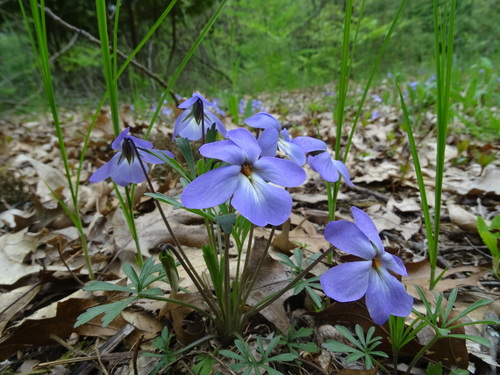
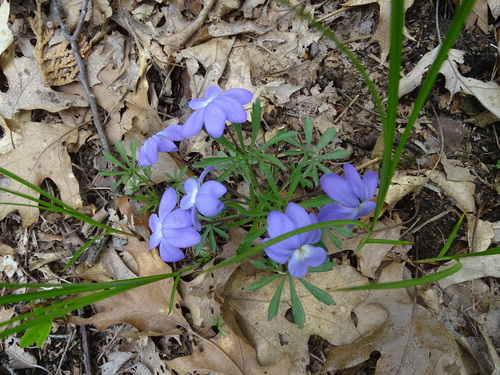
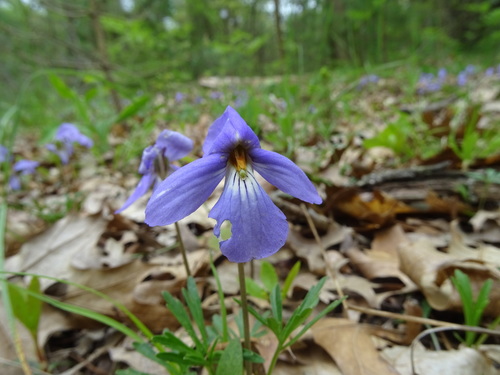
A stemless plant. It grows 10-15 cm high and spreads 20-40 cm wide. It spreads by runners. The leaves have 5 narrow lobes spread out like fingers on a hand. The flowers are 30 mm wide and have spurs. The petals are downy. The flowers are blue. The upper petals and veins are darker.
How to Grow
A beautiful species but very difficult in cultivation. It requires a very well-drained soil plus warmth and moisture in the summer. Some people have recommended that it should be grown on a clay soil, unpoisoned by humus. It has been seen growing on the shaley bank of a newly-made road in full sun. Cool moist well-drained humus-rich soil in partial or dappled shade and protection from scorching winds. Tolerates sandstone and limestone soils but becomes chlorotic if the pH is too high. Prefers a pH between 6 and 6.5. All members of this genus have more or less edible leaves and flower buds, though those species with yellow flowers can cause diarrhoea if eaten in large quantities.
Propagation: Seed is best sown in autumn in a cold frame. Stored seed can be sown in early spring in a cold frame. Prick out seedlings into individual pots when large enough to handle and plant out in summer. Divide plants in autumn or just after flowering. Larger divisions can go straight into permanent positions, but smaller divisions are better potted up and grown on in light shade in a greenhouse or cold frame until establishing well, then planted out in summer or the following spring.
Medicinal Uses
A poultice of the leaves has been used to relieve headache pain. An infusion of the plant has been used to treat dysentery, coughs, and colds. A poultice of crushed root has been applied to boils.
Other Uses
An infusion of the root has been used to soak corn seeds before planting to deter insects. The flowers attract long-tongued bees, small butterflies, and skippers; spring bee visitors include bumblebees and Anthophorine bees. Compared to other violets, this species attracts more butterflies and skippers, whose horizontal flower orientation makes landing easier. Caterpillars of various Fritillary butterflies feed on the foliage and flowers, and caterpillars of Speyeria idalia (Regal Fritillary) may prefer this species over others. Ants are attracted to the sugary gel on the seeds and help to disperse them. Suitable landscape uses include alpine gardens, borders, rock gardens, and woodland gardens.
Wikipedia
Source ↗Viola pedata, the birdsfoot violet, bird's-foot violet, or mountain pansy, is a violet native to sandy areas in central and eastern North America.
Notes
There are about 500 Viola species.
References (6)
- Cundall, P., (ed.), 2004, Gardening Australia: flora: the gardener's bible. ABC Books. p 1474
- Facciola, S., 1998, Cornucopia 2: a Source Book of Edible Plants. Kampong Publications, p 245
- Kermath, B. M., et al, 2014, Food Plants in the Americas: A survey of the domesticated, cultivated and wild plants used for Human food in North, Central and South America and the Caribbean. On line draft. p 914
- Loughmiller, C & L., 1985, Texas Wildflowers. A Field Guide. University of Texas, Austin. p 239
- Plants for a Future database, The Field, Penpol, Lostwithiel, Cornwall, PL22 0NG, UK. http://www.scs.leeds.ac.uk/pfaf/
- Sp. pl. 2:933. 1753