Viola pedunculata
Torr. & A. Gray
Grass pansy, California Golden Violet

(c) Naomi Fraga, some rights reserved (CC BY-NC-SA), uploaded by Naomi Fraga
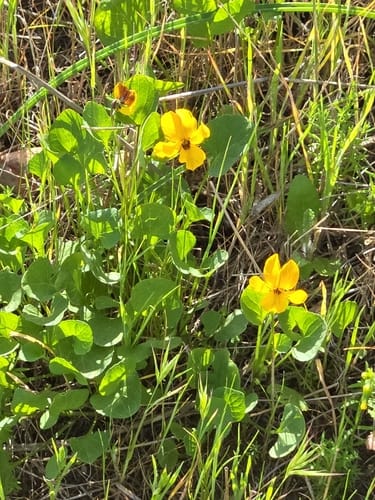
(c) Jason Cerulli, some rights reserved (CC BY-NC)

(c) madge, some rights reserved (CC BY-NC)
What to Eat
Edible parts: Flowers, Leaves
Young leaves and flower buds can be eaten raw or cooked. When added to soup, they act as a thickener much like okra. Leaves are best harvested before the flowers open in spring. A tea can be brewed from the leaves. Caution is advised: the yellow flowers of this species can cause diarrhoea if eaten in large quantities.
Known Hazards
Where to Find It
It is a temperate plant.
North America, USA,
How to Identify
A perennial hardy to UK zone 8. Flowers in May. Hermaphroditic and insect-pollinated. Tolerates light sandy, medium loamy, and heavy clay soils with good drainage. Prefers mildly acid to neutral pH and moist conditions. Grows in semi-shade or full sun.
How to Grow
Prefers a cool moist well-drained humus-rich soil in partial or dappled shade and protection from scorching winds. Tolerates sandstone and limestone soils but becomes chlorotic if the pH is too high. Prefers a pH between 6 and 6.5. Plants are not very hardy in Britain, though they should succeed outdoors in the milder areas of the country. Plants grow and flower during the winter and early spring in California, dying down in the summer. All members of this genus have more or less edible leaves and flower buds, though those species, such as this one, that have yellow flowers can cause diarrhoea if eaten in large quantities.
Propagation: Seed is best sown in autumn in a cold frame. Stored seed can be sown in early spring in a cold frame. Prick out seedlings into individual pots when large enough to handle and plant out in summer. Divide plants in autumn or just after flowering. Larger divisions can go straight into permanent positions, but smaller divisions are better potted up and grown on in light shade in a greenhouse or cold frame until establishing well, then planted out in summer or the following spring.
Medicinal Uses
None known
Other Uses
No other uses known.
Wikipedia
Source ↗Viola pedunculata, the California golden violet, Johnny jump up, or yellow pansy, is a perennial yellow wildflower of the coast and coastal ranges in California and northwestern Baja California. However, the common name "Johnny jump up" is usually associated with Viola tricolor, an introduced garden annual. The plant grows on open, grassy slopes, in chaparral habitats, and in oak woodlands, from sea level to around 3,280 feet (1,000 m). It prefers part shade, but will tolerate sun in many locations.
Notes
There are about 500 Viola species.
References (4)
- Beckstrom-Sternberg, Stephen M., and James A. Duke. "The Foodplant Database." http://probe.nalusda.gov:8300/cgi-bin/browse/foodplantdb.(ACEDB version 4.0 - data version July 1994)
- Fl. N. Amer. 1:141. 1838
- Moerman, D. F., 2010, Native American Ethnobotany. Timber Press. p 597
- Plants for a Future database, The Field, Penpol, Lostwithiel, Cornwall, PL22 0NG, UK. http://www.scs.leeds.ac.uk/pfaf/