Viola sempervirens
Greene
Redwood violet, Evergreen violet

(c) Nick Turland, some rights reserved (CC BY-NC-ND)
(c) vladimir_epiktetov, some rights reserved (CC BY-NC), uploaded by vladimir_epiktetov

(c) Jennifer Rycenga, some rights reserved (CC BY-NC), uploaded by Jennifer Rycenga
What to Eat
Edible parts: Flowers, Leaves
Young leaves and flower buds can be eaten raw or cooked. When stirred into soups, they act as a thickener much like okra. Note that this plant has yellow flowers, and eating the leaves in large quantities can cause diarrhoea, so some caution is advised. The flowers are edible raw, and the leaves can be brewed into a tea.
Where to Find It
It suits hardiness zones 6-9.
Australia, North America, USA,
How to Identify
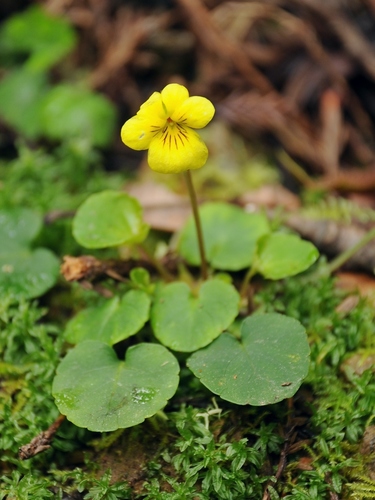
A low spreading plant. It grows 5-10 cm high and spreads 20-45 cm wide. The leaves are broadly oval and pointed. It keeps its leaves. The leaves are 30 mm long and wide and have teeth and are slightly downy. The flowers are yellow and have brown veins. They are 25 mm wide.
How to Grow
Prefers a cool moist well-drained humus-rich soil in partial or dappled shade and protection from scorching winds. Tolerates sandstone and limestone soils but becomes chlorotic if the pH is too high. Prefers a pH between 6 and 6.5. All members of this genus have more or less edible leaves and flower buds, though those species with yellow flowers can cause diarrhoea if eaten in large quantities.
Propagation: Sow seed in autumn in a cold frame for best results; stored seed can be sown in early spring in a cold frame instead. Prick seedlings out into individual pots once large enough to handle and plant out during summer. Divide plants in autumn or just after flowering. Larger divisions can go straight into their permanent positions, but smaller divisions do better when potted up and grown on in light shade in a greenhouse or cold frame until established, then planted out in summer or the following spring.
Medicinal Uses
None known.
Other Uses
None known.
Wikipedia
Source ↗Viola sempervirens, known by the common names redwood violet and evergreen violet, is a species in the genus Viola. It is native to the West Coast of the United States and British Columbia, Canada, and grows in closed-cone pine forest, California mixed evergreen forest, Douglas fir forest communities, and very frequently redwood forests. It is a small herbaceous plant that has leathery purple-spotted green leaves and bright yellow flowers. Often found in wetter regions under tree cover. It blooms in late winter and spring.
Production
It is very slow growing.
Notes
There are about 500 Viola species.
References (3)
- Cundall, P., (ed.), 2004, Gardening Australia: flora: the gardener's bible. ABC Books. p 1474
- Pittonia 4:8. 1899
- Plants for a Future database, The Field, Penpol, Lostwithiel, Cornwall, PL22 0NG, UK. http://www.scs.leeds.ac.uk/pfaf/