Virectaria procumbens
(Sm.) Bremek.
RubiaceaeLeaves
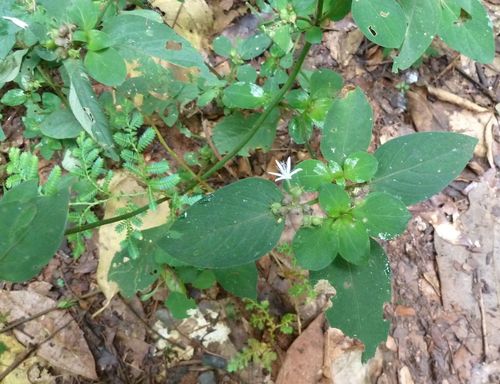
iNaturalist · cc-by-nc
(c) Carel Jongkind, some rights reserved (CC BY-NC), uploaded by Carel Jongkind
(c) Carel Jongkind, some rights reserved (CC BY-NC), uploaded by Carel Jongkind

iNaturalist · cc-by
(c) Justin Ponder, some rights reserved (CC BY)
(c) Justin Ponder, some rights reserved (CC BY)
What to Eat
Edible parts: Leaves
The leaves are eaten.
Where to Find It
A tropical plant. It grows in flooded rice fields and forests along rivers.
Africa, Angola, Cameroon, Central Africa, Central African Republic, CAR, Congo, Congo DR, Côte d'Ivoire, Equatorial Guinea, Gabon, Ghana, Guinea, Guinée, Guinea-Bissau, Ivory Coast, Liberia, Nigeria, Sierra Leone, West Africa,
Countries: Angola, Burkina Faso, Burundi, Benin, Botswana, Congo (DRC), Central African Republic, Congo (Republic), Cote d'Ivoire, Cameroon, Cape Verde, Djibouti, Algeria, Egypt, Eritrea, Ethiopia, Gabon, Ghana, Gambia, Guinea, Equatorial Guinea, Guinea-Bissau, Kenya, Comoros, Liberia, Lesotho, Libya, Morocco, Madagascar, Mali, Mauritania, Mauritius, Malawi, Mozambique, Namibia, Niger, Nigeria, Rwanda, Seychelles, Sudan, Sierra Leone, Senegal, Somalia, South Sudan, Sao Tome & Principe, Eswatini, Chad, Togo, Tunisia, Tanzania, Uganda, South Africa, Zambia, Zimbabwe
How to Identify
A straggling annual herb. It grows 30 cm high. It often forms roots at the nodes. The flowers are white.
Medicinal Uses
The leaves are used as medicine.
Notes
The leaves are used as medicine.
Names & Synonyms
Alanba, Kwalu, Sokoi buru
Virecta procumbens Sm.
References (3)
- Burkill, H. M., 1985, Vol. 4
- Jardin, C., 1970, List of Foods Used In Africa, FAO Nutrition Information Document Series No 2.p 109
- Martin, F.W. & Ruberte, R.M., 1979, Edible Leaves of the Tropics. Antillian College Press, Mayaguez, Puerto Rico. p 201


