Vitex acuminata
R. Br.
Bush grape, Black plum
(c) Thomas Mesaglio, some rights reserved (CC BY), uploaded by Thomas Mesaglio
(c) Thomas Mesaglio, some rights reserved (CC BY)
What to Eat
Edible parts: Fruit
The ripe fruit are eaten and are highly regarded as food.
Known Hazards
Where to Find It
A tropical plant. It grows naturally in monsoon vine forests in coastal regions. It needs well-drained soil. In tropical Queensland it grows from sea level to 550 m altitude.
Australia*,
How to Identify
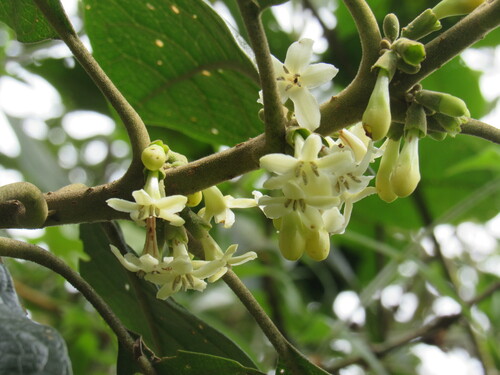
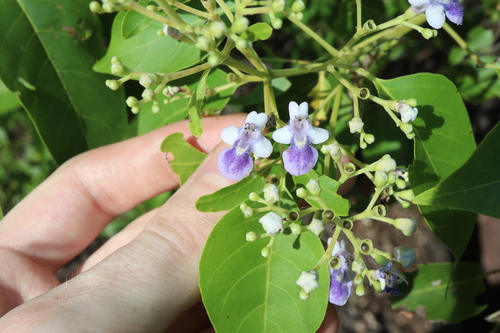
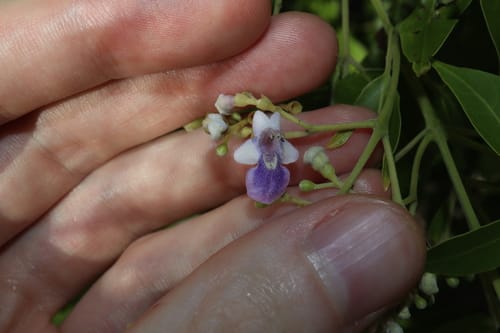
A moderate sized tree. It grows 7-15 m high. It can be 23 m tall. It loses many leaves during the year. It has a spreading habit. The leaves are opposite and have 3 leaflets. The central leaflet is the longest. The leaflet blades are 5-15.5 cm long by 2-5.5 cm wide. They are green and the veins are distinct. The stalk has fine hairs and is 2-10 cm long. The flowers are blue with a cream throat. They are like tubes and 0.8-1 cm long. Several flowers occur together in groups 8-15 cm long by 8-10 cm wide. They are either at the ends of branches of in the upper leaf axils. The fruit is smooth and round. It is fleshy. The fruit is 0.5-1 cm long by 0.4-0.8 cm wide. The fruit turn purple black when ripe. There are 4 seeds inside a woody shell.
How to Grow
Plants can be grown from seed or cuttings.
Other Information
It is a highly regarded food.
Notes
There are 250 Vitex species. They grow in the tropics. Also put in the family Verbenaceae.
Names & Synonyms
Anbalindja, Wurnika
References (13)
- Brock, J., 1993, Native Plants of Northern Australia, Reed. p 327
- Cherikoff V. & Isaacs, J., The Bush Food Handbook. How to gather, grow, process and cook Australian Wild Foods. Ti Tree Press, Australia p 201
- Cooper, W. and Cooper, W., 2004, Fruits of the Australian Tropical Rainforest. Nokomis Editions, Victoria, Australia. p 240
- Garde, M., et al, 2003, A Preliminary List of Kundedjnjenghmi Plant Names. Northern Land Council. (Arnhem Land, Australia)
- Heywood, V.H., Brummitt, R.K., Culham, A., and Seberg, O. 2007, Flowering Plant Families of the World. Royal Botanical Gardens, Kew. p 179 (Family)
- Lazarides, M. & Hince, B., 1993, Handbook of Economic Plants of Australia, CSIRO. p 247
- Paczkowska, G . & Chapman, A.R., 2000, The Western Australian Flora. A Descriptive Calatogue. Western Australian Herbarium. p 567
- Prodr. 512. 1810
- Tiwi Plants and Animals. 2001, Aboriginal flora and fauna knowledge from Bathurst and Melville Islands, northern Australia. Northern Territory Botanical Bulletin; No. 24 p 89
- Townsend, K., 1994, Across the Top. Gardening with Australian Plants in the tropics. Society for Growing Australian Plants, Townsville Branch Inc. p 362
- Vigilante, T., et al, 2013, Island country: Aboriginal connections, values and knowledge of the Western Kimberley islands in the context of an island biological survey. Records of the Western Australian Museum Supplement 81: 145-182
- Wheeler, J.R.(ed.), 1992, Flora of the Kimberley Region. CALM, Western Australian Herbarium, p 792
- Williams, K.A.W., 1999, Native Plants of Queensland Volume 4. Keith A.W. Williams North Ipswich, Australia. p 380