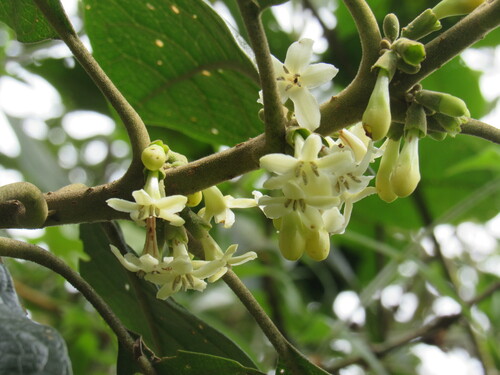
Vitex micrantha
Gurke

Ehoarn Bidault & West and Central Africa Program.

Ehoarn Bidault & West and Central Africa Program.

Ehoarn Bidault & West and Central Africa Program.
What to Eat
Edible parts: Fruit
Fruits raw or cooked. Fleshy. They can be used to make an alcoholic drink. The purplish-black fruit is an ellipsoid drupe about 15mm long.
Where to Find It
A tropical plant. It is an understorey tree of the lowland evergreen forest.
Africa, Côte d'Ivoire, Ghana, Guinea, Guinée, Ivory Coast, Liberia, Sierra Leone, West Africa,
How to Identify
A tree. It is evergreen and grows 27 m tall. The trunk is 60 cm across. The bark is grey, cracked and scaly. The leaves are opposite and compound. There are 3-5 leaflets arranged like fingers on a hand. The leaflets are broadly oval and 9-12 cm long by 2-3 cm wide.
How to Grow
Plants are grown from seed. Seeds germinate after about 5 months.
Propagation: Seed - germination rates are often low, with the seed starting to sprout 5 months or more after sowing.
Medicinal Uses
The leaves are applied externally to treat onchocerciasis (craw-craw). Various parts of the plant are probably used in similar ways to those of Vitex doniana. These uses are:- The fruit is used to improve fertility and to treat anaemia, jaundice, leprosy and dysentery. Both the dried and the fresh fruits are eaten as a treatment against diarrhoea The root is anodyne. A decoction is used to treat gonorrhoea, ankylostomiasis, rickets, gastro-intestinal disorders and jaundice. A decoction of the root is drunk by women to treat backaches. The leaves are anodyne, febrifuge, galactagogue and tonic. A decoction is taken internally as a tonic and to treat fevers and respiratory diseases. It is applied externally to increase milk flow and as a treatment for headache, stiffness, measles, rash, fever, chickenpox and hemiplegia. The young tender leaves are pounded and the juice squeezed into the eyes to treat conjunctivitis and other eye troubles. A paste made from the pounded leaves and bark is applied to wounds and burns. The powdered bark is added to water and then taken to treat colic. A bark extract is used to treat stomach complaints, kidney troubles, leprosy, liver diseases, and to control bleeding after childbirth.
Other Uses
The heartwood is creamy white to pale yellowish brown, darkening on exposure, and indistinctly demarcated from the sapwood. The grain is straight to wavy; texture moderately fine and even, the wood fairly lustrous. The wood is not durable and is liable to termite, powder post beetle and marine borer attacks. It is easy to saw and work with hand and machine tools; it planes to a smooth surface and finishes well; it glues satisfactorily. Veneer of good quality can be produced, but the shape of the bole is often too poor for rotary cutting. The wood is used on a local scale for light construction, drums and writing boards. It is suitable for light flooring, joinery, interior trim, shipbuilding, furniture, cabinet work, toys, novelties, boxes, crates, veneer, plywood, hardboard, particle board and pulpwood.
Notes
Also put in the family Verbenaceae.
Names & Synonyms
Andofiti, Gbema, Ketebobove, Sah-sah
References (6)
- Abbiw, D.K., 1990, Useful Plants of Ghana. West African uses of wild and cultivated plants. Intermediate Technology Publications and the Royal Botanic Gardens, Kew. p 48
- Burkill, H. M., 1985, The useful plants of west tropical Africa, Vol. 1. Kew.
- Hwang, L. C., et al, 2020, Traditional Botanical Uses of Non-Timber Forest Products (NTFP) in Seven Counties in Liberia. ACS Symposium Series; American Chemical Society: Washington, DC, 2020.
- Jardin, C., 1970, List of Foods Used In Africa, FAO Nutrition Information Document Series No 2.p 168
- Lemmens, R.H.M.J., 2008. Vitex micrantha Gürke. [Internet] Record from Protabase. Louppe, D., Oteng-Amoako, A.A. & Brink, M. (Editors). PROTA (Plant Resources of Tropical Africa), Wageningen, Netherlands. < http://database.prota.org/search.htm>. Accessed 23 October 2009
- World Checklist of Useful Plant Species 2020. Royal Botanic Gardens, Kew