Vitex negundo
L.
Chinese vitex, Indian Privet, Five-leaved chaste tree

(c) 王美芳, some rights reserved (CC BY-NC)
no rights reserved, uploaded by 葉子
(c) Jim Walker, some rights reserved (CC BY-NC)
What to Eat
Edible parts: Seeds, Roots - tea, Leaves - tea, Fruit, Leaves
The seed is occasionally used as a condiment and pepper substitute. When washed to remove bitterness it can be ground into a flour, though it is very much a famine food used only when other options are exhausted. A tea is made from the roots and leaves.
Where to Find It
It grows in subtropical uplands. It grows in moist places and near water and up to 1,700 m above sea level. It can grow in arid places. It suits hardiness zone 8. At MARDI.
Afghanistan, Africa, Asia, Australia, Bangladesh, Britain, Cambodia, Caroline Islands, China, Cuba, East Africa*, Europe, Fiji, France, Guam, Haiti, Himalayas, India, Indochina, Indonesia, Iran, Japan, Kenya, Korea, Madagascar, Malaysia, Maldives, Mariana Islands, Mauritius, Micronesia, Middle East, Mozambique, Myanmar, Nepal, Niue, Northeastern India, Pacific, Pakistan, Palau, Philippines, Samoa, SE Asia, Sikkim, Singapore, Somalia, Sri Lanka, Taiwan, Tanzania, Thailand, Tibet, Trinidad-Tobago, USA, Vanuatu, Vietnam, West Indies,
How to Identify
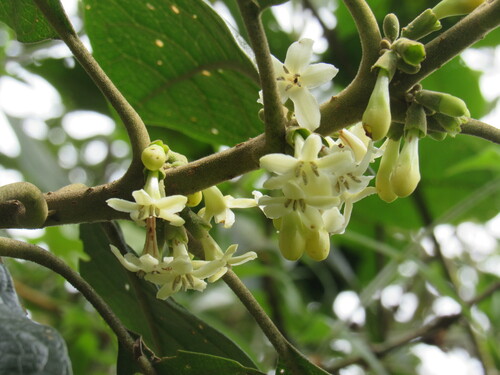
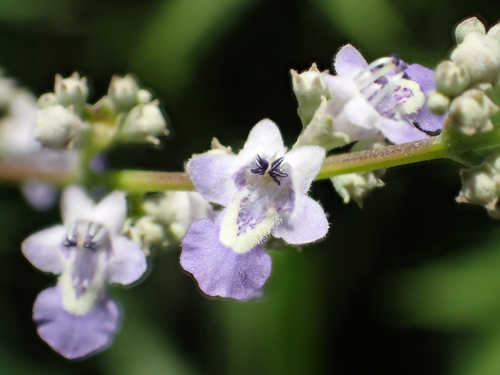
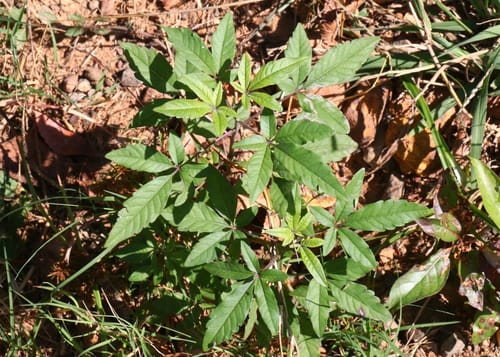
A small bush. It loses its leaves during the year. It can grow 5-10 m high. The leaves are compound and with 3-5 leaflets. These are sword shaped and have stalks. They are 4-12 cm long. They are dark green on the upper surface and have whitish hairs underneath. The flowers are in a spreading cluster. They are light blue or purple. The flowers are about 1 cm long. The fruit are about 1 cm across.
How to Grow
An easily grown plant, it prefers a light well-drained loamy soil in a warm sunny position sheltered from cold drying winds. Succeeds in poor dry soils. Plants tolerate temperatures down to about -10°c. They are not very hardy in Britain, they succeed outdoors at Kew, but in general are best given the protection of a sunny wall outside the milder areas of the country. Plants only flower freely after a warm summer, so they are best grown against a sunny wall even in areas where they are hardy. The flowers are produced so late in the season that they are unlikely to produce viable seed in this country even if they flower properly. The plants require abundant summer sunshine in order to ripen their wood fully, the well-ripened wood is more frost resistant. There are some named forms, selected for their ornamental value. The leaves and stems are strongly aromatic. The flowers have a most pronounced musk-like perfume.
Propagation: Sow seed in March in a greenhouse; no pre-treatment is needed and germination is usually free and quick. Prick out seedlings into individual pots when large enough to handle and overwinter in the greenhouse. Plant out into permanent positions in early summer the following year. Alternatively, take half-ripe wood cuttings 5–8 cm with a heel in July or August in a frame — a good percentage can be expected. Cuttings of mature wood from the current season's growth can also be taken in November in a cold frame.
Medicinal Uses
This species is widely used in Chinese herbal medicine and is the second most important treatment for chronic bronchitis (specifically the sub-species V. negundo cannabifolia). The leaves are astringent, febrifuge, sedative, tonic, and vermifuge. They are useful for dispersing swellings of the joints from acute rheumatism and of the testes from suppressed gonorrhoea. Leaf juice is used to remove foetid discharges and worms from ulcers, and an oil prepared from the leaf juice is applied to sinuses and scrofulous sores. Leaves are harvested in early summer and used fresh or dried. A decoction of the stems treats burns and scalds. The dried fruit is vermifuge and is also used for angina, colds, coughs, and rheumatic difficulties. Fresh berries are pounded to a pulp and used as a tincture to relieve paralysis, pains in the limbs, and weakness. The root is expectorant, febrifuge, and tonic, used for colds and rheumatic ailments; it is harvested in late summer and autumn and dried for later use. The plant is said to act as a malarial preventative and is used in the treatment of bacterial dysentery. Leaf extracts have shown bactericidal and antitumor activity.
Other Uses
Young stems are used in basket making and for making wattles. The leaves are used to repel insects in grain stores, and leaf extracts have demonstrated insecticidal activity. Fresh leaves are burnt with grass as a fumigant against mosquitoes. The plant is grown on slopes to counter landslides.
Wikipedia
Source ↗Vitex negundo, commonly known as the Chinese chaste tree, five-leaved chaste tree, or horseshoe vitex, or nisinda is a large aromatic shrub with quadrangular, densely whitish, tomentose branchlets. It is widely used in folk medicine, particularly in South and Southeast Asia. Vitex negundo is an erect shrub or small tree growing from 2 to 8 m (6.6 to 26.2 ft) in height. The bark is reddish brown. Its leaves are digitate, with five lanceolate leaflets, sometimes three. Each leaflet is around 4 to 10 cm (1.6 to 3.9 in) in length, with the central leaflet being the largest and possessing a stalk. The leaf edges are toothed or serrated and the bottom surface is covered in hair. The numerous flowers are borne in panicles 10 to 20 cm (3.9 to 7.9 in) in length. Each is around 6 to 7 cm (2.4 to 2.8 in) long and are white to blue in color. The petals are of different lengths, with the middle lower lobe being the longest. Both the corolla and calyx are covered in dense hairs. The fruit is a succulent drupe, 4 mm (0.16 in) in diameter, rounded to egg-shaped. It is black or purple when ripe.
Other Information
It is sold in local markets in China.
Notes
It is used in medicine. Also put in the family Verbenaceae.
Names & Synonyms
Aggla-chita, Banna, Begundia, Beyguna, Dhunnika, Huang ping, Kyaungban-gyi, Lakkigida, Lala tea, Leban, Leggundi, Marwan, Nagaol, Nagoda, Nakkilu, Nekki, Nigudi, Nirgundi, Nirkkundi, Nishida, Nishindra, Nisind, Nisinda, Pachatia, Pasotia, Pasutia, Pohon suci daun lima, Posotia, Samalu, Sambhalu, Shambalu, Shan pu jiang, Shivari, Shiwali, Shwari, Simali, Tellavaaviti, Urik-shibi, Vaavili, Vellai-nocohi, Vellanocchi, Venmochi, Vorke abap, Warek-lou, Wu-chih-kan
References (31)
- Ambasta, S.P. (Ed.), 2000, The Useful Plants of India. CSIR India. p 682
- Baro, D., Baruah, S. and Borthukar, S. K. 2015, Documentation on wild vegetables of Baksa district, BTAD (Assam). Scholars Research Library. Archives of Applied Science Research, 2015, 7 (9):19-2
- Bremness, L., 1994, Herbs. Collins Eyewitness Handbooks. Harper Collins. p 90
- Brickell, C. (Ed.), 1999, The Royal Horticultural Society A-Z Encyclopedia of Garden Plants. Convent Garden Books. p 1056
- Burkill, I.H., 1966, A Dictionary of the Economic Products of the Malay Peninsula. Ministry of Agriculture and Cooperatives, Kuala Lumpur, Malaysia. Vol 2 (I-Z) p 2280
- Chowdhury, M. & Mukherjee, R., 2012, Wild Edible Plants Consumed by Local Communities of Maldah of West Bengal, India. Indian J.Sci.Res.3(2) : 163-170
- Dale, I. R. and Greenway, P. J., 1961, Kenya Trees and Shrubs. Nairobi. p 597
- Facciola, S., 1998, Cornucopia 2: a Source Book of Edible Plants. Kampong Publications, p 244
- Kar, A., & Borthakur, S. K., 2008, Wild vegetables of Karbi - Anglong district, Assam, Natural Product Radiance, Vol. 7(5), pp 448-460
- Kunkel,
- Levy-Yamamori, R., & Taaffe, G., 2004, Garden Plants of Japan. Timber Press. p 257
- Li, D. et al, 2017, Ethnobotanical survey of herbal tea plants from the traditional markets in Chaoshan, China. Journal of Ethnopharmacology. 205 (2017) 195-206
- MARDI Malaysia
- Meitei, L. R., et al, 2022, An ethnobotanical study on the wild edible plants used by forest dwellers in Yangoupokpi Lokchao Wildlife Sanctuary, Manipur, India. Ethnobotany Research and Application 23:15
- Morley, B.D., & Toelken, H.R., (Eds), 1983, Flowering Plants in Australia. Rigby. p 287
- Narzary, H., et al, 2013, Wild Edible Vegetables Consumed by Bodo tribe of Kokrajhar District (Assam), North-East India. Archives of Applied Science Research, 5(5): 182-190
- Patiri, B. & Borah, A., 2007, Wild Edible Plants of Assam. Geethaki Publishers. p 102
- Pegu, R., et al, 2013, Ethnobotanical study of Wild Edible Plants in Poba Reserved Forest, Assam, India. Research Journal of Agriculture and Forestry Sciences 1(3):1-10
- Plants for a Future database, The Field, Penpol, Lostwithiel, Cornwall, PL22 0NG, UK. http://www.scs.leeds.ac.uk/pfaf/
- READ,
- Royal Botanic Gardens, Kew (1999). Survey of Economic Plants for Arid and Semi-Arid Lands (SEPASAL) database. Published on the Internet; http://www.rbgkew.org.uk/ceb/sepasal/internet [Accessed 19th April 2011]
- Saikia, M., 2015, Wild edible vegetables consumed by Assamese people of Dhemaji District of Assam, NE India and their medicinal values. Archives of Applied Science Research, 2015, 7 (5):102-109
- Selvam, V., 2007, Trees and shrubs of the Maldives. RAP Publication No. 2007/12 p 170
- Sp. pl. 2:638. 1753
- Staples, G.W. and Herbst, D.R., 2005, A tropical Garden Flora. Bishop Museum Press, Honolulu, Hawaii. p 569
- Sujanapal, P., & Sankaran, K. V., 2016, Common Plants of Maldives. FAO & Kerala FRI, p 281
- Sukarya, D. G., (Ed.) 2013, 3,500 Plant Species of the Botanic Gardens of Indonesia. LIPI p 732
- Tanaka,
- Thaman, R. and W. Clarke, Paper on Agroforestry on Aneityum and Tanna, Vanuatu from Internet
- World Checklist of Useful Plant Species 2020. Royal Botanic Gardens, Kew
- www.worldagroforestrycentre.org/treedb/