Vitis acerifolia
Raf.
Bush grape, Maple-leaf Grape
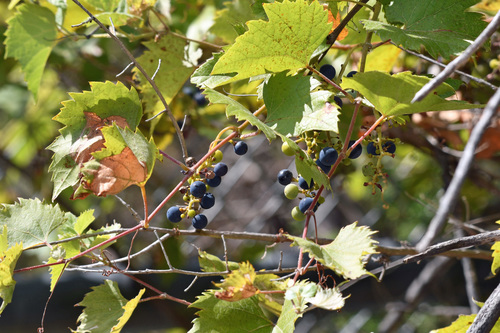
(c) Todd Fitzgerald, some rights reserved (CC BY-NC), uploaded by Todd Fitzgerald

(c) Chuck Sexton, some rights reserved (CC BY-NC)

(c) Chuck Sexton, some rights reserved (CC BY-NC)
What to Eat
Edible parts: Fruit, Leaves
The fruit can be eaten raw or dried for winter use; it has a sweet flavour and measures about 16 mm in diameter. Young leaves are wrapped around other foods and baked, imparting a pleasant flavour. Young tendrils can be eaten raw or cooked.
Dangerous Lookalikes
This plant can be confused with the following toxic species. Always verify identification carefully before consuming any wild plant.


Canadian Moonseed: No tendrils, single crescent/moon-shaped seed, leaf stem attaches to underside of leaf.
Bush grape: Vine with tendrils, round seeds, leaf stem at edge of leaf, bark that peels.
Where to Find It
It is a temperate plant.
North America, USA,
How to Identify
A vine. It is climbing. The bark peels off the branches. The leaves are broadly heart shaped and 7-12 cm long and can have 3 shallow lobes. The flowering shoots are 3-7 cm long. The fruit are black berries. They are 8-12 mm across.
How to Grow
Prefers a deep rich moist well-drained moderately fertile loam. Grows best in a calcareous soil. Succeeds in sun or partial shade though a warm sunny position is required for the fruit to ripen. Plants climb by means of tendrils. Any pruning should be carried out in winter when the plants are dormant, otherwise they bleed profusely. This species is closely related to V. rupestris. Plants in this genus are notably susceptible to honey fungus.
Propagation: Sow seed in a cold frame as soon as it is ripe. Six weeks of cold stratification improves germination rates, so stored seed is best sown in a cold frame as soon as it is obtained. Germination usually takes place in the first spring but can take an additional 12 months. Prick out seedlings into individual pots when large enough to handle and overwinter in a cold frame. Plant out in early summer. Cuttings of mature wood from the current season's growth can be taken in December or January in a frame. These can be 15–30 cm long, or short sections of about 5 cm with a single bud at the top — in the latter case, remove a thin strip of bark about 3 cm long from the lower side of the stem to encourage callusing and root formation. These shorter cuttings require a more sheltered environment than longer ones. Layering is also an option.
Medicinal Uses
No medicinal uses are known for this plant.
Other Uses
A yellow dye is obtained from the fresh or dried leaves.
Wikipedia
Source ↗Vitis acerifolia is a species of grape native to the south-central part of the Great Plains of the United States (Kansas, Oklahoma, northern Texas, eastern Colorado, and northeastern New Mexico). Its leaf shape is the origin of its name, which is Latin for maple-leaf grape, but it is widely referenced in literature by the synonym, Vitis longii.
Notes
There are about 70 species of Vitis.
Names & Synonyms
References (3)
- Kermath, B. M., et al, 2014, Food Plants in the Americas: A survey of the domesticated, cultivated and wild plants used for Human food in North, Central and South America and the Caribbean. On line draft. p 919 (Also as Vitis cordifolia var. solonis)
- Med. fl. 2:130, t. 99. 1830 May
- Plants for a Future database, The Field, Penpol, Lostwithiel, Cornwall, PL22 0NG, UK. http://www.scs.leeds.ac.uk/pfaf/


