Vitis riparia
Michx.
Riverbank grape
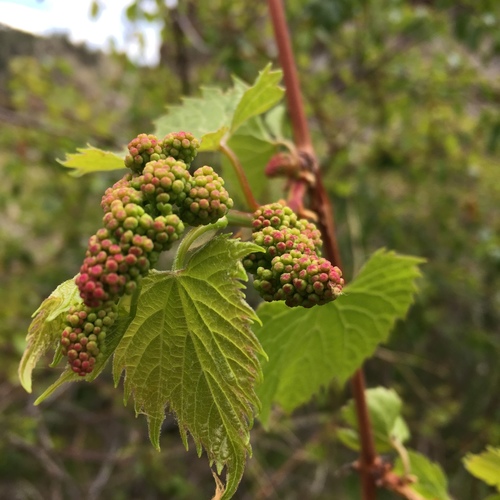
(c) roomthily, some rights reserved (CC BY-NC), uploaded by roomthily

(c) Anna Evans, some rights reserved (CC BY-NC), uploaded by Anna Evans

(c) charrob, some rights reserved (CC BY-NC)
What to Eat
Edible parts: Fruit, Leaves, Sap
The fruit, 6–12mm in diameter and carried in fairly large bunches, can be eaten raw or dried for later use. It is juicy and somewhat acid, with flavour that improves after a frost. Young leaves can be cooked, and are traditionally wrapped around other foods and baked, imparting a pleasant flavour. Young tendrils are good raw or cooked. The sap has a sweet flavour and is used as a drink; it can be harvested in spring and early summer, though it should not be taken in large quantities as this will weaken the plant.
Dangerous Lookalikes
This plant can be confused with the following toxic species. Always verify identification carefully before consuming any wild plant.


Canadian Moonseed: No tendrils, single crescent/moon-shaped seed, leaf stem attaches to underside of leaf.
Riverbank grape: Vine with tendrils, round seeds, leaf stem at edge of leaf, bark that peels.
Where to Find It
It is a temperate plant. It grows along streams and in woodland. It suits hardiness zones 2-8.
Asia, Australia, Canada, India, Mexico, North America, Slovenia, USA,
How to Identify
A climbing or scrambling plant. It grows 12 m high and spreads 3-6 m wide. The leaves usually have 3 lobes. They are shiny green and have teeth along the edge. The flowers have a sweet scent. The fruit are purple-black and round. They are tart but edible. There are sweet varieties.
How to Grow
Prefers a deep rich moist well-drained moderately fertile loam. Grows best in a calcareous soil. Succeeds in sun or partial shade though a warm sunny position is required for the fruit to ripen. The young growth in spring can be damaged by late frosts. Plants climb by means of tendrils. They grow particularly well into elm trees. Any pruning should be carried out in winter when the plants are dormant otherwise they bleed profusely. Occasionally cultivated for its edible fruit in N. America, there are some named varieties. 'Brandt' is of uncertain parentage, probably involving this species, it usually ripens its fruit in S.E. England. Resistant to Phylloxera disease, a disease that almost destroyed the European grape crops. This species can be used as a rootstock in areas where the disease is prevalent and can also be used in breeding programmes with V. vinifera in order to impart resistance to that species. The flowers are powerfully scented of mignonette. Plants in this genus are notably susceptible to honey fungus. Woody. Growth habit is a single or multiple shooting vine from a crown. Vitis riparia, also known as the riverbank grape, can self-pollinate. It can also be pollinated by bees or wind. Grapes are usually harvested in late summer to early autumn, specifically from late summer through fall, depending on the variety and climate. Grapes typically flower in late spring to early summer. Grapes are considered fast-growing vines, often reaching maturity within 3 to 4 years, depending on the variety and growing conditions.
Propagation: Seed is best sown in a cold frame as soon as it is ripe. Six weeks of cold stratification improves germination, so stored seed should also be sown in a cold frame as soon as it is obtained. Germination usually occurs in the first spring, but may take another 12 months. Prick out seedlings into individual pots once large enough to handle, grow on in a cold frame through their first winter, then plant out in early summer. Cuttings of mature wood from the current season's growth can be taken in December or January and rooted in a frame. These can be 15–30cm long, or short single-bud sections around 5cm long. For the shorter sections, remove a thin strip of bark about 3cm long from the lower half of one side to encourage callusing and root formation — these smaller cuttings need a more sheltered environment than the longer ones. Layering is also an option.
Medicinal Uses
None known.
Other Uses
Grapevines can be used as ground cover to prevent soil erosion and support biodiversity, providing habitat for beneficial insects and wildlife. A yellow dye is obtained from the fresh or dried leaves. The plant is used as a rootstock for the common grape, Vitis vinifera, particularly in areas where phylloxera disease is a problem. The flowers produce nectar attractive to bees and other pollinators. The fruit is consumed by birds, mammals and insects. Foliage and leaf litter offer shelter for various invertebrates.
Wikipedia
Source ↗Vitis riparia Michx, with common names riverbank grape or frost grape, is a vine indigenous to North America. As a climbing or trailing vine, it is widely distributed across central and eastern Canada and the central and northeastern parts of the United States, from Quebec to Texas, and eastern Montana to Nova Scotia. There are reports of isolated populations in the northwestern USA, but these are probably naturalized. It is long-lived and capable of reaching into the upper canopy of the tallest trees. It produces dark fruit that are appealing to both birds and people, and has been used extensively in commercial viticulture as grafted rootstock and in hybrid grape breeding programs. Riverbank grape is a translation of the scientific name Vitis riparia; rīpārius means 'of riverbanks' in Latin, deriving from rīpa 'riverbank'.
Notes
There are 60 to 70 species of Vitis.
Names & Synonyms
Ban angur, Dhoto pako, Frost grape, Riparija, Riverside grape, Uva riparia, Wild grape vine
References (19)
- Cundall, P., (ed.), 2004, Gardening Australia: flora: the gardener's bible. ABC Books. p 1478
- Elias, T.S. & Dykeman P.A., 1990, Edible Wild Plants. A North American Field guide. Sterling, New York p 214
- Esperanca, M. J., 1988. Surviving in the wild. A glance at the wild plants and their uses. Vol. 2. p 177
- Facciola, S., 1998, Cornucopia 2: a Source Book of Edible Plants. Kampong Publications, p 246
- Fisk, J. R. & Hoover, E., 2015, Wild Fruits of Minnesota. A Field Guide. University of Minnesota p 21
- Fl. bor.-amer. 2:231. 1803
- Flowerdew, B., 2000, Complete Fruit Book. Kyle Cathie Ltd., London. p 92
- Hedrick, U.P., 1919, (Ed.), Sturtevant's edible plants of the world. p 685
- http://www.botanic-gardens-ljubljana.com/en/plants
- Jackes, D. A., 2007, Edible Forest Gardens
- Jordan, J., et al, 2006, Vascular Plants Utilized by the Plains Apache in Southwestern Oklahoma, Publications of the Oklahoma Biological Survey. 2nd Series. Volume 7: 24-33, 2006
- Kermath, B. M., et al, 2014, Food Plants in the Americas: A survey of the domesticated, cultivated and wild plants used for Human food in North, Central and South America and the Caribbean. On line draft. p 922
- MacKinnon, A., et al, 2009, Edible & Medicinal Plants of Canada. Lone Pine. p 155
- Marandi, R. R. & Britto, S. J., 2015, Medicinal Properties of Edible Weeds of Crop Fields and Wild plants Eaten by Oraon Tribals of Latehar District, Jharkhand. International Journal of Life Science and Pharma Research. Vo. 5. (2) April 2015
- Moerman, D. F., 2010, Native American Ethnobotany. Timber Press. p 599
- Plants for a Future database, The Field, Penpol, Lostwithiel, Cornwall, PL22 0NG, UK. http://www.scs.leeds.ac.uk/pfaf/
- Segura, S., et al, 2018, The edible fruit species in Mexico. Genet Resour Crop Evol (2018) 65:1767–1793
- Toupal, R. S. & Hollenback, K., 2009, An Ethnobotany of Indiana Dunes National Lakeshore: Plant Uses of the Ojibwa People. Bureau of Applied Research in Anthropology. University of Arizona
- www.wildediblefood.com


