Abrus precatorius
L.
Bird's eye, Indian liquorice
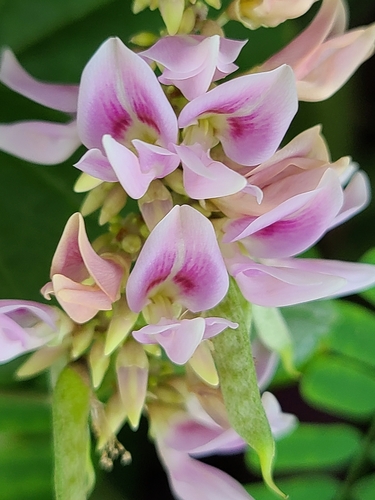
(c) sandrae34242, some rights reserved (CC BY-NC), uploaded by sandrae34242
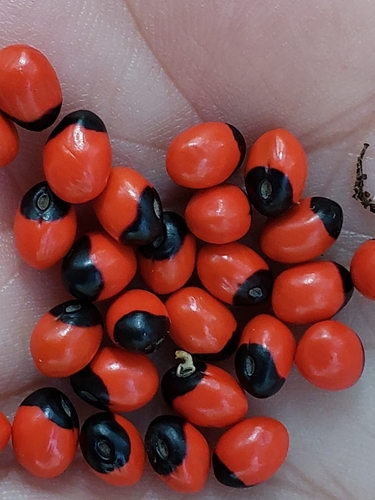
(c) John Plischke, some rights reserved (CC BY-NC), uploaded by John Plischke
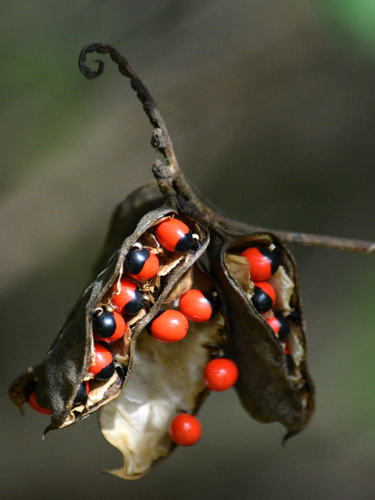
(c) Livan, some rights reserved (CC BY-NC), uploaded by Livan
What to Eat
Edible parts: Seeds (POISONOUS) , Roots, Leaves, Flowers
The roots are boiled and eaten as a liquorice substitute, particularly in India and the Andaman Islands. The very young leaves are cooked and eaten in Nepal when other food is scarce, and dry leaves are chewed with betel nut. The leaves have been used to make tea drinks in Australia. The pods are roasted and eaten in the Andaman Islands. Seeds have been recorded as eaten in Egypt and India only after very long cooking.
Known Hazards
Documented Toxic Effects
Source: Encyclopedia of Life TraitBank. Toxicity often varies by plant part — consult the hazards section above for preparation-specific details.
Where to Find It
It is a tropical plant. It will grow on most soils but often occurs in sandy positions. It suits areas with a high rainfall and does best in sunny positions. It is damaged by drought and frost. They are widely distributed in areas of shrub throughout the Philippines. In Papua New Guinea it grows near mangroves. In Papua New Guinea they grow up to 660 m altitude. It Africa it grows up to 1,350 m above sea level. It needs a temperature above 16°C. It can grow in arid places.
Africa, American Samoa, Andamans, Angola, Asia, Australia, Benin, Botswana, Burkina Faso, Cameroon, Cape Verde, Central Africa, Chad, China, Chuuk, Congo DR, Côte d'Ivoire, East Africa, East Timor, Egypt, Eswatini, Ethiopia, Fiji, FSM, Ghana, Grenada, Guiana, Guianas, Guinea, Guinée, Guinea-Bissau, Guyana, Haiti, Hawaii, Himalayas, India, Indochina, Indonesia, Ivory Coast, Kenya, Laos, Liberia, Madagascar, Malawi, Mali, Marianas, Marquesas, Mozambique, Myanmar, Namibia, Nepal, Niger, Nigeria, North Africa, Northeastern India, Pacific, Pakistan, Papua New Guinea, PNG, Philippines, Puerto Rico, Rotuma, Sahel, Samoa, SE Asia, Senegal, Sierra Leone, Somalia, Southern Africa, South America, St Lucia, Swaziland, Sudan, Suriname, Taiwan, Tanzania, Timor-Leste, Tonga, Torres Strait, Turks & Caicos, Uganda, USA, Venezuela, Vietnam, West Africa, West Indies, Zambia, Zimbabwe,
How to Identify
A shrub or small tree. It grows 5 m tall. There are prickles along the stem. The leaves are twice divided and there are 8-18 pairs of pinnae. There are up to 50 pairs of pinnules on each pinnae. The flowers are yellow. They are in large clusters at the ends of branches. The pods are flattened.
Nutrition Score: 34/100
| Part | Moisture | kJ | kcal | Protein | Vit A | Vit C | Iron | Zinc |
|---|---|---|---|---|---|---|---|---|
| Leaves | 79 | 259 | 62 | 5.6 | — | — | — | — |
| Seeds boiled | — | — | — | — | — | — | — | — |
| Root | — | — | — | — | — | — | — | — |
| Leaves - tea | — | — | — | — | — | — | — | — |
How to Grow
It is grown from seed. The seed need to be treated to break the dormancy. Putting them in boiling water can do this. Plants can also be grown from cuttings.
Propagation: Seed - pre-soak for 24 hours in warm water prior to sowing. Softwood cuttings.
Medicinal Uses
Abrus precatorius, called Gulaganji in Kannada, kundu mani in Tamil, Guruvinda ginja in Telugu and Kunni kuru in Malayalam, has been used in Siddha medicine for centuries. The white variety is used to prepare oil that is claimed to be an aphrodisiac. A tea is made from the leaves and used for fevers, coughs and colds. Seeds are poisonous and therefore are only consumed after heat treatment. The Tamil Siddhars knew about the toxic effects in plants and suggested various methods which is called "suththi seythal" or purification. This is done by boiling the seeds in milk and then drying them. Like with castor oil, the protein toxin is denatured when subjected to high temperatures rendering it innocuous. The 1889 book 'The Useful Native Plants of Australia' records that "The roots of this plant are used in India as a substitute for liquorice, though they are somewhat bitter. In Java the roots are considered demulcent. The leaves, when mixed with honey, are applied to swellings, and in Jamaica are used as a substitute for tea. Under the name of "Jequirity" the seeds have recently been employed in cases of ophthalmia, a use to which they have long been put in India and Brazil." The plant is also used in Ayurveda and is said to promote hair growth. It is sometimes used as an ingredient in Indian hair products. The leaves of Abrus precatorius are used by the indigenous communities of the Western region of Ghana as an anti-diabetic medicine.
Other Uses
The thin stems or branches are used as temporary tying material. The bark is twisted into rough cordage. The brightly coloured, red and black poisonous seeds are used as beads and to make necklaces. Popular for ornamental use and for rosaries, the necklace is traditionally given to children to wear as protection against disease. The seeds are fairly uniform in weight (individual seeds weigh about 1.75g or 1 carat) and are used traditionally in India to weigh gemstones. A light, reddish oil is obtained from the seed. No uses are given. The leaves are sensitive to light changes and droop from a horizontal to a vertical position at night and during storms. The plant is said to be able to be used as a predictor of storms based in the movement of the leaves.
Wikipedia
Source ↗Abrus precatorius, commonly known as jequirity bean or rosary pea, is a herbaceous flowering plant in the bean family Fabaceae. It is a slender, perennial climber with long, pinnate-leafleted leaves that twines around trees, shrubs, and hedges. The plant is best known for its seeds, which are used as beads and in percussion instruments, and which are toxic because of the presence of abrin. Ingestion of a single seed, well chewed, can be fatal to both adults and children. The plant is native to Asia and Australia. It has a tendency to become weedy and invasive where it has been introduced.
Production
Plants flower in January to April in the southern hemisphere. The fruit develops from December to August. The young leaves are picked off.
Other Information
Not known to be used as food in Papua New Guinea. A very minor food plant.
Notes
There are about 26 Abrus species. The seeds are very poisonous. The roots, leaves and seeds have been used medicinally. It can become an invasive plant. The roots and leaves contain glycrrhizine that is in liquorice.
Names & Synonyms
Akarunga, Chanothi, Chek-awn, Chuselok, Crab’s Eye vine, Ghuguchi, Gidee Gidee, Gomchi, Guluganji, Gunchi, Gunj, Gunja, Gundu-mani, Gunja, Gurunginia, Jequirity Bean, Kansasaga, Kelimiefitra, Kulales halom tano, Kunch, Kunni, Masokoaky, Matamoso, Ngenguba, Ojos de cangrejo, Peronias, Prayerbead, Rati, Ratti, Rosary Pea, Tanuve, Wild licorice, Yerra gurija, Ywe, Ywe-nge, Ywe-nwe
References (76)
- Agea, J. G., et al 2011, Wild and Semi-wild Food Plants of Bunyoro-Kitara Kingdom of Uganda: etc. Environmental Research Journal 5(2) 74-86
- Ambasta S.P. (Ed.), 2000, The Useful Plants of India. CSIR India. p 3
- Badwar, R. R., & Fernandez, R. R., 2011, Edible Wild Plants of the Himachal Pradesh State by IHBT, Himalayas, Daya Publishing House,. Delhi, India
- Bhardwaj, J. & Seth, M. K., 2017, Edible wild plant resources of Bilaspur, Hamirpur and Una districts of Himachal Pradesh, India. International Journal of Botany Studies. Volume 2; Issue 6; p 09-17
- Bircher, A. G. & Bircher, W. H., 2000, Encyclopedia of Fruit Trees and Edible Flowering Plants in Egypt and the Subtropics. AUC Press. p 3
- Bhargava, N., 1983, Ethnobotanical Studies of the Tribes of Andaman and Nicobar Islands, India. 1. Onge. Economic Botany 37(1): 110-119
- Bodkin, F., 1991, Encyclopedia Botanica. Cornstalk publishing, p 5
- Borrell, O.W., 1989, An Annotated Checklist of the Flora of Kairiru Island, New Guinea. Marcellin College, Victoria Australia. p 89
- Bremness, L., 1994, Herbs. Collins Eyewitness Handbooks. Harper Collins. p 276
- Brock, J., 1993, Native Plants of Northern Australia, Reed. p 54
- Brown, D., 2002, The Royal Horticultural Society encyclopedia of Herbs and their uses. DK Books. p 97
- Burkill, H. M., 1985, The useful plants of west tropical Africa, Vol. 4. Kew. (As subsp. africanus)
- Burkill, I.H., 1966, A Dictionary of the Economic Products of the Malay Peninsula. Ministry of Agriculture and Cooperatives, Kuala Lumpur, Malaysia. Vol 1 (A-H) p 4
- Busson, 1965,
- Chandrakumar, P., et al, 2015, Ethnobotanical studies of wild edible plants of Gond, Halba and Kawar tribes of Salekasa Taluka, Gondia District, Maharashtra State, India. International Research Journal of Pharmacy 6(8)
- Cooper, W. and Cooper, W., 2004, Fruits of the Australian Tropical Rainforest. Nokomis Editions, Victoria, Australia. p 200
- Cowie, I, 2006, A Survey of Flora and vegetation of the proposed Jaco-Tutuala-Lore National Park. Timor-Lests (East Timor) www.territorystories.nt/gov.au p 47
- Cundall, P., (ed.), 2004, Gardening Australia: flora: the gardener's bible. ABC Books. p 70
- Datar, M. N. & Upadhye, A. S., 2016, Forest foods of northern region of Western Ghats. MACS - Agharkar Research Institute, Pune. Pp 1-160. ISBN: 978-93-85735-10-3 p 15
- Dobriyal, M. J. R. & Dobriyal, R., 2014, Non Wood Forest Produce an Option for Ethnic Food and Nutritional Security in India. Int. J. of Usuf. Mngt. 15(1):17-37
- Elliot, W.R., & Jones, D.L., 1982, Encyclopedia of Australian Plants suitable for cultivation. Vol 2. Lothian. p 6
- Food Composition Tables for use in Africa FAO http://www.fao.org/n Herbarium. p 416
- Glew, R. H., et al, 2010, The Amino Acid, Mineral and Fatty Acid Content of Three Species of Human Plant Foods in Cameroon. Food 4(1):1-6
- Gul, M. Z., et al, 2013, Antioxidant and antiproliferative activites of Abrus precatorius leaf extracts- an in vitro study. Complementary & Alternative Medicine. 13:53
- Jadhav, R., et al, 2015, Forest Foods of Northern Western Ghats: Mode of Consumption, Nutrition and Availability. Asian Agri-History Vol. 19, No. 4: 293-317
- Kar, A., & Borthakur, S. K., 2008, Wild vegetables of Karbi - Anglong district, Assam, Natural Product Radiance, Vol. 7(5), pp 448-460
- Kiran, K. C., et al, 2019, Diversity and Seasonal Availability of Potential Wild Edible Plants from Vidarbha Region of Maharashtra State, India. Int.J.Curr.Microbiol.App.Sci (2019) 8(2): 1434-1446
- Kumar, A., 2013, Ethnobotanical study of wild vegetables used by rural communities of Kannauj district, Uttar Pradesh, India. Emir. J. Food Agric. 2013. 25 (10): 760-766
- Latham, P., 2004, Useful Plants of Bas-Congo province. DFID p 9
- Latham, P. & Mbuta, A. K., 2017, Plants of Kongo Central Province, Democratic Republic of Congo. 3rd ed p 11
- Lulekal, E., et al, 2011, Wild edible plants in Ethiopia: a review on their potential to combat food insecurity. afrika focus — Volume 24, Nr. 2, 2011 — pp. 71-121
- Melzer, R. & Plumb, J., 2011, Plants of Capricornia. Belgamba, Rockhampton. p 365
- Mua Bioversity Profile, 2013, Profile for Management of the Habitats and Related Ecological and Cultural Resources of Mua Island. Torres Strait Regional Authority Land & Sea Management Unit. p 142
- Narayanan Ratheesh, M. K. et al, 2011, Wild edible plants used by the Kattunaikka, Paniya and Kuruma tribes of Wayanad District, Kerala, India. Journal of Medicinal Plants Research Vol. 5(15), pp. 3520-3529
- Peekel, P.G., 1984, (Translation E.E.Henty), Flora of the Bismarck Archipelago for Naturalists, Division of Botany, Lae, PNG. p 245, 244
- Peters, C. R., O'Brien, E. M., and Drummond, R.B., 1992, Edible Wild plants of Sub-saharan Africa. Kew. p 130
- Pham-Hoang Ho, 1999, An Illustrated Flora of Vietnam. Nha Xuat Ban Tre. p 890
- Plants of Haiti Smithsonian Institute http://botany.si.edu/antilles/West Indies
- Prabha, Y. P., et al, 2010, Documentation of Wild Edible Plants of Melghat Forest, Dist. Amravati, Maharashtra State, India. Ethnobotanical Leaflets 14: 751-58, 2010.
- Recher, P, 2001, Fruit Spirit Botanical Gardens Plant Index. www.nrg.com.au/~recher/ seedlist.html p 4
- Reddy, K. N., et al, 2006, Traditional knowledge on wild food plants in Andhra Pradesh. Indian Journal of Traditional Knowledge 6(1) pp 223-229
- Roodt, V., 1998, Common Wild Flowers of the Okavango Delta. Medicinal Uses and Nutritional value. The Shell Field Guide Series: Part 2. Shell Botswana. p 83
- Royal Botanic Gardens, Kew (1999). Survey of Economic Plants for Arid and Semi-Arid Lands (SEPASAL) database. Published on the Internet; http://www.rbgkew.org.uk/ceb/sepasal/internet [Accessed 28th April 2011]
- Scarth-Johnson, V., 2000, National Treasures. Flowering Plants of Cooktown and Northern Australia. Vera Scarth-Johnson Gallery Association. Cooktown, Australia. p 127
- Seidemann J., 2005, World Spice Plants. Economic Usage, Botany, Taxonomy. Springer. p 2
- Shah, G.L. et al, 1981, An account of the Ethnobotany of Saurashtra in Gujarat State (India). J. Econ. Tax. Bot. Vol 2 pp 173-182
- Staples, G.W. and Herbst, D.R., 2005, A tropical Garden Flora. Bishop Museum Press, Honolulu, Hawaii. p 330
- Syst. nat. ed. 12, 2:472. 1767
- Townsend, K., 1994, Across the Top. Gardening with Australian Plants in the tropics. Society for Growing Australian Plants, Townsville Branch Inc. p 46
- Townsend, K., 1999, Field Guide to Plants of the Dry Tropics. Society for Growing Australian Plants, Townsville Branch Inc. p 138
- VAN ETTEN et al.,
- Verdcourt, B., 1979, Manual of New Guinea Legumes. Botany Bulletin No 11, Division of Botany, Lae, Papua New Guinea. p 305
- WATT
- Wheeler, J.R.(ed.), 1992, Flora of the Kimberley Region. CALM, Western Australian Herbarium, p 365
- Wightman, G. M. & Andrews, M.R., 1989, Plants of Northern Territory Monsoon Vine Forests (Vol 1). Conservation Commission of Northern Territory. p 112
- Wightman, G. & Brown, J., 1994, Jawoyn Plant Identikit, Common Useful Plants in the Katherine Area of Northern Australia. Conservation Commission Northern Territory. p 54
- Williamson, J., 2005, Useful Plants of Malawi. 3rd. Edition. Mdadzi Book Trust. p 9
- Wilson, S., 1997, Some Plants are Poisonous. Reed. p 3
- Yuncker, T.G., 1959, Plants of Tonga, Bernice P. Bishop Museum, Hawaii, Bulletin 220. p 144atabase. Published on the Internet; http://www.rbgkew.org.uk/ceb/sepasal/internet [Accessed 28th April 2011]
- Scarth-Johnson, V., 2000, National Treasures. Flowering Plants of Cooktown and Northern Australia. Vera Scarth-Johnson Gallery Association. Cooktown, Australia. p 127
- Shah, G.L. et al, 1981, An account of the Ethnobotany of Saurashtra in Gujarat State (India). J. Econ. Tax. Bot. Vol 2 pp 173-182
- Staples, G.W. and Herbst, D.R., 2005, A tropical Garden Flora. Bishop Museum Press, Honolulu, Hawaii. p 330
- Syst. nat. ed. 12, 2:472. 1767
- Townsend, K., 1994, Across the Top. Gardening with Australian Plants in the tropics. Society for Growing Australian Plants, Townsville Branch Inc. p 46
- Townsend, K., 1999, Field Guide to Plants of the Dry Tropics. Society for Growing Australian Plants, Townsville Branch Inc. p 138
- VAN ETTEN et al.,
- Verdcourt, B., 1979, Manual of New Guinea Legumes. Botany Bulletin No 11, Division of Botany, Lae, Papua New Guinea. p 305
- WATT
- Wheeler, J.R.(ed.), 1992, Flora of the Kimberley Region. CALM, Western Australian Herbarium, p 365
- Wightman, G. M. & Andrews, M.R., 1989, Plants of Northern Territory Monsoon Vine Forests (Vol 1). Conservation Commission of Northern Territory. p 112
- Wightman, G. & Brown, J., 1994, Jawoyn Plant Identikit, Common Useful Plants in the Katherine Area of Northern Australia. Conservation Commission Northern Territory. p 54
- Wild edible plants of Himachal Pradesh
- Williamson, J., 2005, Useful Plants of Malawi. 3rd. Edition. Mdadzi Book Trust. p 9
- Wilson, S., 1997, Some Plants are Poisonous. Reed. p 3
- World Checklist of Useful Plant Species 2020. Royal Botanic Gardens, Kew
- Yuncker, T.G., 1959, Plants of Tonga, Bernice P. Bishop Museum, Hawaii, Bulletin 220. p 144


