Zingiber mioga
(Thunb.) Roscoe
Myoga ginger, Ginger bud
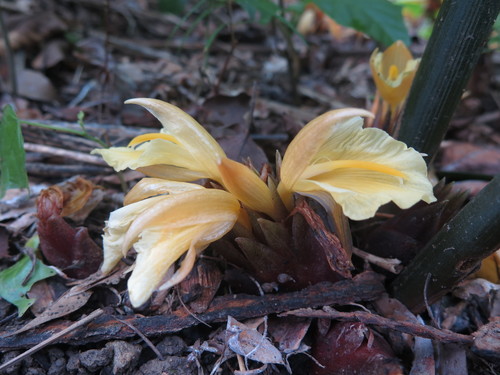
(c) Yao Li, some rights reserved (CC BY-NC), uploaded by Yao Li

(c) ssnp208, some rights reserved (CC BY-NC)
What to Eat
Edible parts: Buds, Flowers, Vegetable, Rhizome, Root, Leaves
The buds, flowers, rhizomes, roots, and leaves are edible. Young flower buds are blanched by covering with straw and used fresh in soups, tempura, and tofu dishes, or pickled. The buds and leaves are also used to flavor soups. It is commercially cultivated as a vegetable.
Where to Find It
It is a subtropical plant. It grows in mountain valleys and is sometimes cultivated. The top growth is frost tender. It can re-grow from the underground rootstock. In Yunnan.
Asia, Australia, China, Hawaii, India, Japan, Korea, Pacific, Taiwan, Tasmania, USA,
How to Identify
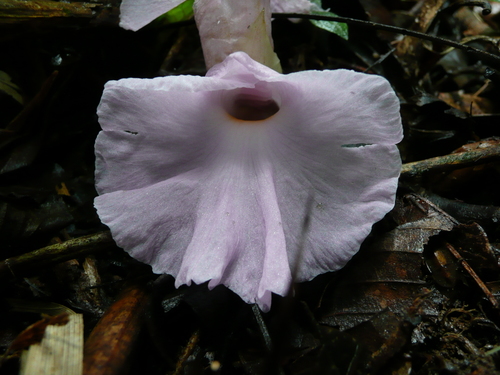
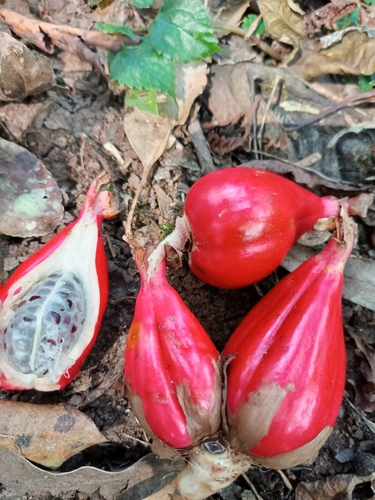
A ginger family herb. It keeps growing from year to year and grows in woodland. The rhizomes are yellowish. There is often no leaf stalk. The leaf blade is sword shaped and 20-37 cm long by 4-6 cm wide. The tip is heart shaped. The flower arises from the rhizome. It is 5-7 cm long. There can be a stalk up to 17 cm long. The sheaths are scale like. The bracts are reddish green with purple veins. The fruit is a capsule which is oval and red inside. The seeds are black. The seed layer is white.
Nutrition Score: 12/100
| Part | Moisture | kJ | kcal | Protein | Vit A | Vit C | Iron | Zinc |
|---|---|---|---|---|---|---|---|---|
| Flower bracts | 94.2 | 71 | 17 | 1.2 | — | — | 0.6 | — |
How to Grow
Requires a well-drained, fertile soil and a position in semi-shade. The plant is aromatic.
Medicinal Uses
Myoga has shown promise for potentially anticarcinogenic properties.
Other Uses
The old leaves when twisted and kneaded are used for making saddles.
Other Information
It is a commercially cultivated vegetable.
Notes
There are about 100-150 Zingiber species. It is used in medicine.
Names & Synonyms
Chandramala, Japanese ginger, Mioga, Myohga, Proh hom, Rang he, Xiang he
References (23)
- Arora, R. K., 2014, Diversity in Underutilized Plant Species - An Asia-Pacific Perspective. Bioversity International. p 110
- Bremness, L., 1994, Herbs. Collins Eyewitness Handbooks. Harper Collins. p 227
- Chen, B. & Qiu, Z., Consumer's Attitudes towards Edible Wild Plants, Ishikawa Prefecture, Japan. p 26 www.hindawi.com/journals/ijfr/aip/872413.pdf
- Creasy, R., 2000, The Edible Asian Garden. Periplus p 44
- Eisenberg et al, 2009, Kam Local Indigenous Knowledge and Sustainable Resource Management in Ghuizhou and Guangxi Provinces, China. Ethnobotany Research and Applicatons 7:067-113
- Facciola, S., 1998, Cornucopia 2: a Source Book of Edible Plants. Kampong Publications, p 248
- Flora of China. www.eFloras.org
- Food Composition Tables for use in East Asia FAO http://www.fao.org/infoods/directory No. 528
- Fujime, Y., 2012, Introduction to Some Indigenous Vegetables in Japan. HortScience Vol. 47(7) July 2012. p 831
- Hedrick, U.P., 1919, (Ed.), Sturtevant's edible plants of the world. p 704
- Hu, Shiu-ying, 2005, Food Plants of China. The Chinese University Press. p 329
- Kays, S. J., and Dias, J. C. S., 1995, Common Names of Commercially Cultivated Vegetables of the World in 15 languages. Economic Botany, Vol. 49, No. 2, pp. 115-152
- Kermath, B. M., et al, 2014, Food Plants in the Americas: A survey of the domesticated, cultivated and wild plants used for Human food in North, Central and South America and the Caribbean. On line draft. p 939
- Kiple, K.F. & Ornelas, K.C., (eds), 2000, The Cambridge World History of Food. CUP p 1820
- Liu, Yi-tao, & Long, Chun-Lin, 2002, Studies on Edible Flowers Consumed by Ethnic Groups in Yunnan. Acta Botanica Yunnanica. 24(1):41-56
- Morton,
- Solomon, C., 2001, Encyclopedia of Asian Food. New Holland. p 173
- Song, M., et al, 2013, Traditional knowledge of wild edible plants in Jeju Island, Korea. Indian Journal of Traditional Knowledge. 12(2) pp 177-194
- Staples, G.W. and Herbst, D.R., 2005, A tropical Garden Flora. Bishop Museum Press, Honolulu, Hawaii. p 768
- Thomson, G. & Morgan, W., (Ed.) 1999, Access to Asian Foods Newsletter, Vic Govt., Australia Issue 6; 2003 Issue 62
- Wiersema, J. H. & Leon, B., 2013, World Economic Plants. A Standard Reference CRC Press. 2nd Ed. p 735
- Wu Delin, Larsen, K., Zingiberaceae. Flora of China.
- World Checklist of Useful Plant Species 2020. Royal Botanic Gardens, Kew