Zingiber zerumbet
(L.) Roscoe ex Smith
Wild ginger, Pine cone ginger, Fragrant ginger

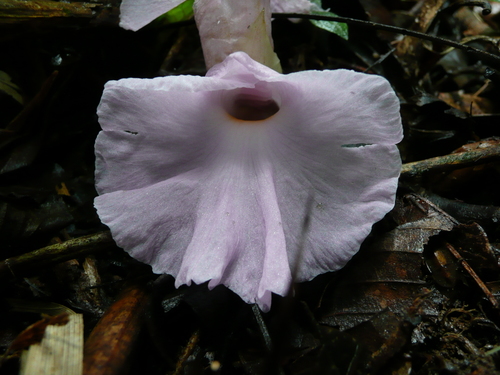
(c) Alex Abair, some rights reserved (CC BY), uploaded by Alex Abair
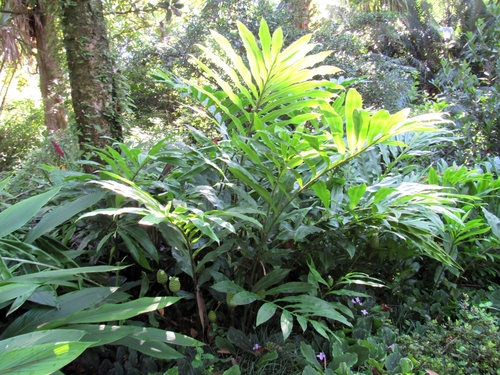
(c) Lori A Owenby, some rights reserved (CC BY-NC), uploaded by Lori A Owenby

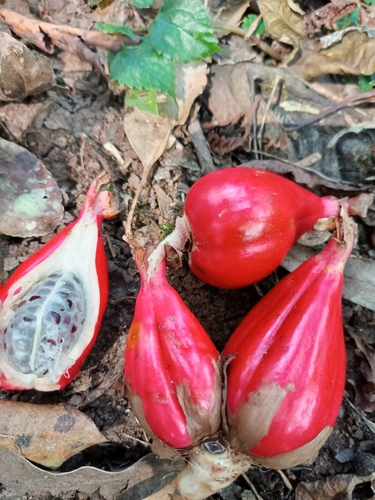
no rights reserved, uploaded by Daniel Estabrooks
What to Eat
Edible parts: Rhizomes, Root, Leaves, Flowers
The rhizome and leaves are eaten as a vegetable or used as flavoring in cooking, including in chutneys. The flowers are fried and eaten as a vegetable.
Known Hazards
Where to Find It
A tropical plant. It grows in tropical Asia. It occurs in coastal areas in the Philippines. It is most common in damp open forest. It suits seasonally moist and dry climates. It needs a fertile, organically-rich, well-drained soil. It grows in S China. It suits hardiness zones 8-12. In Yunnan.
American Samoa, Andaman Is., Asia, Australia, Bangladesh, Cambodia, Caribbean, China, Chuuk, East Timor, Fiji, Guam, Hawaii, Himalayas, India, Indochina, Indonesia, Japan, Laos, Madagascar, Malaysia, Marquesas, Micronesia, Myanmar, Nauru, New Caledonia, Niue, North America, Northeastern India, Pacific, Palau, Papua New Guinea, PNG, Philippines, Puerto Rico, Rotuma, Samoa, SE Asia, Sri Lanka, Taiwan, Thailand, Timor-Leste, Tonga, USA, Vanuatu, Vietnam, Wallis & Futuna, West Indies,
How to Identify
An upright clumpy ginger family herb up to 0.4-1 m high. The rhizome is thick and yellow. The stems are stout. The leaves do not have a leaf stalk. Leaves are broadly sword shaped. The base is narrowed. They taper to the tip. The leaves are shorter and fatter than true ginger. They are 15-40 cm long by 3-8 cm wide. The flower cone is also longer and thinner than true ginger. The flower comes from the rhizome and is cone shaped and 6-15 cm long by 3.5-5 cm wide. The stalk is 10-30 cm long. The sheaths are scale like. The bracts are green when young and red when old. The fruit is a capsule which is 0.8-1.2 cm across. The seeds are black.
Nutrition
| Part | Moisture | kJ | kcal | Protein | Vit A | Vit C | Iron | Zinc |
|---|---|---|---|---|---|---|---|---|
| Leaves | — | — | — | — | 19 | — | — | — |
How to Grow
It mostly grows wild in regrowth forest. It can be grown from sections of the rhizome.
Medicinal Uses
The rhizome and leaves are used in traditional medicine and magic.
Other Uses
An essential oil obtained from the rhizome is used to perfume soap and other toilet articles. The dried rhizome is ground into a powder and used as a perfume.
Wikipedia
Source ↗Zingiber zerumbet is a species of plant in the ginger family with leafy stems growing to about 1.2 m (4 ft) tall. It originates from Asia, but can be found in many tropical countries. Common names include: awapuhi (from Hawaiian: ʻawapuhi spelled with an ʻokina, doublet of ʻawa), bitter ginger, shampoo ginger, lempoyang (from Malay) and pinecone ginger. The rhizomes of Z. zerumbet are used as food flavoring and appetizers in various cuisines, and the rhizome extracts have been used in herbal medicine.
Other Information
In Papua New Guinea this is a quite common plant but only a minor food plant. It is cultivated plant.
Notes
There are about 100-150 Zingiber species.
Names & Synonyms
'Avapui, Awapuhi, Bitter ginger, Drove, Hong qiu jiang, Karpooraharidra, Karrallamu, Kattinji, Katu, Kra tue, Lampoyang, Lampuyang pahit, Lempoyang, Lempuyang emprit, Lempuyang gajah, Lempuyang wangi, Linne-gyi, Martinique ginger, Narkachur, Phtu, Phtue, Phrilang dung, Poloi, Red pinecone, Shampoo ginger, Vorek hanso, Zerumbet ginger
References (60)
- Arora, R. K., 2014, Diversity in Underutilized Plant Species - An Asia-Pacific Perspective. Bioversity International. p 110
- Bau, B. B. and Poulson, A. D., 2007, Ethnobotanical Notes on Gingers of the Huon Peninsula in Papua New Guinea. Gardens’ Bulletin Singapore 59 (1&2): 23-34. 2007
- Borrell, O.W., 1989, An Annotated Checklist of the Flora of Kairiru Island, New Guinea. Marcellin College, Victoria Australia. p 43
- Bourret, D., 1981, Bonnes-Plantes de Nouvelle-Caledonie et des Loyaute. ORSTOM. p 40
- Bremness, L., 1994, Herbs. Collins Eyewitness Handbooks. Harper Collins. p 227
- Burkill, I.H., 1966, A Dictionary of the Economic Products of the Malay Peninsula. Ministry of Agriculture and Cooperatives, Kuala Lumpur, Malaysia. Vol 2 (I-Z) p 2345
- Burkill, I.H., 1966, A Dictionary of the Economic Products of the Malay Peninsula. Ministry of Agriculture and Cooperatives, Kuala Lumpur, Malaysia. Vol 2 (I-Z) p 2335 (As Zingiber amaricans)
- Cowie, I, 2006, A Survey of Flora and vegetation of the proposed Jaco-Tutuala-Lore National Park. Timor-Lests (East Timor) www.territorystories.nt/gov.au p 55
- Cundall, P., (ed.), 2004, Gardening Australia: flora: the gardener's bible. ABC Books. p 1496
- Eiadthong, W., et al, 2010, Management of the Emerald Triangle Protected Forests Complex. Botanical Consultant Technical Report. p 52
- Ethnobotany of Karbis. Chapter 4 in p 103
- Exot. bot. 2:105, t. 112. 1806
- Facciola, S., 1998, Cornucopia 2: a Source Book of Edible Plants. Kampong Publications, p 248 (As Zingiber amaricans)
- Franklin, J., Keppel, G., & Whistler, W., 2008, The vegetation and flora of Lakeba, Nayau and Aiwa Islands, Central Lau Group, Fiji. Micronesica 40(1/2): 169–225, 2008
- French, B.R., 1986, Food Plants of Papua New Guinea, A Compendium. Asia Pacific Science Foundation p 393
- Hani Medicine of Xishuangbanna, 1999, p 159
- Hedrick, U.P., 1919, (Ed.), Sturtevant's edible plants of the world. p 704
- Hibbert, M., 2002, The Aussie Plant Finder 2002, Florilegium. p 311
- Kar, A., & Borthakur, S. K., 2008, Wild vegetables of Karbi - Anglong district, Assam, Natural Product Radiance, Vol. 7(5), pp 448-460
- Kar, A., et al, 2013, Wild Edible Plant Resources used by the Mizos of Mizoram, India. Kathmandu University Journal of Science, Engineering and Technology. Vol. 9, No. 1, July, 2013, 106-126
- Kachenchart, B., et al, 2008, Phenology of Edible Plants at Sakaerat Forest. In Proceedings of the FORTROP II: Tropical Forestry Change in a Changing World. Bangkok, Thailand.
- Kermath, B. M., et al, 2014, Food Plants in the Americas: A survey of the domesticated, cultivated and wild plants used for Human food in North, Central and South America and the Caribbean. On line draft. p 939
- Lavelle, M., 2008, Wild Flowers of Australia and Oceania. Southwater. p 109
- Larsen, K., Ibrahim, H., Khaw, S.H., & Saw, L.G., 1999, Gingers of Peninsula Malaysia and Singapore. Natural History Publications (Borneo). p 9, 31
- Lazarides, M. & Hince, B., 1993, Handbook of Economic Plants of Australia, CSIRO. p 251
- Lembaga Biologi Nasional, 1977, Ubi-Ubian, Balai Pustaka, Jakarta. p 60
- Lembaga Biologi Nasional, 1977, Ubi-Ubian, Balai Pustaka, Jakarta. p 58 (As Zingiber amaricans)
- Lembaga Biologi Nasional, 1977, Ubi-Ubian, Balai Pustaka, Jakarta. p 62 (As Zingiber aromaticum)
- Liefting, A., et al, Samoan plant names. http://en.wikipedia.org
- Lim, T. K., 2015, Edible Medicinal and Non Medicinal Plants. Volume 9, Modified Stems, Roots, Bulbs. Springer p 87
- Lim, T. K., 2016, Edible Medicinal and Non-Medicinal Plants: Volume 12 Modified Stems, Roots p 8
- Liu, Yi-tao, & Long, Chun-Lin, 2002, Studies on Edible Flowers Consumed by Ethnic Groups in Yunnan. Acta Botanica Yunnanica. 24(1):41-56
- Llamas, K.A., 2003, Tropical Flowering Plants. Timber Press. p 372
- Low, T., 1992, Bush Tucker. Australia’s Wild Food Harvest. Angus & Robertson. p 184
- Morton,
- Mot So Rau Dai an Duoc O Vietnam. Wild edible Vegetables. Ha Noi 1994, p 244
- Niwano, Y. et al., 2009, Extensive Screening for Plant Foodstuffs in Okinawa, Japan with Anti-Obese Activity on Adipocytes, in vitro. Plant Foods in Human Nutrition 64:6-10
- Ochse, J. J. et al, 1931, Vegetables of the Dutch East Indies. Asher reprint. p 760 (Also as Zingiber amaricans)
- Peekel, P.G., 1984, (Translation E.E.Henty), Flora of the Bismarck Archipelago for Naturalists, Division of Botany, Lae, PNG. p 101, 102
- Phangchopi, U., et al, 2015, Diversity of wild edible plants in Marat Longri Wildlife Sanctuary, Assam. Indian Journal of Natural Products and Resources Vol. 6(4), December 2015 pp. 305-313
- Phon, P., 2000, Plants used in Cambodia. © Pauline Dy Phon, Phnom Penh, Cambodia. p 645
- Powell, J.M., Ethnobotany. In Paijmans, K., 1976, New Guinea Vegetation. Australian National University Press. p 112
- Pradhan, R., et al, 2020, Potential Wild Edible Plants and its Significance in Livelihood of Indigenous People of Male Mahadeshwara Hills, Karnataka. Economic Affairs Vol. 64, No. 4 pp. 01-14
- Recher, P, 2001, Fruit Spirit Botanical Gardens Plant Index. www.nrg.com.au/~recher/ seedlist.html p 4
- Smith, A.C., 1979, Flora Vitiensis Nova, Lawaii, Kuai, Hawaii, Volume 1 p 194
- Staples, G.W. and Herbst, D.R., 2005, A tropical Garden Flora. Bishop Museum Press, Honolulu, Hawaii. p 769
- Burkill, I.H., 1966, A Dictionary of the Economic Products of the Malay Peninsula. Ministry of Agriculture and Cooperatives, Kuala Lumpur, Malaysia. Vol 2 (I-Z) p 2335 (As Zingiber aromaticum and Zingiber aromaticum)
- Sukarya, D. G., (Ed.) 2013, 3,500 Plant Species of the Botanic Gardens of Indonesia. LIPI p 1144 (As Zingiber aromaticum)
- Teron, R. & Borthakur, S. K., 2016, Edible Medicines: An Exploration of Medicinal Plants in Dietary Practices of Karbi Tribal Population of Assam, Northeast India. In Mondal, N. & Sen, J.(Ed.) Nutrition and Health among tribal populations of India. p 157
- Terra, G.J.A., 1973, Tropical Vegetables. Communication 54e Royal Tropical Institute, Amsterdam, p 83
- Terra, G.J.A., 1973, Tropical Vegetables. Communication 54e Royal Tropical Institute, Amsterdam, p 83 (As Zingiber amaricans)
- Turreira Garcia, N., et al, 2017, Ethnobotanical knowledgeof the Kuy and Khmer people in Prey Lang, Cambodia. Cambodian Journal of Natural History 2017 (1): 76-101
- Walter, A. & Lebot, V., 2007, Gardens of Oceania. ACIAR Monograph No. 122. p 296
- Wiersema, J. H. & Leon, B., 2013, World Economic Plants. A Standard Reference CRC Press. 2nd Ed. p 735
- World Checklist of Useful Plant Species 2020. Royal Botanic Gardens, Kew
- Xu, Z., Tao, G. & Tan, J., 1988, Tropical Wild Flowers and Plants in Xishuangbanna, Agricultural Publishing House. photo 60
- Xu, You-Kai, et al, 2004, Wild Vegetable Resources and Market Survey in Xishuangbanna, Southwest China. Economic Botany. 58(4): 647-667.
- Yuncker, T. G., 1943, The Flora of Niue Island. Bernice P. Bishop Museum Bulletin 178 p 39
- Yuncker, T.G., 1959, Plants of Tonga, Bernice P. Bishop Museum, Hawaii, Bulletin 220. p 85
- Zeven, A. C. & de West, J. M. J., 1982, Dictionary of cultivated plants and their regions of diversity. Wageningen. p 64