Zizania aquatica
L.
Wild rice, Annual wild rice

(c) bwood708, some rights reserved (CC BY-NC), uploaded by bwood708
(c) K.D. Stutzman, some rights reserved (CC BY-NC), uploaded by K.D. Stutzman

(c) Suzanne Labbé, some rights reserved (CC BY-NC), uploaded by Suzanne Labbé
What to Eat
Edible parts: Seeds, Stem, Cereal, Shoots
The seed can be cooked and used as a cereal. Long considered a staple food of native North American peoples, the long black grain is now valued as a gourmet ingredient and used in the same ways as rice, sometimes combined with rice to add a subtle flavour. It can also be ground into a meal for use in bread-making and as a soup thickener. The seed is a very rich source of riboflavin and is also rich in niacin. The base of the culms is used as a vegetable.
Known Hazards
Where to Find It
It grows in swamps and streams. It can grow in fresh or brackish water. It cannot survive in stagnant water. A water depth of 15 cm is suitable. It needs plenty of sunlight.
Asia, Australia, Canada, China, India, Indochina, Japan, Malaysia, Manchuria, North America, SE Asia, Taiwan, Thailand, USA, Vietnam,
How to Identify
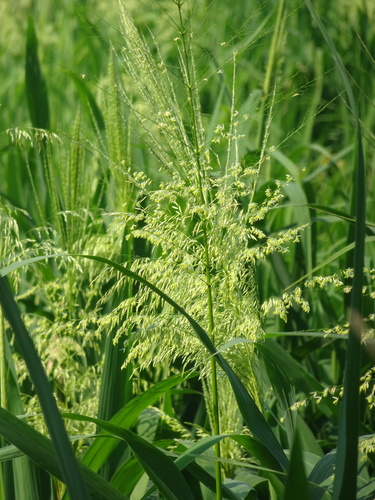
A millet grass. It is a tall annual grass. The stems are upright and usually 1-3 m tall. They are stout. The leaf blades are long and narrow. They can be 0.3-1 m long and 2-5 cm wide. They are soft. They have many flowers in open branched clusters. These can be 60 cm high and the side branches 15-20 cm long. The lower branches have male flowers and the upper branches have female flowers. The seed case is tipped with a long stiff hair like structure. The seeds are narrow, hard and brown. Seeds often easily fall off the grass.
Nutrition Score: 3/100
| Part | Moisture | kJ | kcal | Protein | Vit A | Vit C | Iron | Zinc |
|---|---|---|---|---|---|---|---|---|
| Seeds | 1492 | 357 | 14.7 | — | — | — | — | — |
How to Grow
Easily grown in water up to 60cm deep, it tolerates water up to 1 metre deep though it prefers growing in water 10 - 20cm deep. It dislikes stagnant water. A very ornamental plant, it grows, flowers and fruits well in the lake and lily pond at Kew. Plants can self-sow in Britain, but the seed tends to germinate too late to mature a fresh crop of seed in this country, so the plant gradually dies out. It would possibly maintain itself in areas such as the Isle of Wight, Cambridgeshire and Norfolk. It is a very hardy plant, the seed survives being frozen in ice. Plants grown at a 30cm square spacing can produce 20 or more flowering shoots. Often collected from the wild, this plant is now being cultivated commercially for its edible seed. It is considered a gourmet's delicacy and is sold in many parts of the world, usually in health food shops and usually at a very high price. Plants require protection from wild fowl otherwise they will devour the young growth. Plants are occasionally sown by lakes and rivers in Europe to attract wild fowl.
Propagation: Seed must not be allowed to dry out, as it loses viability quickly — usually within 4 weeks. Store collected seed in jars of water in a cool place such as the salad compartment of a refrigerator. Sow in spring, immersing pots so they are covered by about 5cm of water. For best results, sow 2 seeds per 7cm pot in a greenhouse to encourage early germination and improve chances of a crop. Pot on as required and plant out at approximately 30cm spacing in May, by which time plants should be 20–30cm tall. Larger quantities can be sown in shallow boxes and plunged into the pond or growing site in May.
Medicinal Uses
None known
Other Uses
None known Special Uses
Wikipedia
Source ↗Wild rice is an annual grass reaching 3.5m tall and 0.2m wide, growing at a fast rate. Hardy to UK zone 6, it flowers from July to September with seeds ripening September to October. The plant is monoecious and wind-pollinated, thriving in light sandy, medium loamy, or heavy clay soils across a wide pH range. It cannot tolerate shade but grows well in water.
Production
Ripe seeds easily fall from the plant. Seeds are normally harvested with a boat and the heads are bent over the boat then tapped to allow seed to fall. The grains are then dried. The grains are separated by threshing or rubbing.
Other Information
It is grown commercially.
Names & Synonyms
Canadian wild rice, Gao bai shun, Gau sun, Makomo-zuno, Manoomin, Normai-nam, Rebong ayer, Water rice
References (25)
- Ambasta, S.P. (Ed.), 2000, The Useful Plants of India. CSIR India. p 702
- Beckstrom-Sternberg, Stephen M., and James A. Duke. "The Foodplant Database." http://probe.nalusda.gov:8300/cgi-bin/browse/foodplantdb.(ACEDB version 4.0 - data version July 1994)
- Brickell, C. (Ed.), 1999, The Royal Horticultural Society A-Z Encyclopedia of Garden Plants. Convent Garden Books. p 1071
- Dahlen, M., 1995, A Cook's Guide to Chinese Vegetables. The Guidebook Company. p 105
- Elias, T.S. & Dykeman P.A., 1990, Edible Wild Plants. A North American Field guide. Sterling, New York p 129
- Esperanca, M. J., 1988. Surviving in the wild. A glance at the wild plants and their uses. Vol. 2. p 344
- Facciola, S., 1998, Cornucopia 2: a Source Book of Edible Plants. Kampong Publications, p 183
- Hedrick, U.P., 1919, (Ed.), Sturtevant's edible plants of the world. p 704
- Hibbert, M., 2002, The Aussie Plant Finder 2002, Florilegium. p 311
- Kermath, B. M., et al, 2014, Food Plants in the Americas: A survey of the domesticated, cultivated and wild plants used for Human food in North, Central and South America and the Caribbean. On line draft. p 940
- Kiple, K.F. & Ornelas, K.C., (eds), 2000, The Cambridge World History of Food. CUP p 113, 1881
- Larkcom, J., 1991, Oriental Vegetables, John Murray, London, p 125
- MacKinnon, A., et al, 2009, Edible & Medicinal Plants of Canada. Lone Pine. p 374
- Marinelli, J. (Ed), 2004, Plant. DK. p 278
- Menninger, E.A., 1977, Edible Nuts of the World. Horticultural Books. Florida p 152
- Moerman, D. F., 2010, Native American Ethnobotany. Timber Press. p 614
- Plants for a Future database, The Field, Penpol, Lostwithiel, Cornwall, PL22 0NG, UK. http://www.scs.leeds.ac.uk/pfaf/
- PROSEA (Plant Resources of South East Asia) handbook Volume 10 Cereals. p 154
- Purseglove, J.W., 1972, Tropical Crops. Monocotyledons. Longmans p 162
- Romanowski, N., 2007, Edible Water Gardens. Hyland House. p 73
- Saunders, C.F., 1948, Edible and Useful Wild Plants. Dover. New York. p 45
- Solomon, C., 2001, Encyclopedia of Asian Food. New Holland. p 407
- Sp. pl. 2:991. 1753
- Toupal, R. S. & Hollenback, K., 2009, An Ethnobotany of Indiana Dunes National Lakeshore: Plant Uses of the Ojibwa People. Bureau of Applied Research in Anthropology. University of Arizona
- van Wyk, B., 2005, Food Plants of the World. An illustrated guide. Timber press. p 390


