Zostera marina
L.
Water Nut, Eel grass
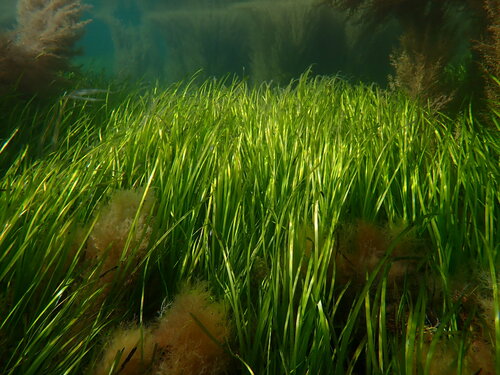
(c) Nicolas Jouault, some rights reserved (CC BY-NC), uploaded by Nicolas Jouault

(c) Ed Sheldon, some rights reserved (CC BY-NC)

(c) Ed Sheldon, some rights reserved (CC BY-NC)
What to Eat
Edible parts: Leaves, Root, Seeds, Rhizome
The leaf bases are crisp and sweet and were frequently used as a feast food by native North American peoples; the leaves can be eaten raw or cooked. The root is chewed for its saccharine juice — crisp and sweet, it was used as a flavouring by native North American peoples, dried for winter food, and the raw rhizomes were often eaten as a feast food. The seed is also edible, though no further details are available.
Where to Find It
It is a plant of temperate coasts. It grows in subtropical places. It grows in sand and forms beds just below the low tide mark. It is salt tolerant.
Alaska, Asia, Britain, Canada, Central America, China, Europe, Indochina, Japan, Korea, Mexico, Myanmar, North Africa, North America, Norway, Russia, Scandinavia, SE Asia, Thailand,
How to Identify
A grass like plant that grows in sea water. The leaves are bright green and ribbon like. There are extensive white rhizomes or underground stems. These develop short stems that carry the leaves. The flowers are small and white. They are enclosed in the sheaths of the leaf bracts.
How to Grow
A plant of shallow sea water, it is not really suitable for normal cultivation.
Propagation: Seed is best sown as soon as it is ripe. Division.
Medicinal Uses
The leaves are used in the treatment of dropsy, goitre, and women's illnesses.
Other Uses
The dried leaves and stems are used as a packing material. The plant is frequently used as a manure.
Wikipedia
Source ↗Zostera marina is a flowering vascular plant species as one of many kinds of seagrass, with this species known primarily by the English name of eelgrass with seawrack much less used, and refers to the plant after breaking loose from the submerged wetland soil, and drifting free with ocean current and waves to a coast seashore. It is a saline soft-sediment submerged plant native to marine environments on the coastlines of northern latitudes from subtropical to subpolar regions of North America and Eurasia.
Notes
There are 12 Zostera species. They grow in temperate regions.
Names & Synonyms
Grass-wrack, Sea grass
References (9)
- Alm, T., 2003, On the Uses of Zostera marina, Mainly in Norway. Economic Botany 57(4): 640-645
- Felger, R.S., Ancient Crops for the Twenty first century, in Rickie, G.A., (ed), 1979, New Agricultural Crops, AAAS Selected Symposium 38. Westview Press, Colarado. p 11
- Hedrick, U.P., 1919, (Ed.), Sturtevant's edible plants of the world. p 708
- Menninger, E.A., 1977, Edible Nuts of the World. Horticultural Books. Florida p 112
- Moerman, D. F., 2010, Native American Ethnobotany. Timber Press. p 614
- Plants for a Future database, The Field, Penpol, Lostwithiel, Cornwall, PL22 0NG, UK. http://www.scs.leeds.ac.uk/pfaf/
- Sp. pl. 2:968. 1753
- Turner, N., 1995, Food Plants of Coastal First Peoples. Royal BC Museum Handbook p 53
- Wickens, G.E., 1995, Edible Nuts. FAO Non-wood forest products. FAO, Rome. p172


