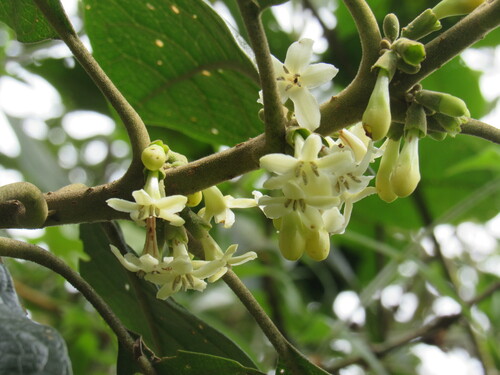
Ocimum micranthum
Willd.
Peruvian basil
iNaturalist · cc-by-nc
(c) JOSE JAVIER MAY CHAN, some rights reserved (CC BY-NC)
(c) JOSE JAVIER MAY CHAN, some rights reserved (CC BY-NC)
iNaturalist · cc-by-nc
(c) JOSE JAVIER MAY CHAN, some rights reserved (CC BY-NC)
(c) JOSE JAVIER MAY CHAN, some rights reserved (CC BY-NC)
iNaturalist · cc-by-nc
(c) JOSE JAVIER MAY CHAN, some rights reserved (CC BY-NC)
(c) JOSE JAVIER MAY CHAN, some rights reserved (CC BY-NC)
What to Eat
Edible parts: Stem, Leaves
The leaves are used in soups and stews.
Where to Find It
It is a tropical plant.
Amazon, Central America, Cuba, Guyana, Nicaragua, South America, St Lucia, West Indies,
Countries: Antigua & Barbuda, Argentina, Barbados, Bolivia, Brazil, Bahamas, Belize, Chile, Colombia, Costa Rica, Cuba, Dominica, Dominican Republic, Ecuador, Grenada, French Guiana, Guatemala, Guyana, Honduras, Haiti, Jamaica, St Kitts & Nevis, St Lucia, Nicaragua, Panama, Peru, Puerto Rico, Paraguay, Suriname, El Salvador, Trinidad & Tobago, Uruguay, St Vincent, Venezuela
How to Identify
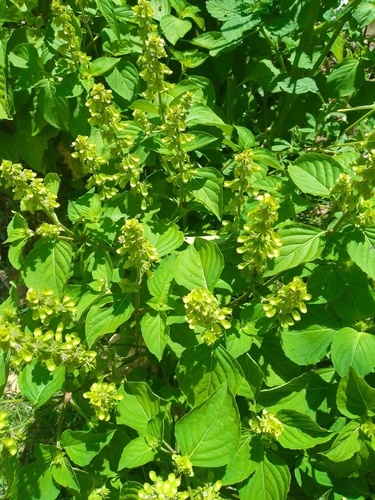
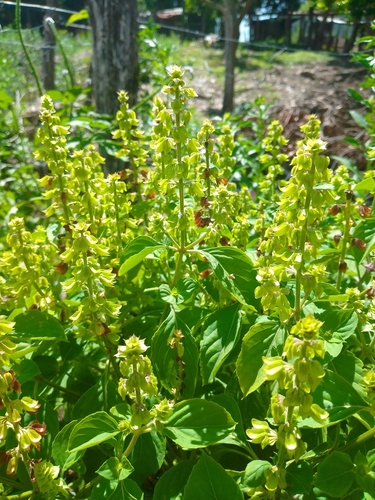
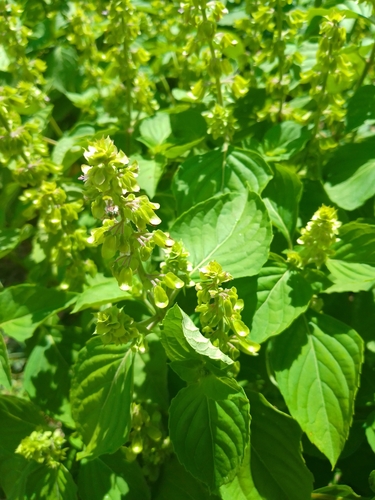
A tropical herb in the Lamiaceae family with edible leaves and stems, belonging to a genus of between 100 and 150 Ocimum species.
Notes
There are between 100 and 150 Ocimum species.
Names & Synonyms
Alfavaca, Barsley Fonbwafen, Married man pork, Sika kaira
See Ocimum americanum
References (7)
- Coe, F. G., and Anderson, G. J., 1996, Ethnobotany of the Garifuna of Eastern Nicaragua. Economic Botany 50(1) pp 71-107 (As Ocimum micranthum)
- Coe, F. G. & Anderson, G. J., 1997, Ethnobotany of the Miskitu of Eastern Nicaragua. Journal of Ethnobiology 17(2): 171-214
- Coe, F. G. and Anderson, G. J., 1999, Ethnobotany of the Sumu (Ulwa) of Southeastern Nicaragua and Comparisons with Miskitu Plant Lore. Economic Botany Vol. 53. No. 4. pp. 363-386
- Enum. pl. 2:630. 1809
- Katz, E., et al, 2012, No greens in the forest? Note on the limited consumption of greens in the Amazon. Acta Soc Bot Pol 81(4):283–293
- Miguel, E., et al, 1989, A checklist of the cultivated plants of Cuba. Kulturpflanze 37. 1989, 211-357
- Omawale, 1973, Guyana's edible plants. Guyana University, Georgetown p 69 (As Ocimum micranthum)