Leptothrium senegalense
(Kunth) W. D. Clayton

no rights reserved, uploaded by Bat
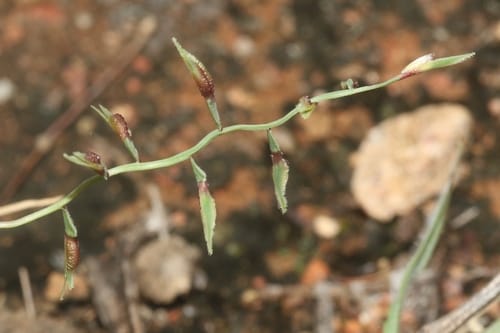
(c) James Bailey, some rights reserved (CC BY-NC)
What to Eat
Edible parts: Seeds, Cereal
The seeds are ground into flour and used as a cereal.
Where to Find It
A tropical plant. It grows in sub-desert grassland. It can grow in arid places.
Africa, Asia, Burkina Faso, Central Africa, Congo, East Africa, Egypt, Ethiopia, Ghana, India, Kenya, Mali, Mauritania, North Africa, Pakistan, Senegal, Somalia, West Africa,
How to Identify
A grass. It grows for a few years. It forms tough bunches. It grows 10-60 cm high. The leaf blades are narrow and 2-10 cm long by 1-3 mm wide. The flower panicles are 2-17 cm long. They are purple and light green.
How to Grow
Grows in semi-arid regions of the tropics and subtropics at elevations from sea level to 2,000 metres. Plants are not frost-tolerant. Requires a well-drained soil and a position in full sun. Plants can be established on bare, sandy soils. Plants self-sow prolifically, thereby maintaining pasture land in arid areas.
Other Uses
The plant is an efficient colonizer of bare ground and has been used in reseeding projects to protect the soil from erosion.
Notes
There are 2 Leptothrium species.
Names & Synonyms
Ainguiem, Askanit, Firri, Tigurit
References (12)
- Abbiw, D.K., 1990, Useful Plants of Ghana. West African uses of wild and cultivated plants. Intermediate Technology Publications and the Royal Botanic Gardens, Kew. p 26
- Ambasta, S.P. (Ed.), 2000, The Useful Plants of India. CSIR India. p 318 (As Latipes senegalensis)
- Burkill, H. M., 1985, The useful plants of west tropical Africa, Vol. 1. Kew.
- Dalziel, J. M., 1937, The Useful plants of west tropical Africa. Crown Agents for the Colonies London.
- Ferns, Useful Tropical Plants
- Flora of Pakistan. www.eFloras.org
- Jardin, C., 1970, List of Foods Used In Africa, FAO Nutrition Information Document Series No 2.p 4, 44 (As Latipes senegalensis)
- Monod, T., (On wild edible plants of Mauritania) (As Latipes senegalensis)
- National Research Council, 1996, Lost crops of Africa. Volume 1 grains, p 271 (As Latipes senegalensis)
- Peters, C. R., O'Brien, E. M., and Drummond, R.B., 1992, Edible Wild plants of Sub-saharan Africa. Kew. p 23
- Revis. gramin. 261, t. 42. 1830 (As Latipes senegalensis)
- World Checklist of Useful Plant Species 2020. Royal Botanic Gardens, Kew


