Pentodon pentandrus
(Schumach. & Thonn.) Vatke
Hale's pentodon

(c) Robert Taylor, some rights reserved (CC BY), uploaded by Robert Taylor
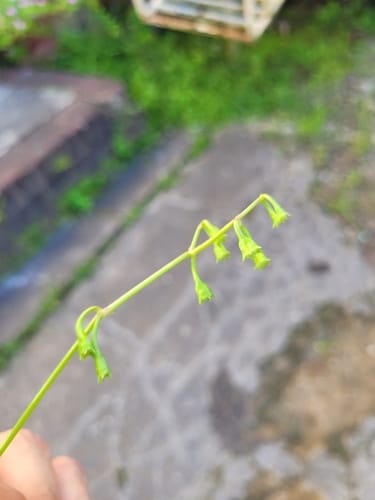
(c) Guillaume Léotard, some rights reserved (CC BY-NC)
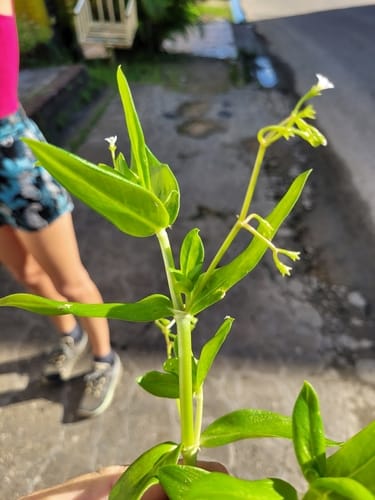
(c) Guillaume Léotard, some rights reserved (CC BY-NC)
What to Eat
Edible parts: Leaves, Stem, Vegetable
The young leaves and stems are eaten as a vegetable, serving as a minor vegetable and famine food.
Where to Find It
A tropical plant. It grows in wet muddy sites in West Africa and most of Africa. It grows from sea level to 2,250 m above sea level.
Africa*, Arabia, Benin, Botswana, Brazil, Central Africa, Central America, Côte d'Ivoire, Cuba, East Africa, Eswatini, Gabon, Ghana, Ivory Coast, Kenya, Liberia, Middle East, Mozambique, Namibia, Nicaragua, Nigeria, Sao Tome and Principe, Sierra Leone, South Africa, South America, Southern Africa, Swaziland, Tanzania, USA, West Africa, West Indies,
How to Identify
A straggling herb. It is partly succulent. It grows each year from seeds or can last a few years. It has a slender rootstock. The stems are 90 cm long. The leaves are opposite and simple. They do not have leaf stalks. The leaves are very narrowly oval and 2-8 cm long by 1-3 cm wide. The flowers are in rings in the axils of leaves. There are 1-4 flowers in a group. The flowers have both sexes and are small. The fruit is a capsule 2-4 mm long and has many seeds. The seeds are small, angular and black.
How to Grow
The plant has been introduced into the southern United States, Cuba, Nicaragua and Brazil. In the United States it has become a weed known as Hale’s pentodon.
Medicinal Uses
A decoction of the plant is used internally and externally to promote lactation in nursing mothers. The ground-up leaves, mixed with oil, are rubbed onto the body as a treatment against fever, rheumatism and headache. The leaf sap is instilled in the eyes to cure conjunctivitis. An infusion of the roots is drunk to alleviate the pain of a swollen spleen.
Other Information
A famine food. It is a minor vegetable.
Names & Synonyms
Bubuampere, Buburanya
References (11)
- Abbiw, D.K., 1990, Useful Plants of Ghana. West African uses of wild and cultivated plants. Intermediate Technology Publications and the Royal Botanic Gardens, Kew. p 41
- Bortolotto, I. M., et al, 2018, Lista preliminar das plantas alimenticias nativas de Mato Grosso do Sul, Brasil. Iheringia, Serie Botanica, Porto Alegre, 73 (supl.):101-116
- Burkill, H. M., 1985, The useful plants of west tropical Africa, Vol. 4. Kew.
- Dalziel, J. M., 1937, The Useful plants of west tropical Africa. Crown Agents for the Colonies London.(As Oldenlandia macrophylla)
- Dansi, A., et al, 2008, Traditional leafy vegetables and their use in the Benin Republic. Genet Resour Crop Evol (2008) 55:1239–1256
- Fox, F. W. & Young, M. E. N., 1982, Food from the Veld. Delta Books. p 325
- Grubben, G. J. H. and Denton, O. A. (eds), 2004, Plant Resources of Tropical Africa 2. Vegetables. PROTA, Wageningen, Netherlands. p 412
- Long, C., 2005, Swaziland's Flora - siSwati names and Uses http://www.sntc.org.sz/flora/
- Martin, F.W. & Ruberte, R.M., 1979, Edible Leaves of the Tropics. Antillian College Press, Mayaguez, Puerto Rico. p 217 (As Oldenlandia macrophylla)
- Peters, C. R., O'Brien, E. M., and Drummond, R.B., 1992, Edible Wild plants of Sub-saharan Africa. Kew. p 173
- World Checklist of Useful Plant Species 2020. Royal Botanic Gardens, Kew


