Cyclocodon parviflorus
(Wall. ex A. DC.) Hook.f. & Thomson
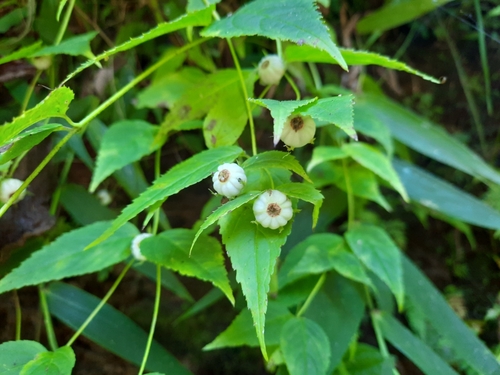
iNaturalist · cc-by-nc
(c) Phuentsho, some rights reserved (CC BY-NC), uploaded by Phuentsho
(c) Phuentsho, some rights reserved (CC BY-NC), uploaded by Phuentsho
What to Eat
Edible parts: Leaves, Seeds
The young leaves are eaten, and the seeds are also edible.
Where to Find It
It is a subtropical plant. In the Himalayas it grows between 300-1,500 m above sea level.
Asia, Bangladesh, Bhutan, China, Himalayas, India, Laos, Myanmar, Northeastern India, SE Asia, Sikkim,
Countries: United Arab Emirates, Afghanistan, Armenia, Azerbaijan, Bangladesh, Bahrain, Brunei, Bhutan, China, Georgia, Indonesia, Israel, India, Iraq, Iran, Jordan, Japan, Kyrgyzstan, Cambodia, North Korea, South Korea, Kuwait, Kazakhstan, Laos, Lebanon, Sri Lanka, Myanmar, Mongolia, Maldives, Malaysia, Nepal, Oman, Philippines, Pakistan, Qatar, Saudi Arabia, Singapore, Syria, Thailand, Tajikistan, Timor-Leste, Turkmenistan, Turkey, Taiwan, Uzbekistan, Vietnam, Yemen
How to Identify
A herb. It is erect and can grow 1-2 m tall. The stems are branched and the leaves have short leaf stalks. The leaves are sword shaped and 5-11 cm long by 2-3 cm wide. The leaves on branches are smaller. The flowers are at the top of the plant. The fruit is a round berry. It has many seeds.
Notes
There are at least 5 Campanumoea species. They are similar to Codonopsis.
Names & Synonyms
Ja-tyndong, Xiao hua lun zhong cao
Campanula punduana D. Dietr.Campanumoea parviflora Benth.Codonopsis parviflora Wall. ex DC.Cyclodon distans Griff. [Invalid]
References (3)
- Dobriyal, M. J. R. & Dobriyal, R., 2014, Non Wood Forest Produce an Option for Ethnic Food and Nutritional Security in India. Int. J. of Usuf. Mngt. 15(1):17-37 (As Codonopsis parviflora)
- Singh, H.B., Arora R.K.,1978, Wild edible Plants of India. Indian Council of Agricultural Research, New Delhi. p18 (As Campanumoea parviflora)
- Wild edible plants of Himachal Pradesh (As Codonopsis parviflora)


